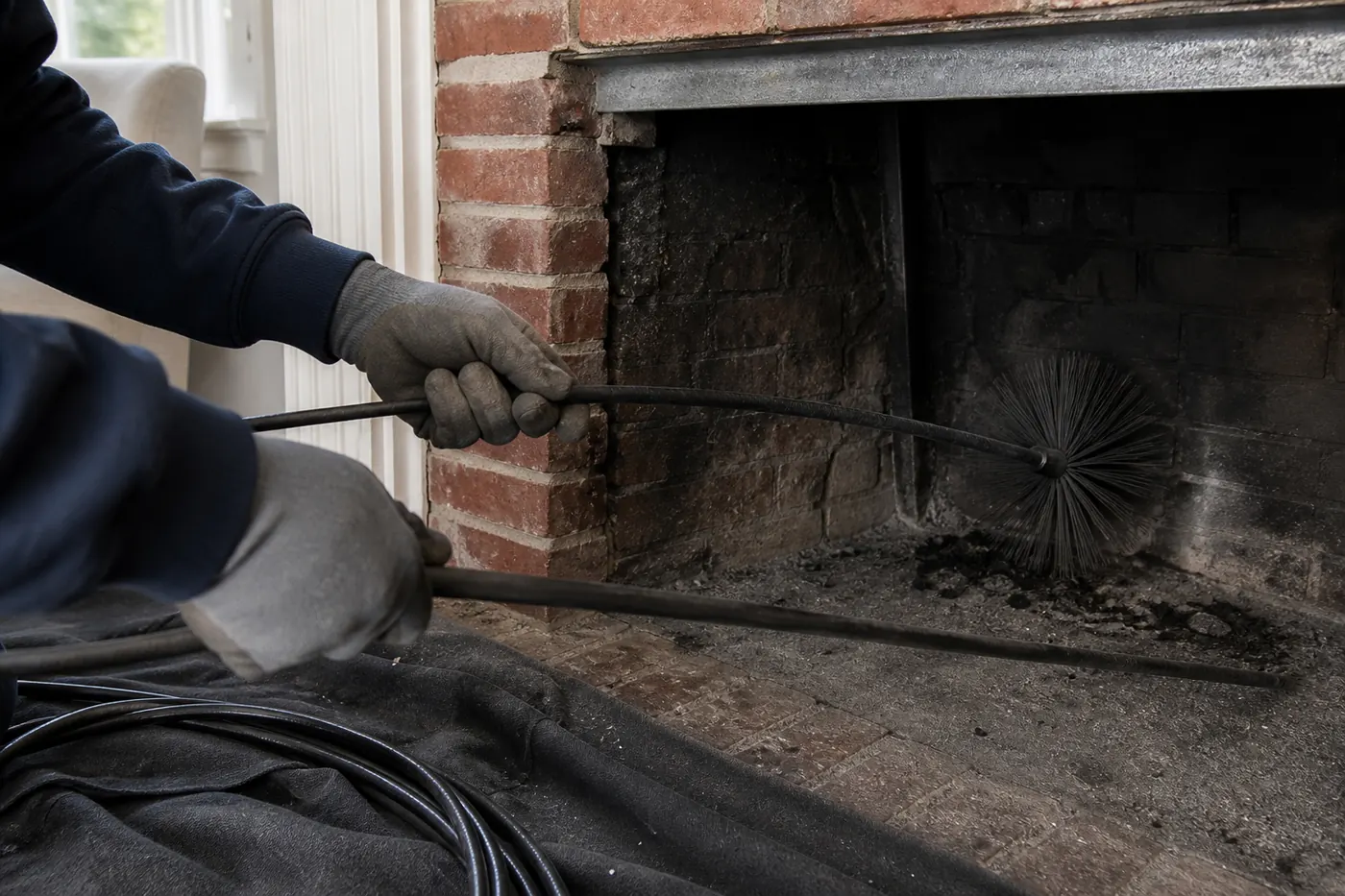
Start with a map of every flue and every appliance that uses it, then inspect them on a set schedule and keep the reports in one place. A $49 inspection covers a look at the chimney and is credited toward approved repair work, and a cleaning with inspection is $299 fixed. The hard part in a multifamily building is not the chimney itself, it is knowing which unit connects to what.
Why shared chimneys are harder than single-family ones
Greater Boston has a lot of triple-deckers, rowhouses and older brick buildings with a chimney stack that serves several floors. A single masonry stack may carry a boiler flue from the basement, a water heater flue, and a fireplace flue on each floor, all side by side. Some openings were closed years ago. Some were never labeled.
That creates problems a single-family owner rarely sees:
- A tenant on the second floor may use a fireplace the owner thinks is sealed
- A flue that looks unused may still be connected to a heater below
- Water or rubble from a failing top can fall into flues serving different units
- Nobody is sure who last had the stack checked, or when
One failing top of the stack can affect everyone below it. That is why the building needs a plan, not a one-off call after the first complaint.
Step one: a flue and appliance map
Before any inspection, build a simple map. A sketch on paper is enough. For each floor and each chimney, write down:
- Which room has a fireplace, stove, boiler or water heater connection
- Which fuel each one uses (wood, gas, oil)
- Which flue each appliance vents into, if known
- Any openings that were bricked, capped or covered with a plate
- Who lives in the unit and how to reach them
The technician will check the map against what they find. A mismatch is useful information. It may mean an appliance is venting into the wrong flue, or that an abandoned opening is still open to a shared stack. Photos taken during the visit help you label each flue so the next person does not have to guess.
A chimney inspection is the right starting point because it documents the actual condition, not the one on the old drawings.
Coordinating tenants and safe access
Most chimney work in a multifamily building touches someone's living space. The technician may need to enter the firebox, check a clean-out door in the basement, or look at a connector pipe in a kitchen. That means notice, a clear arrival window and a way to reach each resident.
A few habits make it go smoothly:
- Tell residents in writing a few days ahead, with the date and a 3-hour arrival window
- Ask them to clear furniture, shelving and rugs from around the fireplace or appliance
- Make sure someone can let the technician into basements, utility closets and the roof hatch if there is one
- Keep a list of units where nobody answered, so they can be rescheduled
We call ahead before arriving. Notice requirements for tenants vary by lease and by local rules, so check with your attorney or the local housing office about what applies to your building. Do not ask tenants or maintenance staff to go on the roof.
Common exterior work versus work inside a unit
The simplest way to avoid disputes is to separate the chimney into two parts. The first part is the shared exterior: the stack above the roof, the crown, the cap, the flashing and the brick. The second part is anything inside one unit: a fireplace firebox, a damper, a stove connector or a gas log set.
| Part | Usually affects | Typical Boston price |
|---|---|---|
| Crown repair | Whole stack | $300 to $900 |
| Repointing | Whole stack | $300 to $2,500 |
| Flashing repair | Roof joint | $200 to $2,500 |
| Firebox repair | One unit | $350 to $900 |
| Damper | One unit | $199 to $1,200 |
Who pays for what depends on your lease, your condominium documents or your agreement among owners. We cannot advise you on that, so ask your attorney or the association's counsel. What we can do is write the findings by location, so the split is easy to see.
How often to inspect and sweep
NFPA 211 recommends at least one inspection a year for chimneys and vents. In a building with several flues, a yearly visit is the natural rhythm. Do it in late summer or early fall, before heating season, so there is time to fix problems.
A sensible split:
- Inspect every flue once a year, even those you think are unused
- Sweep any wood-burning flue that has been used, with the chimney sweep at $299 fixed with inspection
- Look at the shared stack again after a hard winter, after a nor'easter, or if you see bricks or mortar on the roof or ground
- Re-inspect when a unit changes tenants, if the new tenant plans to use a fireplace
Gas appliances still need attention. A gas fireplace cleaning is $299. A boiler or water heater flue can be blocked by debris from above.
Spotting trouble between visits
Your residents see things you do not. Give them a short list of what to report right away:
- Smoke or a burning smell in a room, especially when a heater runs
- A carbon monoxide alarm sounding. Everyone leaves the building and calls 911
- Soot or rust stains around a fireplace, a flue connector or a ceiling
- Water marks on a chimney breast, or damp wallpaper on an upper floor
- Loose brick or mortar on the ground, in a yard or on a porch roof
If a chimney fire starts, everyone leaves and someone calls 911. Do not wait to see if it burns out.
An appliance that vents poorly can put carbon monoxide into several units at once, so do not treat one tenant's complaint as a single-apartment problem.
Records that protect the building
Keep every report in one folder, paper or digital, that does not belong to one person's email. For each visit, save:
- The date, the unit or flue serviced and who was on site
- The photos of what was found, with a note of the location
- The written price and what was approved
- Completion photos after any repair
- The flue and appliance map, updated after each change
Those records help when you sell the building, change managers, file an insurance claim or answer a tenant's question about safety. Ask your insurance agent what documentation they want for the building. Records also stop the same debate every year about what was done, and by whom.
What it costs and how to start
A $49 inspection gives you the first set of photos and a written price, and the $49 is credited if you approve repair work. A cleaning with inspection is $299 fixed. If the stack needs work, the common items are crown repair at $300 to $900 or a crown rebuild at $900 to $2,500, and masonry repair from $300 to $2,500, with major work above that. Our chimney inspection cost guide and chimney repair page lay out what each level includes.
Do the map first, then book the inspection. You can book at /contact/ or call (617) 404-9587.
Questions homeowners ask
Do I need to inspect a flue that nobody uses?
Yes. An unused flue can still connect to a heater, hold water or rubble, or be open to a neighboring unit. An inspection confirms that it is closed or safe, and gives you a label for it.
Can one inspection cover every chimney in the building?
One visit can cover several flues, but each one needs its own look and its own notes. Give the technician the flue map ahead of time so no unit is missed.
Who is responsible when a shared chimney needs repair?
That is set by your lease, your condo documents or your agreement among owners. We cannot advise on it. Ask your attorney, and use our written findings, which name the location of each problem.
What if a tenant refuses access?
Notice rules differ by lease and by local law, so ask your attorney or the local housing office. In the meantime, record the attempt and reschedule within a new arrival window.
Should a boiler flue be inspected with the fireplaces?
Yes, if it shares the stack. Debris or a crumbling liner from the top can block a boiler or water heater flue. Including it in the same visit saves a second trip.