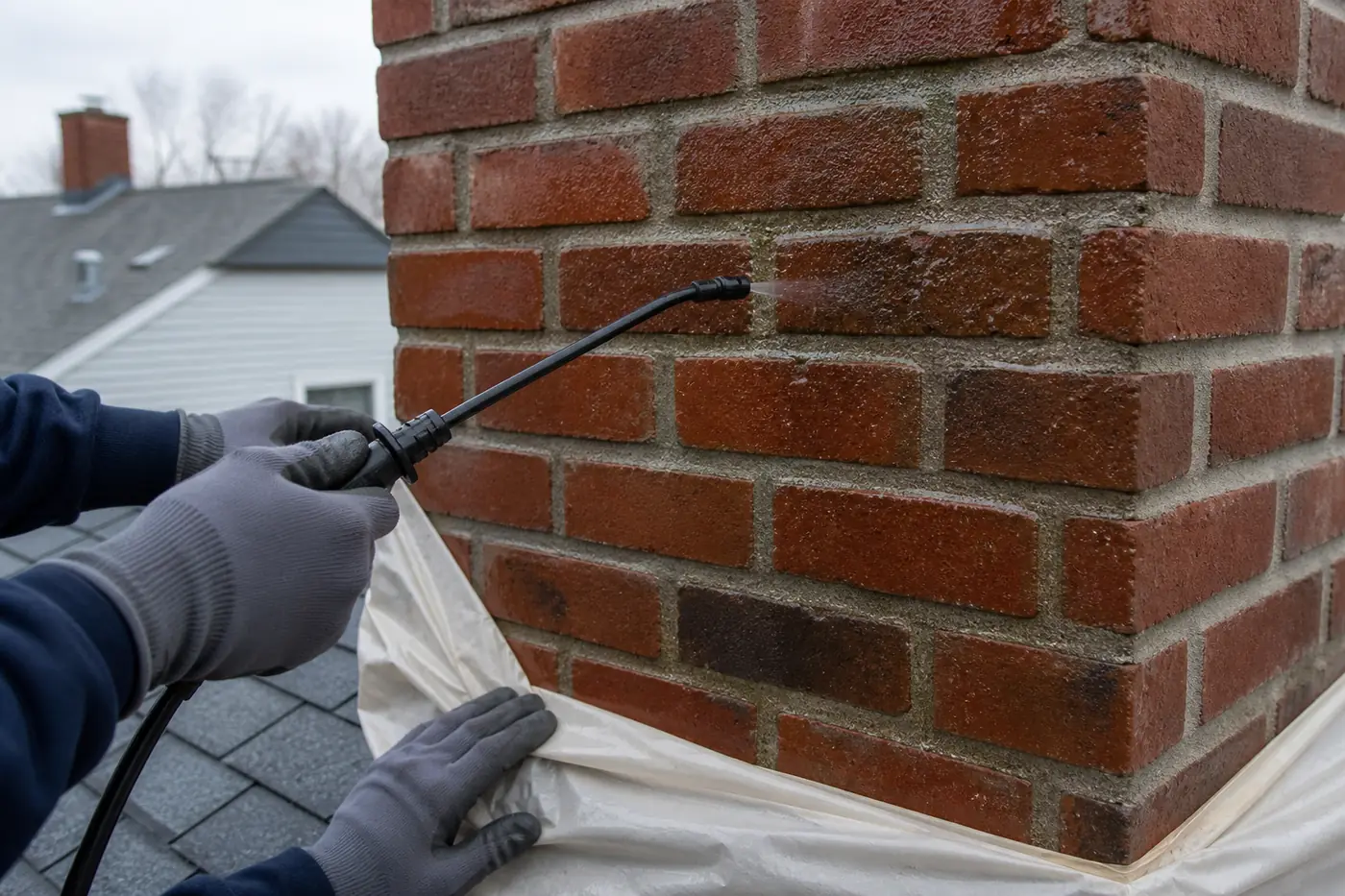
Yes, if your brick soaks up rain and stays dark and damp, and in Boston chimney waterproofing runs $300 to $800 or more depending on how much of the chimney is treated. It works on sound masonry that absorbs water, not on open cracks or failed flashing, so the chimney is checked first. The $49 inspection is credited toward approved work, and the written price comes before anything is applied.
- Chimney waterproofing in Boston starts at $300 to $500 for a standard treatment, with crown seal $500 to $800 and a full system from $800.
- It is a breathable water-repellent treatment for sound brick, not a fix for cracks, bad flashing or a broken crown.
- Cracks and failed joints are repaired first, because a coating cannot bridge an open gap.
- The $49 inspection is credited toward approved work, and you get the written price before anything is applied.
What chimney waterproofing does and what it cannot do
Brick looks solid, but it is full of tiny pores. In rain, those pores draw water in like a sponge. A water-repellent treatment changes how the surface of the brick and mortar behaves, so that water beads and runs off instead of soaking in. Done properly, it uses a breathable product, which means water vapor from inside the wall can still escape and the masonry can dry.
That second part matters. A chimney that cannot dry traps moisture, and trapped moisture freezes. Greater Boston has cold winters with plenty of freeze-thaw cycles, so brick that stays wet is brick that spalls, which means the face flakes or pops off. Waterproofing is meant to cut down how much water goes in, so there is less to freeze.
There are firm limits. A water repellent cannot close an open mortar joint, rebuild brick that has already broken apart, or stop water coming through a cracked crown or past failed flashing. If liquid water has a direct path in, the treatment will not stop it. That is why this page and the chimney leak repair page are different jobs. Leak repair finds and fixes the entry point. Waterproofing protects sound masonry once the entry points are closed.
Think of it as a maintenance job rather than a repair. A chimney sits above the roof with every face exposed, so it takes more weather than any wall of the house. In a region with coastal salt air, nor'easters and older brick homes, triple-deckers and rowhouses, a well-timed treatment can slow the wear that rain and frost put on the masonry. It does not make a chimney immune, and it does not promise a set lifespan, but it reduces what the brick has to absorb.
Signs your chimney could use a water-repellent treatment
These are the signs that point to treatment rather than repair:
- Sound-looking brick darkens quickly in rain and takes a long time to lighten again.
- Minor dampness remains on the chimney after the specific openings, such as a cracked crown or loose joints, have been repaired.
- Surface weathering is speeding up, with sanded-down edges, rough brick faces and loose grit at the base of the chimney.
- The chimney has never been treated with a compatible product.
- An older breathable treatment has worn out, and water no longer beads on the brick.
- Wind-driven rain hits one broad wall face of the chimney, and that face always looks wetter than the others.
You can do a simple check from the ground after a dry spell. Take a garden hose or wait for a rain shower and watch how the brick behaves. If the surface beads and sheds water, the masonry is shedding it well. If it darkens within moments, it is absorbing. You are not diagnosing anything with this check. It is just a way to see whether a conversation about treatment is worth having.
Also look at the base of the chimney and the ground or roof below it. Fine reddish grit, flaked brick faces or a crumbly texture to the mortar are signs that the surface is wearing down. Those are the signs that treatment is meant to slow, and they are also the signs that tell the technician whether repair has to come first.
What the technician checks before anything is applied
Treatment goes on last, so the inspection comes first. The aim is to confirm the masonry is clean, dry enough, and sound enough to take a treatment, and that no open defect is feeding water behind it.
Look for open defects
The technician checks the crown, the cap, the mortar joints, the flashing and the brick faces. Any of these can be a direct water path, and a treatment on top would hide the problem for a while and then fail.
Judge the masonry itself
Brick varies a lot. Some is dense and absorbs little. Some, especially in older homes, is soft and thirsty. A chimney with heavy surface loss, deep cracks or loose units may need repair, repointing or rebuilding before it can hold a treatment. The technician will tell you which side your chimney falls on.
Find out what is already on it
If a coating or paint is on the brick, or an older treatment is partly worn off, that affects how a new product will behave. Tell the technician what you know about past work. Ask for the plan to be written down, not just spoken.
Choose a test area where appearance matters
Water repellents can change how brick looks, usually by darkening it slightly. Where the look of the chimney is important, a small test patch is the safe way to see the result before the full wall is treated.
The inspection is the right place to ask questions. How porous is the brick? Which faces take the most weather? Is the crown ready for a seal? Is there anything on the surface that would stop a treatment from soaking in? You are paying for answers as much as for a list of findings, and the written report should reflect them. Photos of the chimney show you what the technician saw, so you can follow the reasoning.
Repairs that come before waterproofing
The order of the work decides whether treatment succeeds. If a chimney has open defects, they are repaired first, in this general order of priority.
- Crown and cap: a cracked crown lets water in from above, behind any treatment on the walls. See the chimney crown repair page for how those repairs are done.
- Mortar joints: open or crumbling joints are water highways. Failed joints are repaired through repointing, covered on the chimney repointing page.
- Damaged brick: cracked or crumbling units are replaced or repaired so the surface is sound.
- Flashing: failed flashing at the roof line is dealt with before the walls are treated.
This sequence is why a quote for waterproofing alone should come after an inspection. A company that offers a coating without looking at the crown, joints and flashing is selling a product, not solving a problem. Treating a chimney with an open crown is like waxing a boat with a hole in the hull.
Homeowners sometimes ask whether they can skip a repair and treat anyway to save money. It rarely works. Water that gets past an open joint or crown crack will sit inside the masonry, and a repellent on the outside will not push it out. You end up paying twice: once for the coating and again for the repair that should have come first. Doing the work in order costs less in the long run than doing it out of order.
How the treatment is applied on the day
On the work day, the process follows a set order so the product soaks in and cures well.
Clean the surface
Dirt, loose material, algae and old residue block the treatment from entering the brick. The surface is cleaned in a way that suits the masonry, because harsh methods can damage soft brick and mortar.
Mask and protect
Roofing, glass, metal, plants and nearby finishes are covered. Overspray on the wrong surface is a common cause of marks, so the protection step takes real time.
Apply to saturation
The product is applied generously enough that the brick soaks it up, working from the top downward. Runoff is controlled so the material goes into the masonry instead of down the wall. Edges, corners and hard-to-reach elevations get particular attention, because those are the spots that get skipped when a job is rushed.
Clean up and protect while it cures
After application, drips and residue are cleaned up. The treatment needs a dry stretch to cure. For that reason, the technician checks the forecast, and the job may be moved if rain is coming. Rain too soon after application can wash the product out before it sets.
Good application is mostly patience. Rushing the cleaning or skipping the masking is where jobs go wrong, and so is applying a thin coat to save material. The point of saturation is that the brick takes in enough product to line its pores. You can ask the technician to explain how each step will be done on your chimney, and what weather would cause a delay.
Breathable water repellent versus a film-forming coating
Not every product sold as chimney sealer is a good match. The main difference is breathability.
A breathable water repellent soaks into the pores and lines them. It leaves the surface looking natural. Moisture trapped in the wall can still leave as vapor. That is the type this service is built around.
A film-forming coating sits on the surface like a layer of paint. If water gets behind it, which can happen through a crack, a bad joint or the top of the chimney, it can get stuck. Trapped water freezes and pushes the coating and the face of the brick off together. That kind of damage is hard to reverse.
If another company has recommended a product, ask whether it is breathable and ask what it does about water already inside the masonry. A straight answer to those two questions tells you a lot. The technician will explain what is proposed for your chimney in the written scope.
One practical test for any claim you read online is whether it explains where the water goes. A product that only talks about keeping water out, and never about letting vapor leave, is describing a coating that can trap moisture. Fair claims describe both sides of the wall.
Standard, crown seal and full system treatment
Waterproofing comes in levels, and the right one depends on what the inspection shows. The tiers below describe what each includes, and the price table further down shows the range for each.
Standard treatment
This is the application of a breathable water repellent to the exposed brick and mortar above the roof line. It fits a chimney whose crown and joints are in good shape and that mainly needs protection from absorption.
Treatment with a crown seal
The crown is the part that sheds the most water, and hairline cracks in it are common. Adding a crown seal protects the top of the chimney as well as the walls. It suits a chimney where the crown is sound but starting to weather, or where small surface cracks have been repaired.
Full system
A full system covers more of the chimney and the details around it, and it suits larger chimneys, chimneys with several faces exposed to wind-driven rain, or those with a history of water trouble. The scope is set in writing after the inspection, so you know exactly which parts are included.
The chimney waterproofing cost page goes through what moves a job up or down the range and how to compare written quotes.
Whichever level fits, the written price lists what is included, which faces and areas of the chimney will be treated, and anything left out. That makes it easy to compare against another quote, because you can see exactly what you would be buying.
When waterproofing is not the answer
A good technician will talk you out of waterproofing when it will not help. These are the cases where it is the wrong tool:
- Water is entering through a cracked crown, a missing cap or failed flashing. Those get repaired, not coated.
- Brick is crumbling, deeply cracked or loose. The wall needs masonry work.
- The wall has been painted or heavily coated in the past with a product that is trapping moisture.
- Interior dampness comes from condensation or a venting problem, not from rain.
In these cases, the inspection will point to a different job first. Waterproofing may still be useful afterward, once the chimney is sound. Think of it as a finishing step that protects good work, rather than a rescue for a failing chimney.
Sometimes the honest recommendation is to wait. If the chimney is sound, the crown is healthy and the brick sheds water well, treatment is optional. It becomes worth doing when the masonry starts absorbing or when the earlier treatment has worn away. The inspection tells you which situation you are in, and that is what the $49 pays for.
Timing, weather and how to prepare
Treatment needs clean, dry masonry and a dry window afterward, so it is a job for settled weather. In the Boston area, that usually means avoiding the wettest and coldest stretches, and the technician will tell you if a date has to move for the forecast.
To prepare, move cars, patio furniture and anything delicate away from the base of the chimney, since spray and runoff can land nearby. Close the windows on that side of the house while the work is under way. If you have plants close to the chimney, tell the technician, because they can be covered.
Note any areas where water has been getting in so far, and mention any past repairs or coatings. Do not try to work on the roof yourself. You get a 3-hour arrival window, and the technician calls before arriving.
If you plan to sell your home, a treated and well-kept chimney is one less item for a buyer's inspector to raise. Waterproofing is not required for a sale, but a chimney with a clear inspection report and a dry, sound surface helps the conversation go smoothly.
Waterproofing price in Boston and how to book
| Level | Boston price |
|---|---|
| Standard waterproofing | $300 to $500 |
| With crown seal | $500 to $800 |
| Full system | From $800 |
| General inspection | $49, credited toward approved work |
The level you need depends on the size and exposure of the chimney, how many faces take weather, and whether the crown needs a seal. Any repair work found during the inspection is quoted separately, in writing, before it starts. The full breakdown is on the waterproofing cost page.
Remember that a treatment is only as good as the masonry under it. If you are not sure the chimney is ready, the inspection tells you before you spend on a coating. To book, use the contact page or call (617) 404-9587.
Questions homeowners ask
How can I tell if my brick is absorbing too much water?
Watch it in a rainstorm or after a hose test from the ground. If water beads and runs off, the surface is shedding well. If the brick darkens quickly and stays dark for a long time, it is absorbing and may benefit from a treatment.
Will waterproofing change how my chimney looks?
A breathable water repellent can darken brick slightly, and the effect varies with the type of brick. Where appearance matters, a small test area is treated first so you can see the result before the full job.
Why can a coating make a wet chimney worse?
A film-forming coating can trap water behind it. When the trapped water freezes, it can push the coating and the face of the brick off together. A breathable repellent lets vapor out, which is why it is the type used here.
Do I need to repair the crown or joints first?
Yes, if they are open or damaged. A treatment cannot bridge a crack or an eroded joint, and water will keep entering behind it. Those repairs are done first, then the walls are treated.
What if it rains right after the treatment?
The product needs a dry period to cure, so the technician checks the forecast and may move the job. Rain too soon can wash the product out before it has set.
Is waterproofing a substitute for chimney leak repair?
No. Leak repair finds the entry point and fixes the physical defect. Waterproofing reduces absorption through sound brick. If your chimney is leaking, the leak is repaired first.
Related guidance
Start with the Boston cost guide, then read the guides below.
- Chimney Waterproofing Cost in Boston: 2026 Prices
- Spalling Chimney Bricks in Boston: Causes and Repair Cost
- White Stains on Chimney Brick: Efflorescence in Boston
- Common Chimney Repairs in Boston (2026)