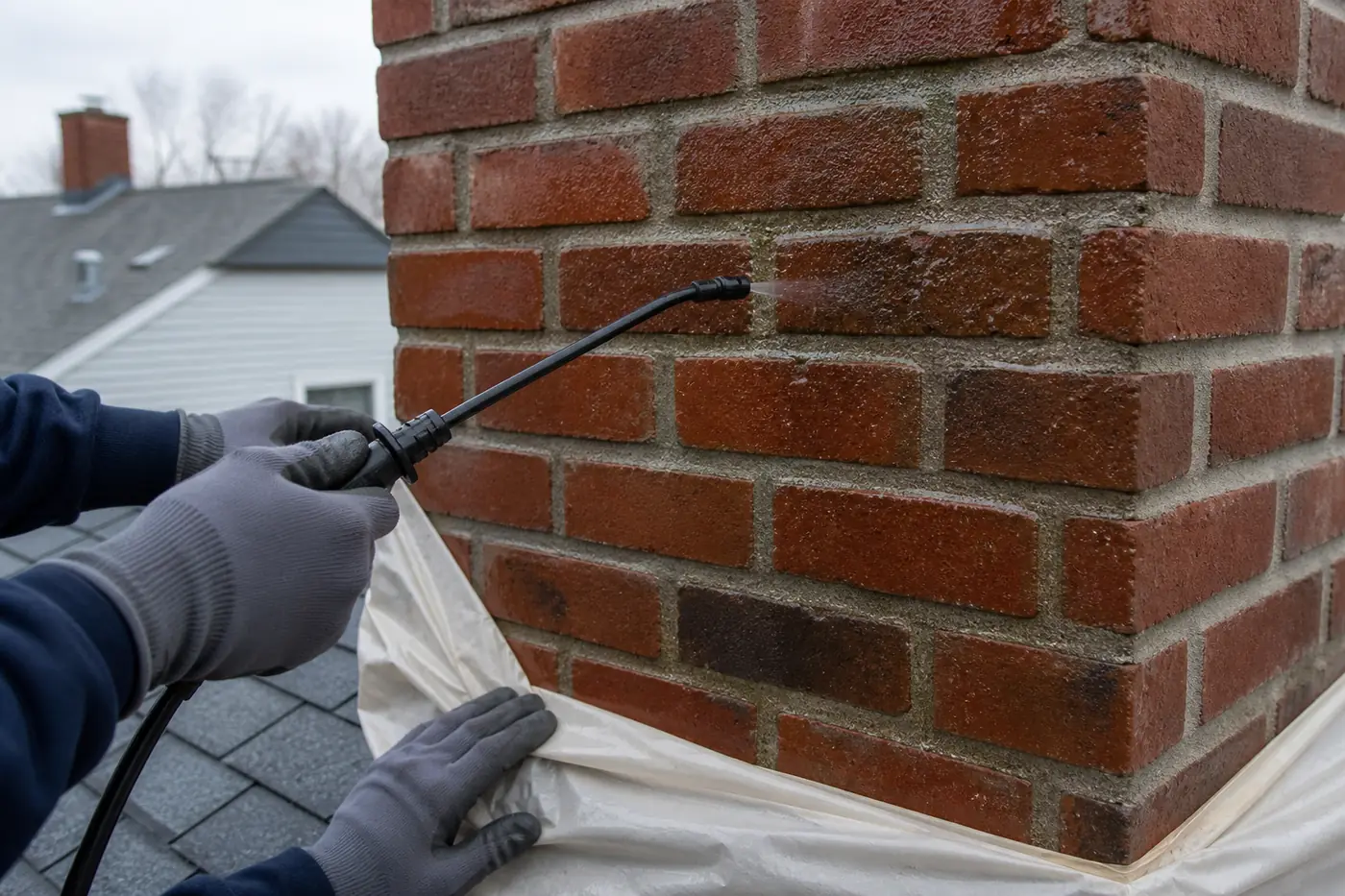
Spalling is when the outer face of a brick peels, flakes or pops off. In Greater Boston it usually happens because water soaks into the brick and freezes. Fixing it means replacing the damaged bricks and stopping the water that caused it. Basic masonry repair costs $300 to $700, standard repair $700 to $2,500, and major work from $2,500.
What spalling looks like
Spalled brick is easy to recognize once you know what to look for. The surface of the brick breaks away, leaving a rough, pitted or shell-like patch. Pieces and grit may land on the roof, in the gutters or on the ground near the chimney.
- Flat chips or thin layers peeling off the brick face.
- A rough, sandy-looking area where the smooth surface used to be.
- Bricks that sound hollow when tapped.
- Orange brick dust or crumbs on the hearth or in the firebox.
- Bricks that look much worse than the ones beside them.
Take photos from the ground with a zoom lens, and note which side of the chimney is affected. Do not climb up to look.
How freeze and thaw break brick
Brick is porous. It soaks up rain, snow melt and moisture from the air. When temperatures drop below freezing, the water inside turns to ice and expands. The ice pushes outward from within the brick. When it thaws, the water drains or moves deeper, and the next freeze repeats the stress.
Boston winters swing above and below freezing many times, so the cycle repeats often. A brick that holds up for decades can start to shed its face after enough cycles, especially if it stays wet. A chimney sticks up above the roof and has water arriving from several directions: rain from the top, snow melt, and wind-driven moisture on its sides.
Nor'easters add to the load. Wind-driven rain and wet snow soak the windward face of the stack for days at a time, and a hard freeze right after a storm gives the water no chance to dry out. That is why damage often shows up on one or two sides of a chimney first, and why a technician will ask which direction the worst of your weather arrives from.
Our post on Boston's freeze-thaw cycle goes deeper on why this weather is hard on masonry.
Why one brick fails while its neighbor does not
Spalling is rarely random. Several conditions can combine:
- Soft or underfired brick. Some bricks are simply more porous than others, especially in older chimneys.
- Mortar that is too hard. Hard cement mortar around soft brick can force the brick to take the stress and flake.
- Paint or sealer that traps water. Film coatings that do not breathe keep moisture inside the brick, where it freezes.
- Extra water at one spot. A cracked crown, failed flashing or open joint above the damage keeps that area wet.
- Salt. Coastal air and salt exposure can add to the damage in some locations.
Knowing which of these applies tells the mason how to repair it. Replacing a spalled brick without fixing the cause just gives the new brick the same fate.
Measuring the damage
The first question is how much is affected. A technician should count and map the damaged units, noting which courses and which sides of the stack are involved.
A few bricks
If only a handful of bricks near the top are damaged and the rest are sound, a targeted repair is likely. The bad units are cut out and replaced and the joints around them are redone.
Many bricks, many courses
If large areas are flaking, the question becomes whether patching is worth it. At some point rebuilding a section is more sensible than replacing brick by brick. Our guide to chimney repair vs rebuild explains how that call is made.
Either way, ask for photos and a written scope that says how many bricks or courses will be replaced.
Fix the water source or the repair will not last
Spalling is a symptom of too much water. Before or along with brick replacement, the technician should trace where the water is coming from:
- Crown. Cracks or missing pieces let rain soak in from above. Crown repair is $300 to $900.
- Cap or chase cover. A missing or rusted cover lets water into the flue and walls.
- Flashing. Gaps at the roof line send water behind the chimney. Flashing repair starts at $200 to $400.
- Mortar joints. Worn joints soak water in. Partial repointing is $300 to $700, and full repointing is $700 to $2,500.
- Coatings. Paint or film sealer may need to be addressed.
See chimney waterproofing for a breathable water repellent that is applied after repairs. Standard waterproofing is $300 to $500.
Repair options and typical prices
| Work | Typical Boston price |
|---|---|
| Basic masonry repair | $300 to $700 |
| Standard masonry repair | $700 to $2,500 |
| Major masonry repair | From $2,500 |
| Partial rebuild | $2,000 to $4,500 |
| Waterproofing, standard | $300 to $500 |
The number of bricks, the height of the chimney and the access to the damage decide where a job falls. Replacement bricks need to be matched to the originals in size and color as closely as possible. More detail is on the chimney repair cost page, and our masonry repair page shows how the work is done.
What you can do while you wait for a repair
You cannot repair masonry yourself, but you can keep a good record and avoid making things worse.
- Take dated photos of each side of the chimney from the ground, and repeat them every few weeks through winter.
- Pick up fallen pieces from the yard or roof edge only if you can reach them from the ground, and keep them to show the technician.
- Check ceilings and walls near the chimney after heavy rain or snow melt for new stains.
- Do not pressure wash the chimney, scrape it, or coat it with paint or sealer.
- Keep the cap and crown clear of debris if you can see them from the ground, and tell the technician about any gaps.
Fall is a good time to book. Repairs done before the first hard freeze keep the next round of ice from working on bricks that are already weak.
When spalling becomes urgent
A few chipped bricks can wait a short while for a scheduled visit. Do not wait if you notice any of these:
- Bricks falling to the ground or onto the roof.
- A lean, a bulge or cracks that run through several courses.
- Pieces loose enough to move by hand, as seen from a safe distance.
- Water stains inside the house that grow after storms.
Keep people and pets away from the base of the chimney. A fallen brick can be dangerous.
Do not paint over spalled brick or fill it with ordinary patching cement. Both can trap water and speed up the damage. Instead, have a technician document the condition. The $49 inspection is credited toward approved repair work, and the price for any fix is given in writing first. Book at /contact/ or call (617) 404-9587, and see chimney repair for what a visit involves.
Questions homeowners ask
Is a spalling brick the same as crumbling mortar?
No. Spalling is damage to the face of the brick. Crumbling mortar is failure of the joints between bricks. They often occur together because water causes both, but they are repaired differently.
Can I turn a spalled brick around instead of replacing it?
Sometimes the brick is reversed or replaced depending on its condition and location. A technician decides based on how deep the damage is. A badly flaked brick usually needs to be replaced.
Will a waterproof sealer stop spalling?
Only a breathable water repellent applied to sound masonry helps. A film coating or paint can trap moisture and cause more spalling. Fix cracks and leaks first, then consider a repellent.
Does spalling mean my chimney is unsafe to use?
Not necessarily, but it can mean water is getting into the masonry and possibly the flue. Have it inspected before you keep using the fireplace through winter.
How can I tell if the spalling is spreading?
Photograph the same sides each season from the ground and compare. Note new pieces on the roof or ground. A technician can document the condition with close-up photos.