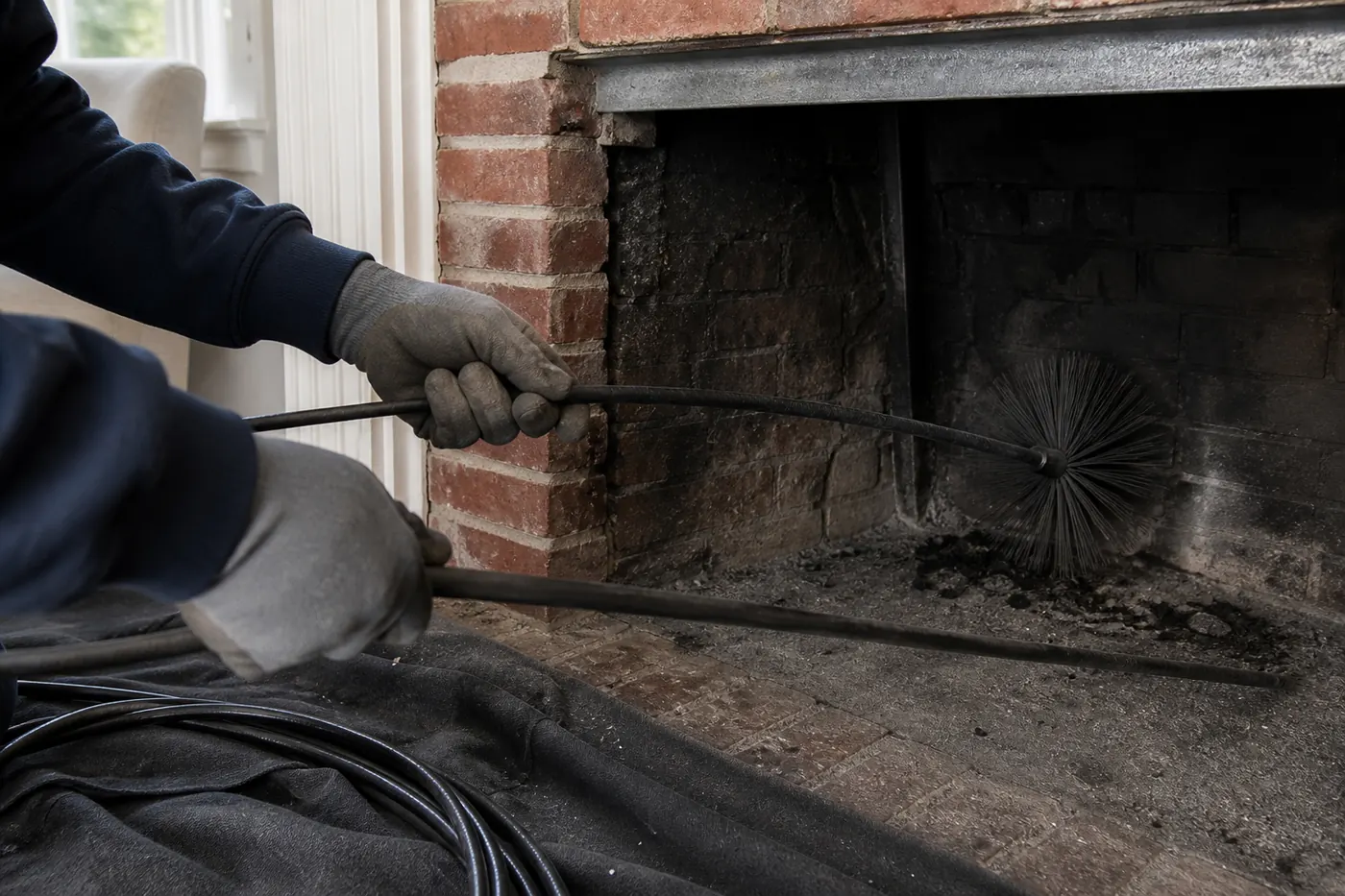
Burn dry, seasoned hardwood that has been split, stacked off the ground and covered on top only. Moisture matters far more than the type of tree, because wet wood smolders, makes smoke and coats the flue with creosote. In Greater Boston, where a fire may run on cold nights for months, that coating is exactly what a sweep spends the visit scraping out.
Why dryness beats species
Every log holds water. A freshly cut tree is full of it, and a fire has to boil that water off before the wood itself can burn hot. The energy spent boiling is energy that never reaches your room. The fire runs cooler, the smoke gets heavier, and the cooler gases condense on the inside of the flue as they climb.
That condensed film is creosote. It starts as a thin, flaky layer and can harden into a glossy, tar-like glaze that is flammable and hard to remove. Our guide to the stages of creosote shows what each stage looks like.
So the first question about any firewood is not oak or maple. It is simply: how wet is it?
How to tell if a log is ready
You do not have to guess. Use several checks together:
- Moisture meter. A cheap pin-style meter pushed into a freshly split face gives a number. Most guidance points to about 20 percent or lower for clean burning.
- Weight. Dry wood feels surprisingly light for its size. Green wood feels heavy and cold.
- Ends. Seasoned logs show cracks radiating from the center of the cut end, and the ends look grey rather than creamy.
- Sound. Knock two logs together. Dry wood gives a sharp crack. Wet wood gives a dull thud.
- Bark. Loose or peeling bark is a good sign.
- Fire behavior. If a log hisses, sizzles at the ends or leaves a sooty glass door, it was not ready.
A split face tells you more than the outside of a log, because the outside dries first. Always test the middle.
Seasoning and storing wood through a New England year
Seasoning simply means letting the wood dry. Dense hardwoods take longer than light ones, and wood left in a wet pile takes longest of all. Plan to buy or cut next winter's supply well ahead of time rather than the week you need it.
What helps wood dry
- Split it. Whole rounds dry very slowly because the bark seals them.
- Stack it on pallets, rails or blocks so air moves underneath.
- Leave gaps between rows and face the stack toward the prevailing wind and any sun.
- Cover only the top with a board or tarp. Wrapping the sides traps moisture and lets the stack sweat.
Where to keep it
Keep the pile a short distance from the house wall. Stacks pressed against siding give mice, insects and damp a bridge into the building. Bring a few days of wood indoors before burning so the surface warms and loses its chill, but do not stack large amounts next to the fireplace.
Wood bought as "seasoned" is sometimes not. Check it with the meter before you accept the delivery.
Damp New England weather can undo your progress. Rain, fog and humid summer stretches slow drying, and a stack that looked ready in August may read high again by November. Re-test a few logs from the middle of the pile before the first hard freeze, and move the driest wood to the front so you burn it first.
Hardwood, softwood and what each is good for
Species still plays a supporting role. Dense hardwoods such as oak, maple, ash, birch and beech generally burn longer and leave steady coals, which suits overnight and cold-snap burning. Lighter softwoods such as pine and spruce light easily and burn fast, which makes them useful as kindling and for shoulder-season fires.
Softwood is not forbidden. Resin in it does not cause a chimney fire by itself. Problems come when softwood or any wood is burned wet or burned slowly with the air supply choked down. A dry pine log in a hot fire is cleaner than a damp oak log in a smoldering one.
Match the wood to the job. Use small, dry softwood to get the fire going and dense, dry hardwood to keep it going.
What should never go in the firebox
Some materials do damage no matter how dry they are. Keep these out:
- Painted, stained or varnished wood, including old trim and furniture.
- Pressure-treated lumber, plywood, particle board and anything glued together.
- Pallets of unknown origin, which may have been chemically treated.
- Cardboard, wrapping paper, magazines and household trash. They flash up, throw sparks and leave ash that can fly out the top.
- Salt-soaked driftwood from the shore, which can give off fumes that attack metal parts.
- Christmas trees, which burn fast, spit sparks and are loaded with resin.
Treated and glued materials also release chemicals into your room and leave residues that are hard to scrub out of a flue.
What poor firewood leaves in your chimney
Wet wood does three things to the system. It deposits creosote on the liner, it blackens the glass and firebox walls, and it makes smoke that wants to leak back into the room whenever the draft is weak. A flue with heavy buildup can also trap moisture against its walls, which speeds up deterioration.
Light, flaky buildup comes off in a regular cleaning. Hard, shiny glaze needs a different treatment. Creosote removal runs $299 to $450 for stage 1, $450 to $700 for stage 2, and from $700 for stage 3. Our page on creosote removal explains how each stage is handled.
If you ever see flames roaring out of the top, hear a low rumble or smell something like hot tar, that is a chimney fire. Get everyone out of the house and call 911.
A burn routine that keeps the flue cleaner
- Start with dry kindling and a small, dry log. Let the fire come up to full heat quickly.
- Keep the air supply open enough that flames stay lively. A fire starved of air smokes and builds creosote.
- Add a few logs at a time instead of packing the box. If you like, try the approach in our post on the top-down fire method.
- Let ash accumulate to a thin bed on the floor, but remove the excess into a metal container with a lid and keep it outside, away from the house.
- Look at the flue and the top of the glass every month of the season. Black soot is normal. Thick, crusty or glossy buildup is a reason to book a cleaning early.
Even with perfect wood, the flue should be checked once a year. A standard chimney sweep with inspection is $299 fixed, and our chimney sweep cost page lists what is included. If the inspection finds cracked flue tile, loose masonry or a damaged cap, the technician photographs it and any chimney repair is quoted in writing before work starts.
Book the $299 sweep and inspection at /contact/ or call (617) 404-9587.
Questions homeowners ask
Is oak really better than pine for a wood fire?
Oak and other dense hardwoods burn longer and hold coals, so they suit long evenings. Pine lights fast and burns quickly, which is useful for kindling. What matters most for your chimney is that either one is dry.
Can I burn wood I cut this spring?
Usually not this winter. Fresh wood needs many months of drying, and dense hardwoods need longer. Split it, stack it with air gaps, and test with a moisture meter before you rely on it.
Is it okay to burn pallets or scrap lumber?
It is best not to. You often cannot tell whether pallets or offcuts were treated, painted or glued. Those chemicals can release harmful fumes and leave residue in the flue.
Should I cover my woodpile completely with a tarp?
No. Cover the top so rain and snow run off, and leave the sides open so air can carry moisture away. A fully wrapped stack stays damp.
If I burn only dry wood, do I still need a yearly cleaning?
Yes. Dry wood reduces buildup but does not remove it, and the annual visit also checks the cap, crown, liner and masonry for damage you cannot see from the room.