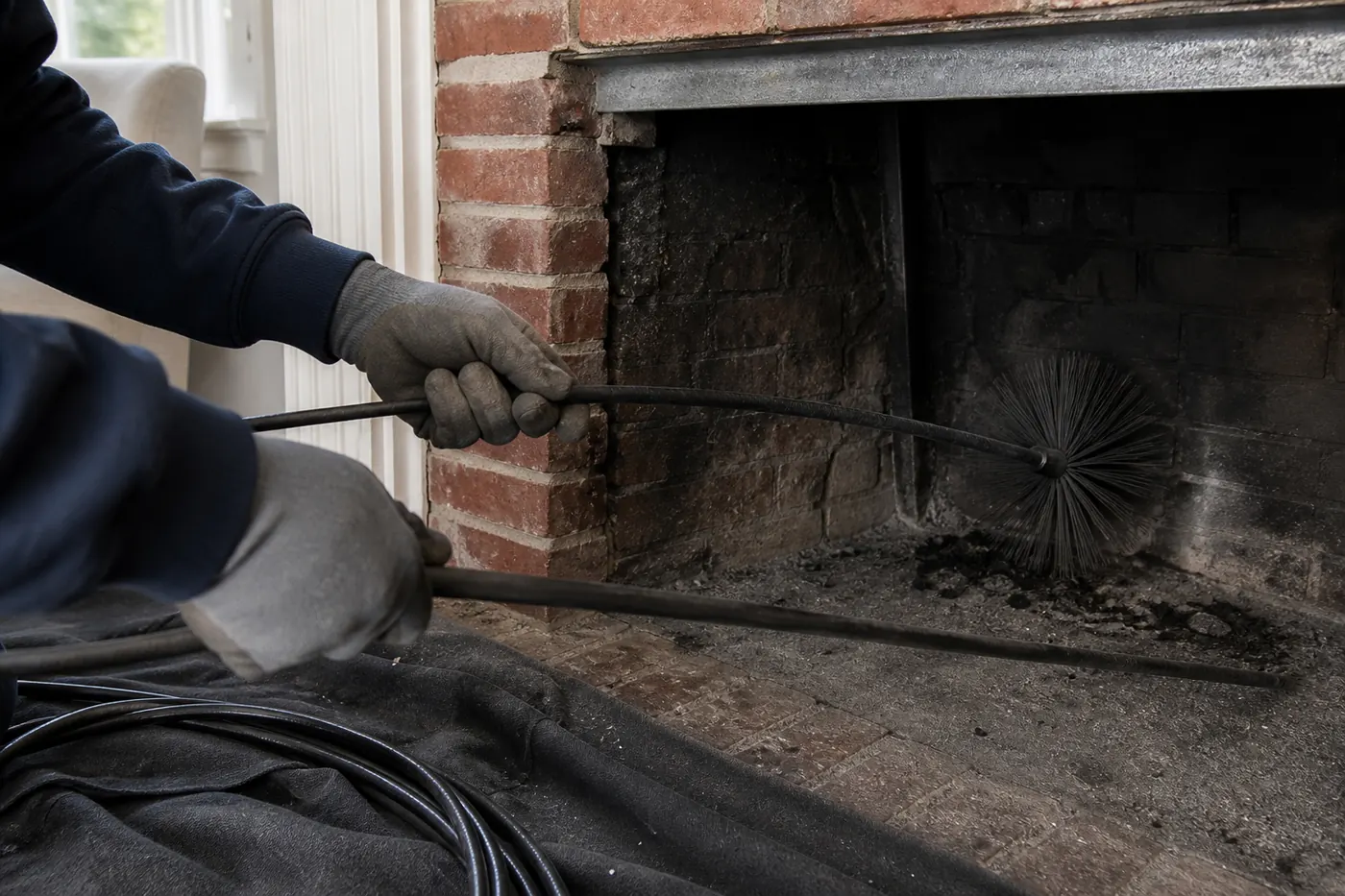
Creosote removal in Boston runs $299 to $450 for stage 1, $450 to $700 for stage 2 and from $700 for hard, glazed stage 3 buildup. You need it when a normal sweep cannot clear the deposit, or when the coating inside your flue is shiny, tarry or thick enough to narrow the passage. This page explains the three stages, how each is removed and what the work involves. Light, brushable soot is an ordinary chimney sweep instead.
- Creosote removal costs $299 to $450 at stage 1, $450 to $700 at stage 2 and from $700 at stage 3.
- Creosote is flammable, and stage 3 glazing is the form that is hardest to brush away.
- Heavy buildup often points to how the fire is burned, so removal is paired with advice on fuel and airflow.
- The technician photographs the deposit and gives you the scope and price in writing before the work starts.
What creosote is and how it forms in a flue
Creosote is the residue that wood smoke leaves behind when it cools inside the chimney. Smoke carries unburned gases and tiny droplets. When they meet a flue wall colder than the fire, they condense and stick. Each fire adds another thin film.
The coating changes as it builds. A single season of good fires leaves a dry, dusty layer. Repeated smoldering fires add a darker, flakier layer. If the smoke stays cool, the layers bake and run together into a hard, shiny coat that looks like tar or wet paint.
That last form is the dangerous one. Creosote is flammable, and a thick, glazed deposit can ignite from a spark or from the heat of an ordinary fire. A chimney fire can burn hot enough to crack a liner and send heat into nearby wood framing. It can also happen quietly, with no flames visible from inside the house.
Creosote also narrows the flue. A smaller opening draws less well, so the fire burns cooler, which makes more creosote. That loop is why a neglected chimney gets worse faster each season.
Where the deposit lands varies too. Creosote gathers most thickly where the flue is coolest and where the smoke slows down: near the top of the chimney, on the smoke shelf, at bends and at the connection to a stove. A chimney on an outside wall, as many older brick homes in Greater Boston have, runs colder than one inside the house, so it tends to collect more.
The three stages of creosote and what each looks like
Technicians sort creosote into three stages by texture. The stage decides the method and the price.
Stage 1: soot and light dust
Dry, black and powdery, easy to brush off. This is the normal deposit of a chimney used with dry wood and a good draft. It comes off with standard brushing and vacuuming.
Stage 2: crunchy flakes and scale
Hard, black, shiny flakes that break off in pieces, sometimes in chunks that fall into the firebox. The layer is thicker, and ordinary brushing may need extra passes or a heavier-duty tool.
Stage 3: glazed creosote
A hardened, tar-like glaze that coats the flue like shiny enamel. It can look wet, bubble when heated and run in drips. It does not come off with a standard brush, and the work often needs to be repeated in layers.
You cannot always tell the stage from the room. The firebox may look moderate while the flue higher up is thickly glazed. That is why the technician looks up the flue and photographs the actual deposit before naming a stage or a price.
The stages are a guide, not a legal grade. Real chimneys often have two stages at once, such as dusty soot low down and a glaze near the top. The price follows the hardest and most extensive condition the technician has to deal with.
Signs you may have creosote beyond a routine sweep
Any of these suggests the buildup is past the normal range:
- You see shiny, tar-like deposits on the damper plate or the walls just above it.
- Large flakes or chunks fall into the fireplace, not just fine dust.
- A strong smoky smell rises from the chimney in warm, humid weather.
- The deposit has returned quickly since the last cleaning.
- The flue looks narrower than it should, or the fire draws poorly.
- A sweep reported deposits that could not be cleared with routine brushing.
What a quick return tells you
If a freshly cleaned flue is coated again within a season, the cause is almost always how the fire is run. Damp wood, a damped-down stove or too little air makes cool, smoky fires. Removing the creosote without changing that only resets the clock.
What a smell in summer tells you
Creosote takes on moisture and releases odor when the air is humid. A smell in July is a clue that something is stored in the flue even when you are not burning.
One more clue is the color and sheen when you shine a light up the flue. Dull black dust is the mild end. A wet-looking, rainbow or varnish-like surface is the sign that the layers have hardened and need more than a sweep.
What the technician checks before removing anything
Removing creosote with the wrong tool can damage the flue, so the plan starts with a look, not a brush.
- Where it is and how much. The technician notes whether the deposit sits only at the bottom or runs the full length, and whether it is dusty, flaky or glazed.
- What the liner is made of. Clay tile, metal and masonry flues all tolerate different tools. A rotary head that suits one can scratch or break another.
- Signs of a past chimney fire. Puffy, honeycombed or cracked creosote, warped metal and cracked tiles can show that the flue has already burned.
- How the chimney is used. The type of wood, how often you burn and how the stove or fireplace is run all explain why the deposit formed.
- Whether one visit will be enough. Thick stage 3 layers are sometimes taken down in stages. The technician tells you if a second pass is likely.
All of this goes into the written scope. You see the photos and the price before the heavier work begins, and you decide whether to go ahead.
How stage 1 and stage 2 creosote are removed
Most jobs in these stages are done mechanically, which means scraping and brushing the deposit off the flue wall and collecting it.
Brushing with the right head
Stiffer brushes fit onto rods and are worked through the flue. For a rough or flaky layer the technician may use a rotary head, a spinning tool that beats the deposit loose. The head is picked to match the liner, so a metal liner is not scraped and a clay one is not stressed.
Controlled collection
As deposits fall they drop into the smoke chamber, onto the smoke shelf and into the firebox. A vacuum draws away loose material so it does not blow into the room. The firebox is cleaned last.
Check after each pass
The technician looks again to see if the surface is clean. If scale remains, another pass follows. A standard sweep is a single clear pass on light soot. Stage 2 often takes more time because the deposit is thicker and some of it needs to be worked loose in pieces.
The result is a flue you can see through and a firebox free of fallen scale. If the cleaning exposes a damaged liner, the technician records it and does not hide it.
The technician also watches the clock. Scraping a flue for a long stretch makes a lot of dust and debris, and a worn liner can shed pieces. The pace is set by what the flue can take rather than by a schedule.
How glazed stage 3 creosote is handled
Glazed creosote is a separate job, and it is scoped separately. The deposit has hardened into a layer that a brush skims over without taking off.
The approach is slow and layered. The technician works the surface with tools suited to the flue until the glaze breaks down, removes what loosens, and then looks at what is underneath. A fresh layer may show up beneath the first, so the process of removal and inspection repeats until the wall is clear or the technician reaches the limit of what can be done safely.
Some stage 3 jobs need more than one visit. Others reach a point where the technician advises against more scraping, because the liner is cracked or too fragile to take it. In that case the right answer is a repair or replacement of the liner rather than more cleaning. You can read how that work is priced and done on the chimney relining page.
No result is promised in advance. Heavy glazing can hide damage, so the written scope names what will be tried and what you will be told if it does not work.
Cleaning a glazed flue also does not make it safe to burn the same way as before. If the cause is a cool, smoky fire, the glaze will return.
When creosote points to a chimney fire or a damaged liner
Sometimes the deposit is a symptom, not the whole problem. A flue that has already burned leaves tell-tale marks.
- Creosote that looks puffed up, like popped popcorn or honeycomb.
- Cracked or missing flue tiles, or tile pieces in the firebox.
- Warped or discolored metal parts, such as a damper or a connector pipe.
- Discolored or cracked masonry on the outside of the stack.
A chimney fire does not always make noise or flames. Slow, smoldering fires can damage a liner and go unnoticed. If the signs are there, the technician stops treating it as a cleaning job and moves to an inspection of the flue.
Do not use the fireplace until a full chimney inspection says it is safe. The $49 general inspection fee is credited toward repair work you approve, and the inspection is also where a liner problem gets documented in photos.
This matters because a flue with cracks lets heat and smoke into wall cavities. Removing creosote from a liner that no longer holds together fixes only the visible half of the problem.
Fuel storage is part of it. Wood left uncovered in rain or stacked fresh from the tree will not be ready to burn. Wood stacked off the ground, covered on top and left open at the sides dries out better over a season, and a simple moisture check before you burn helps you avoid wet logs.
Why it came back, and how to burn so it does not
Removal clears the deposit. Habits decide whether it returns. Technicians often give a short list of operating changes at the end of the visit.
- Burn dry, seasoned wood. Wet wood uses its heat boiling off water and burns cool and smoky.
- Give the fire air. Closing the air supply to stretch a burn makes smoke that cools and sticks in the flue.
- Build small, hot fires. A small fire that burns well makes less residue than a large one that smolders.
- Keep paper, trash and painted or treated wood out. These leave more residue and add other deposits.
- Check the damper and cap. A blocked cap or half-open damper chokes the draft.
If your stove or fireplace has trouble drawing no matter what you burn, the flue size or the appliance connection may be wrong. That is a question for the inspection, not the brush.
The normal cleaning schedule is still worth keeping. A yearly sweep and check catches the next layer while it is still stage 1. Waiting until it hardens to stage 3 costs more in both effort and money.
Creosote removal prices by stage
These are the Greater Boston prices for the work itself. The technician names the stage and confirms the price in writing before starting.
| Stage | What it looks like | Price |
|---|---|---|
| Stage 1 | Soft, dusty soot | $299 to $450 |
| Stage 2 | Hard flakes and crunchy scale | $450 to $700 |
| Stage 3 | Glazed, tar-like coating | From $700 |
Repairs to a damaged liner or masonry found along the way are not included. They are quoted in writing after the $49 inspection. The standard single-flue sweep with inspection is a fixed $299 and is a different service. For the wider list of services and prices, see the Boston chimney pricing page.
A thick glaze can take a long working day, and the technician will not hurry it. If you need the fireplace for a specific date, such as a holiday gathering, say so when you book. That gives the technician the information to plan the visit and tell you honestly whether the date is realistic.
What the visit looks like and how to prepare
You get a three-hour arrival window and a phone call before the technician comes. Do not burn anything the day before, so the firebox is cool and the technician can look into the flue.
The technician puts down protection, looks at the deposit and photographs it. The scope and price are written down, and you are told whether one visit is likely to be enough. If you approve, the removal starts. Heavy work involves a lot of falling material, so expect the technician to spend time on containment and cleanup as well as on the flue.
Before the visit, clear the area in front of the fireplace, move rugs and furniture and keep pets in another room. If you have a stove, note whether it has a pipe that comes apart at the connector, since the technician may need to reach through it.
When the work is done, you get the photos of the finished flue next to the photos of the deposit, so the difference is plain.
When creosote is an emergency
A chimney fire is a house-fire risk. Signs include a loud roaring or rumbling from the flue, dense smoke from the top of the chimney, sparks or flames above the roof, or a very hot chimney surface. If you suspect one, leave the house and call 911. Do not stay to fight it.
If a carbon monoxide alarm goes off, leave and call 911. Do not use the fireplace again after a chimney fire until it has been inspected, even if the fire seemed small.
For everything calmer, book soon. If you have glossy deposits, heavy flakes or a fast return of buildup, stop burning until it has been checked. Book the $49 inspection or a creosote removal visit at our contact page or call (617) 404-9587.
Questions homeowners ask
Can I remove creosote myself with a store-bought log or powder?
Those products are not a substitute for a proper cleaning, and they cannot clear a thick or glazed layer. Never climb onto the roof to try. A technician can see the whole flue and match the method to the liner.
How do I know which stage of creosote I have?
You usually cannot tell from the firebox alone, because the flue higher up can be worse than what you see. The technician looks up the flue and photographs the deposit, then names the stage and the price in writing. Shiny, tar-like coating points to stage 3.
Will creosote removal make my chimney safe to use?
It removes the fuel for a chimney fire, but it does not repair damage to the liner or masonry. If the work shows cracks or signs of a past fire, you will hear that and see photos. Safe use depends on both a clean flue and a sound one.
Why does my chimney smell worse in summer?
Creosote absorbs moisture from humid air and gives off its smoky odor. A strong smell in warm weather means there is deposit in the flue. It is a reason to book a cleaning or an inspection before you light the first fire of the season.
Will I need more than one visit for stage 3 creosote?
Sometimes. Glaze often comes off in layers, and the technician looks again after each stage of work. You will be told in the written scope if a second visit is likely, and you approve any extra cost before it happens.
Does a wood stove build creosote faster than a fireplace?
It can. A stove burned low and damped down overnight sends cool smoke up a narrow pipe, which is ideal for creosote. An open fireplace has a bigger draft, but heavy use still adds up. How you burn matters more than which appliance you have.
Related guidance
Start with the Boston cost guide, then read the guides below.
- Firewood for Boston Fireplaces: What to Burn and Why
- Do Chimney Cleaning Logs Work? A Boston Guide
- Chimney Fire in Boston: What to Do Right Now
- Chimney Sweep Cost in Boston: $299 Cleaning Guide 2026
- Creosote Stages 1, 2 and 3: How Dangerous Is Each?