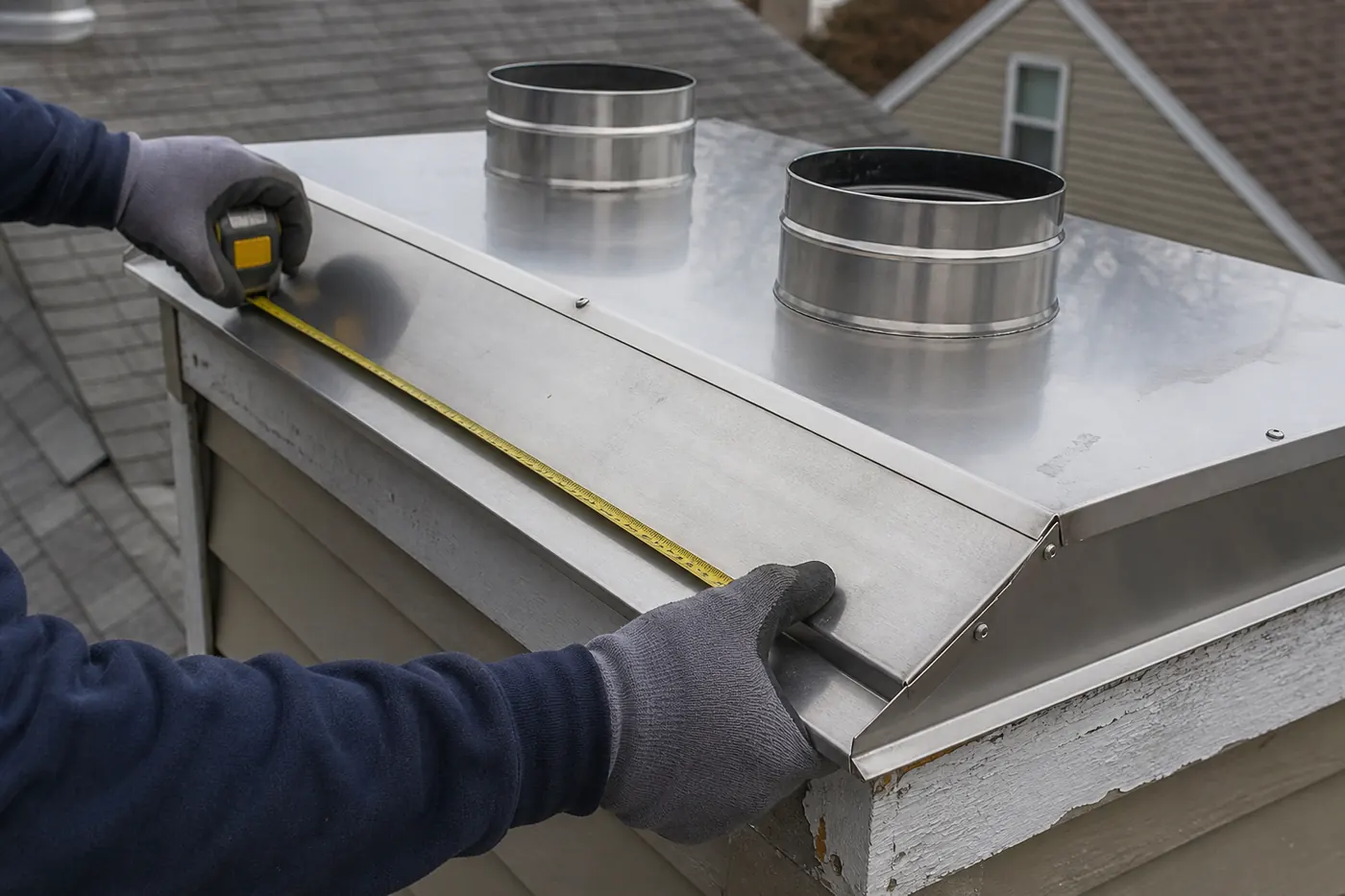
A chase cover replacement in Boston costs $800 to $1,500 for a custom metal cover made to fit your chase. If your chimney is a wood-framed box clad in siding, the cover is the metal lid across its top, and when that lid rusts or ponds water, the rain lands inside the wall. A $49 inspection, credited toward approved work, confirms the measurements and the condition of the framing before any price is written.
- A chase cover is the metal lid on the top of a framed chimney enclosure, not a part of a brick chimney.
- A custom replacement cover runs $800 to $1,500, priced from the measured size of your chase.
- Rust streaks on the siding, pooled water and opened seams are the usual signs it has failed.
- The $49 inspection is credited toward approved work, and you see the written price before anything starts.
What a chase cover does and how it fails
Some chimneys are not brick at all. A framed chase is a wooden box built up from the roof, finished with siding or stucco, with a metal flue pipe running up through the middle. The chase cover is the sheet-metal pan that closes the top of that box. It has one or more round or square holes where the flue pipes pass through, and it is shaped to push rain outward and off the edges.
When the cover works, water never reaches the wood. When it does not, the wooden framing below becomes the place where water collects. A cover can fail in several ways. A flat pan lets rain stand in the middle. Thin metal flexes under snow and ice, and the flexing opens seams. Rust eats through the sheet from the surface it sits on. Corners, where the metal was folded and joined, are the first places to open up. And where the cover meets the flue pipe, a collar that has loosened or cracked gives water a direct way in.
The damage is usually hidden. You may see nothing from the ground until the siding below the chase is streaked orange or the room next to it has a stain. By then, water has often been getting into the framing for some time.
If your chimney is brick, this page does not apply. The part that does the same work on a brick chimney is the crown, and the part that sits over a flue opening is a cap, covered under chimney cap installation.
Signs a chase cover has failed
Most of these show up from the yard or from inside the house. Do not climb up to check the cover.
- Rust streaks down the chase siding. Orange or brown runs below the top edge mean the metal is rusting and washing down the wall.
- Water collects on the cover. If you can see a puddle from an upstairs window after rain, or a stain where it dried, the pan is not draining.
- Corners or seams have opened. Daylight or a visible gap at a corner, or a seam that has pulled apart, lets water enter at that point.
- The pan flexes around the pipes. A cover that moves or sags when touched during an inspection has lost its stiffness, usually from thin metal or rotted support below.
- Collars or storm collars are loose. The ring that hugs each flue pipe may have slipped, split or lost its seal.
- Stains appear after wind-driven rain. Marks on a ceiling or wall near the chase that show up only in a storm from one direction suggest water entering at the cover edge or at a collar.
Be careful about one lookalike. A stain near a chase can also come from the base of the chase, where the siding meets the roof, and not from the top. Metal at that joint is called flashing, and it is a different repair, described on the chimney flashing repair page. A stain that appears only in heavy rain, high on the wall, points to the cover. A stain at the roof line points lower. The technician traces the water from the top down, so you do not pay to replace a lid that is not the leak.
None of these tells you how much damage lies underneath. The inspection looks at that, and the findings are described in the sections below.
What the technician measures and checks at a chase
A chase cover is made to order, so the visit is as much about measuring as about looking. The checks include:
- Overall size of the chase top. Length and width are measured on the actual enclosure, since chases are often not square and the old cover may never have fit well.
- Every opening. Each flue pipe or tile that comes through is counted, measured and located, because the new cover needs a hole for each one in the right place.
- The framing under the cover. The top of the chase is checked for soft, dark or crumbling wood and for whether the surface can support a new cover without sagging.
- Slope and overhang. The existing cover is checked for pitch, for how far it overhangs the siding and for whether the edges drip clear of the wall.
- Collars and seals. The ring around each pipe is checked for slipping, cracking and open joints.
- What the pipe is. If a listed factory-built flue system runs through the chase, its parts have to stay as made, and the plan has to avoid disturbing them.
You get photos of each of these. If the framing is damaged, the photo shows where, so the next conversation is based on what you can see.
Why a rusted chase cover is replaced, not painted or caulked
Owners often ask whether a rusty cover can be sealed with a coating or caulk. Sometimes a small repair is reasonable, but most failed covers are replaced, for three reasons.
Rust is thin metal failing
Rust that shows on the surface usually means the sheet is thin and corroding from underneath as well. Paint covers the colour, not the loss of metal. A pan that already flexes will crack through any coating laid on it.
Caulk does not fix the slope
Sealant can close a pinhole. It cannot make a flat pan drain or stiffen metal that moves. If water ponds, a new bead of caulk only holds the pond.
Seams and corners are the weak part
Where sheet metal was folded and joined, repeated expansion and contraction opens it up again. A replacement cover is formed so those corners are made from folded metal and not stuck together with sealant.
When a smaller repair is reasonable
If the cover is sound, with one failed collar or one opened seam, the technician may recommend resealing only that spot. That would be quoted in writing after the $49 inspection, not at the replacement range.
How a custom chase cover is made
A good cover starts from tape measure numbers, not from a catalogue. Here is the sequence.
- The chase top is measured end to end, including any out-of-square corners.
- Each flue opening is measured and marked, with its distance from the edges, so the holes in the cover line up with the pipes.
- The cover is fabricated from flat metal sheet, with a raised centre or slope so water runs outward, and with the edges bent down to form a drip edge that hangs past the siding.
- The corners are formed with folded joints so they do not depend on caulk to stay closed.
- The finished cover is test-fitted at the chase before the old one is fully removed, or checked against the measurements when it arrives.
The metal comes in more than one type. Stainless steel and galvanized steel are two common choices, and the quote names the metal. Metal choice affects how the cover stands up to Boston's salt air and wet winters, so ask what the quote specifies and why.
A custom cover is the reason this service has a single price band instead of fixed tiers. Two chases are rarely the same size.
Questions worth asking about the quote
- Which metal is it, and how thick is the sheet?
- Does the cover slope outward from the pipes, and by how much at the centre?
- How far will the edge overhang the siding?
- Are the corners folded and joined, or sealed with caulk?
- Are the collars part of the price?
A quote that answers all five in writing is easy to compare with any other quote you collect.
How the old cover comes off and the new one goes on
Replacement is a careful tear-out and fit, not a lid swap. The old cover is removed in a way that does not disturb the flue pipes or the framing beneath it.
Removal
The old cover is unfastened and lifted off in pieces if needed. The surface under it is cleared and examined. Any damp or soft wood is shown to you in photos before the new cover goes on.
Preparing the chase top
If the framing is sound but uneven, minor accessible defects can be corrected when that is included in the written scope. Larger repairs of the framing itself are not assumed in the replacement price and would be quoted separately.
Installation
The new cover is set so that it slopes outward, overhangs the siding on all sides and meets each pipe through its collar opening. It is fastened to the chase and the collars are fitted and sealed with a material compatible with the metal and the pipe.
Final check
The technician looks over each edge, each collar and the overall slope, and photographs the result. You see where the water will run, and that it leaves the chase instead of collecting on it.
Collars, storm collars and the flue pipes
The most-overlooked part of a chase cover is the ring around each pipe. A pan can be perfect and still leak at the collar.
What the collar does
The collar is a short metal sleeve that rises from the pan around the pipe, and a storm collar is a band that clamps around the pipe above it to shed water down onto the sleeve. Together they close the gap between a moving pipe and a fixed pan.
How they fail
The sealant at the top dries out and splits. The band slides down the pipe, or it was never tightened. A collar that was cut a little too wide leaves an opening. Any of these can send water down the outside of the pipe and into the chase.
What is done on replacement
New collar openings are formed to the measured pipe size, and compatible collars and sealant are renewed so the pipe is protected at the same level as the pan. If the pipe is a listed product, the cover is arranged around it without altering it.
If the pipe itself is rusted or damaged, that is a separate flue question and is priced in writing after the inspection.
Wood framing and siding damage under a failed cover
A cover that has leaked for a while can leave the framing wet, and that changes the job.
- Dry, sound wood. The new cover is installed on it as it stands.
- Stained or damp wood. It is allowed to dry, the source is stopped by the new cover, and the wood is watched at later visits.
- Soft or rotted wood. This is a carpentry repair. It sits outside the cover price, and it is quoted separately after the $49 inspection so you can see it as its own line.
Rust staining on siding below the chase is usually cosmetic and washes or paints away once the source stops. Siding that has been wet for a long time is a different matter, and the technician will point it out in the photos so you can raise it with a siding contractor if needed.
For leaks that show up inside the house and might have more than one cause, the page on chimney leak repair explains how water is traced to its source.
What the visit and the install day look like
The inspection visit
You are given a 3-hour arrival window, and the office phones ahead. The technician measures the chase and each pipe, photographs the cover and what is under it, and then prices the work in writing. Nothing is made or fitted until you approve it.
Making the cover
Because the cover is custom, there is a gap between the measuring visit and the install visit while it is fabricated. We do not promise how long that takes, and the written quote tells you the plan.
Install day
On the day, the old cover is removed, the top of the chase is checked, and the new cover goes on. Wet weather can delay it, since the framing should stay dry while it is open. The $49 inspection is credited toward the work if you approved it.
Chase cover replacement price at a glance
A custom chase cover runs $800 to $1,500.
| Chase job | Price |
|---|---|
| Custom chase cover, made to measure and installed | $800 to $1,500 |
| Framing or carpentry repair found under the cover | Quoted in writing after the $49 inspection |
| General inspection, credited toward approved work | $49 |
The size of the chase, the number of pipes, the metal chosen and how easy the top is to reach move the price within the range. The chase cover cost page explains how to read and compare quotes.
How to prepare, and when a leaking chase cover is urgent
Before the visit
- Note which wall, ceiling or room shows stains, and what the weather was when they appeared.
- Clear cars, bikes and anything else from the ground below the chase.
- Tell the office if the chimney serves a gas fireplace or a wood stove.
When it should not wait
Book soon if the stain is spreading, if water drips from a ceiling or light fixture near the chase, or if the siding below is turning soft. A wet chase is open to rot, and rot is slower and costlier to repair than the cover. If you ever smell gas, leave the house and call the gas utility or 911. If a carbon monoxide alarm sounds, leave and call 911.
To have your chase measured and priced, book the $49 inspection on our contact page or call (617) 404-9587.
Questions homeowners ask
How do I know if my chimney has a chase?
A chase looks like a tall box clad in siding or stucco, rising from the roof or the side of the house, with a metal pipe or pipes coming out of the top. A brick or stone chimney is not a chase. If you are unsure, the inspection visit confirms it.
Can a rusty chase cover be painted instead of replaced?
Paint hides the colour but not the thin metal or the flat shape underneath. A cover that ponds water or flexes will keep leaking under paint. If only one collar or seam has failed, a small repair may do, and that is quoted separately.
Why is a chase cover custom made?
Each chase has its own length, width and pipe positions, and many are not square. A cover that is made from your measurements fits the pipes, overhangs the siding and slopes correctly. Stock sizes rarely do all three.
What happens if the wood under the cover is rotted?
Rotted framing is a carpentry repair outside the cover price. It is shown in photos, priced as its own line after the $49 inspection, and done only if you approve it.
Is the cover covered by the $49 inspection fee?
The $49 general inspection is credited toward approved repair work, so it is not an extra charge if you go ahead. The written price comes first, and you decide after seeing it.
Will the new cover change how my fireplace or stove vents?
No. The cover is shaped around the flue pipes without changing them. If a listed factory-built vent runs through the chase, its parts are left as made. Any gas line work belongs to the gas utility or a licensed gas fitter.
Related guidance
Start with the Boston cost guide, then read the guides below.
- Coastal Chimney Corrosion for Quincy and Weymouth Homes
- Questions to Ask a Chimney Contractor in Boston
- Chimney Scam Warning Signs for Boston Homeowners