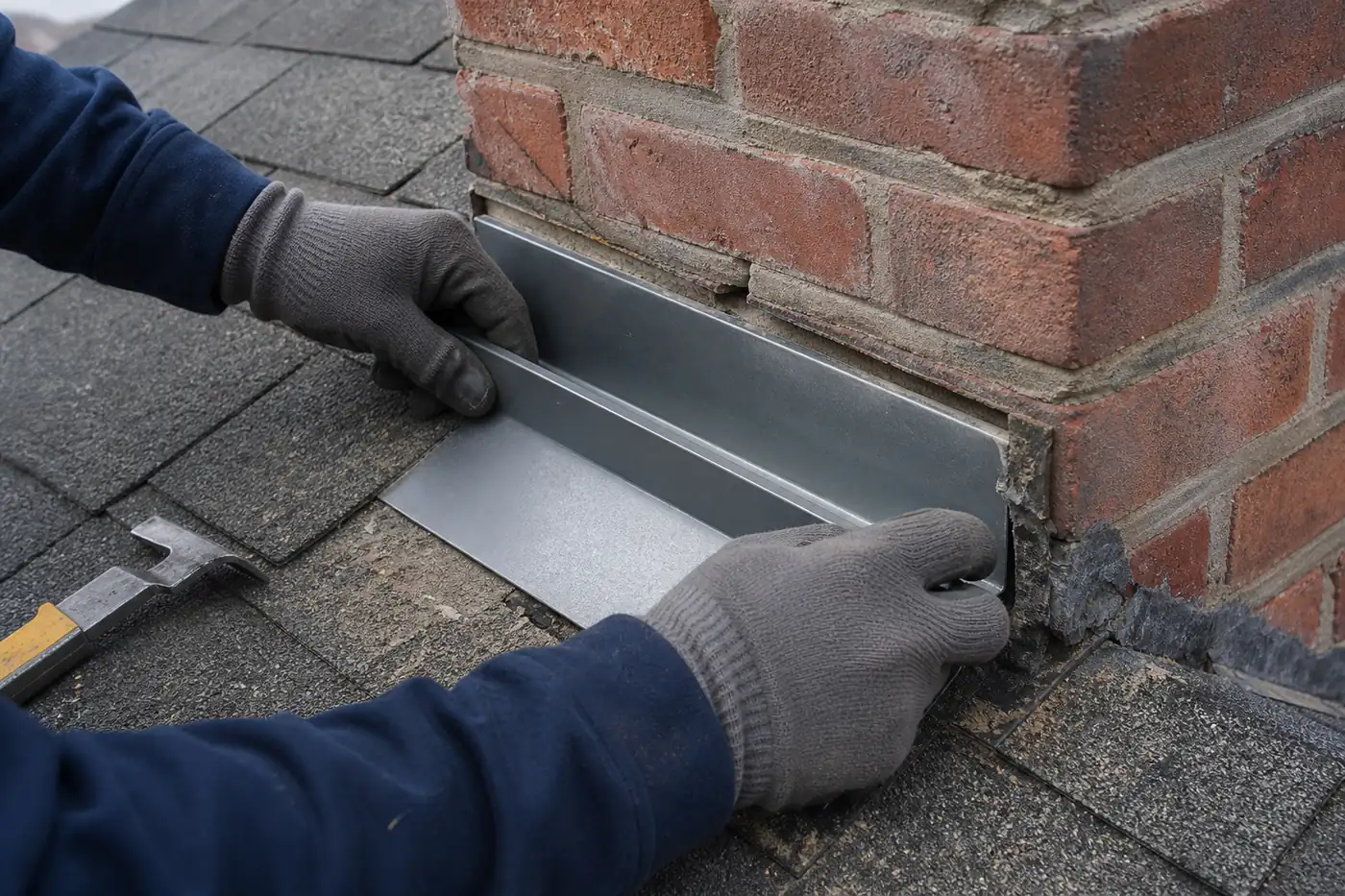
Chimney flashing repair in Boston costs $200 to $400 for a repair, $400 to $800 for a partial replacement and $800 to $2,500 for a full replacement. Flashing is the layered metal where your chimney meets the roof, and it is the most common place for a chimney to leak into an attic or ceiling. A $49 inspection, credited toward approved work, shows which of the three jobs you need before any price is written.
- Flashing is the metal that seals the joint between the chimney and the roof surface.
- A flashing repair runs $200 to $400, a partial replacement $400 to $800 and a full replacement $800 to $2,500.
- Caulk or roof cement alone is a short-term patch, because the joint moves with every season.
- The $49 inspection is credited toward approved work, and you get the price in writing before work begins.
What chimney flashing is and how it fails
A chimney and a roof are two different structures that move at different rates and are built from different materials. The place where they meet has to stay watertight while both of them shift. Flashing is what does that.
It is built in layers. Base flashing and step flashing lie flat against the roof and run up the sides of the chimney, woven in under the roofing so water runs over them and onto the roof. Counterflashing is a second piece set into the masonry, hanging down over the top edge of the first piece. The two overlap without being fixed together, so the joint can move and still shed water. Behind the chimney, on the uphill side, a back pan or a small peaked cricket stops water and debris from piling up against the brick.
Flashing fails when the metal rusts or lifts, when the counterflashing pulls out of the masonry, when the overlaps open, or when a layer was never installed. In Greater Boston, freeze-thaw cycles, ice dams along roof edges and snow that slides and piles at the chimney base all strain these joints. Salt air near the coast speeds the rusting of thin metal. Many older brick homes and triple-deckers have a chimney that rises through a roof that has been reroofed more than once, and flashing that was patched around is common.
A failed flashing joint rarely announces itself outside. The water moves along the framing and shows up inside, often far from where it came in.
Signs your chimney flashing is leaking
Some of these are inside the house, and some can be seen from a window or the yard. Do not climb onto the roof to look.
- Staining on the ceiling or in the attic near the chimney. A brown ring or a damp patch on the chimney side of a room is the classic sign.
- Open counterflashing joints. A visible gap where the upper metal meets the brick, or sections that hang away from the wall, means the layers no longer overlap.
- Rusted or lifted metal. Orange flaking or edges curling up from the roof are signs the metal is failing.
- Cracked roof cement. Black, tar-like filler that has cracked or pulled away from the brick was a patch, and it is no longer sealing.
- Water that shows up in wind from one direction. A leak that appears only when rain blows in from one side points to one section of flashing, not the whole joint.
- Debris or ice piling up behind the chimney. Leaves, snow and ice that collect on the uphill side hold water against the joint, which is why a back pan or cricket exists.
These signs point toward flashing, but a leak is not always the flashing. The next section explains how that is sorted out.
Is the water coming through the flashing or somewhere else?
Water stains near a chimney have several possible sources, and paying for flashing when the leak is elsewhere is a common mistake. The technician traces the water before recommending anything.
Flashing
The leak is at or just below the roof line, it follows the shape of the chimney base and it gets worse in storms. Rust and gaps in the metal confirm it.
The crown or the top of the brick
Water entering at the top of the stack runs down inside the masonry and can emerge lower down, well below the roof line. If the brick above the flashing is wet while the flashing looks sound, the source is higher. That is a chimney crown repair question.
The brick and mortar joints
Brick absorbs water, and open mortar joints let it through. Wall absorption looks like a leak that follows a heavy, long rain, not a gust.
The roof itself
A loose shingle or open roof seam upstream of the chimney can look like a flashing leak. Roof covering work is a roofing job, and it is priced and handled separately.
Because the cause decides the price, the written quote names which source was found and shows photos. For a broader look at how leaks are traced, see the chimney leak repair page.
What the technician checks on the flashing
The flashing inspection is slow and visual. The technician avoids pulling things apart that do not need to be, so a small problem does not become a bigger one.
- Roof drainage above and around the stack. Where does water arrive from, and where does it go? Gutters, valleys and the slope above the chimney all feed the joint.
- Layering. Only the edges that must be lifted are lifted, to see whether base flashing, step flashing and counterflashing overlap in the right order.
- Counterflashing attachment. The metal has to be set into the masonry, usually in a cut groove called a reglet, or built into the mortar joints. The technician checks whether it is still firmly seated and whether the groove is intact.
- Entry versus absorption. Whether water is getting past the metal or soaking in through the brick above it.
- Back pan or cricket. Whether the uphill side of the chimney has one, and whether debris or ice is collecting there.
The photos from the visit show each of these, so you can see the failed section and the sound ones. That is what lets the quote name a repair, a partial replacement or a full replacement with a reason.
Why roof cement and caulk are a patch, not flashing
Many chimneys carry a thick smear of black roof cement or a bead of caulk along the joint, put there by a previous owner or a contractor. It can stop a drip for a while, which is why it is so common.
It fails because the joint is not still. The chimney and the roof expand, shrink and settle at different rates through Boston's cold-to-hot swings, and a rigid filler cracks along the line where the two meet. Once it cracks, water gets behind it and the filler may even trap water against the brick. Real flashing handles the movement by overlapping instead of gluing.
When sealing is the right repair
If the metal is sound, the layers are all present and only one joint has opened or one short run of sealant has failed, then a targeted seal is a fair repair. That is the $200 to $400 job. The technician reseals only the stable minor joint and notes the rest in the photos.
When sealing is the wrong repair
If the metal is rusted, if counterflashing has pulled out of the wall or if the overlaps are missing, sealing hides the problem for one season. The quote will recommend a partial or full replacement instead, and it will say why.
The repair tier is the smallest, so it is worth asking whether your leak truly fits in it.
Partial flashing replacement
A partial replacement is for flashing that has failed in one clear section while the rest remains sound. It is the $400 to $800 tier.
When it fits
Typical cases are a failed run along one side of the chimney, a section of counterflashing that rusted through, or a place where past work left a gap. The remaining flashing is intact and properly layered.
How it is done
- The failed section is identified and its limits marked, so the replacement covers all of the damaged part and a margin of sound metal.
- The old metal is removed from that section, and the roof covering around it is lifted only as far as needed.
- New flashing is cut to fit and layered so that it laps correctly over or under the neighbouring pieces.
- New counterflashing is set into the masonry and finished where it meets the brick.
- The area is checked for drainage, so water leaves the joint and does not pool.
The risk of going small
A partial job only makes sense if the rest of the flashing is sound. If the technician finds the remaining metal is close behind the failed section, the quote will say a full replacement is the better value. You see the reasoning in the photos before you approve.
Full step and counterflashing replacement
A full replacement removes the entire set of flashing around the chimney and installs a new one from scratch. It is the $800 to $2,500 tier, and it is the largest because the work goes around all sides of the chimney.
When it fits
Choose full replacement when the metal is rusted or lifted on several sides, when roof cement has been layered over old problems, when the layers were never built correctly, or when a partial repair would leave sound metal only in scraps. A chimney that has leaked from more than one side usually falls here.
What the work covers
- Removal of the old base flashing, step flashing and counterflashing.
- Careful lifting of the roof covering at the chimney so the new step pieces can be woven in under it.
- New step flashing on the sides, base flashing at the front and a new counterflashing set into the masonry.
- A back pan or cricket on the uphill side if the chimney needs one.
- Final sealing at the joints that need a sealant, with the layers doing the main work.
Where the range goes up
The width of the chimney, the height and pitch of the roof, how many roof layers lie around the stack and how much roof covering has to be opened and put back all move a job within the range. The cost page covers those factors.
Back pans, crickets and masonry reglets
These two details are where an otherwise fine flashing job often fails, so they deserve their own look.
Back pan or cricket
On the uphill side, a chimney acts like a dam. Water, ice and leaves collect against it and sit at the joint. A back pan is a flat metal tray that carries that water to the sides. A cricket is a small peaked structure, usually framed and covered in metal, that splits the water left and right. A wide chimney usually benefits from one. The technician checks whether yours has one that works and whether one is needed.
Reglets and counterflashing
The top edge of counterflashing has to be held in the masonry, and this is where many old installations fail. If the groove is crumbling or the mortar around the edge is loose, the metal pulls out and hangs open. The edge of the metal is then set into a prepared groove and finished so water cannot run behind it, and loose mortar nearby is renewed. Larger brick and mortar problems are priced separately, and you can read about those under masonry repair.
Both details are listed on the written quote as their own lines when they apply, so you can tell whether the price includes them.
What the visit and the work day look like
The inspection visit
You get a 3-hour arrival window, and the office calls ahead. The technician traces the water, looks at each flashing layer, and photographs the chimney base from several angles. The $49 inspection is credited toward approved work. You then receive a written price that names the tier and the reasons for it.
The work day
A small seal is a short visit. A full replacement is a bigger day of work, because the roof covering around the stack has to be opened and put back. We do not promise a time or a number of days, because the roof, the access and the weather decide it, and flashing work is not done in the middle of a downpour.
What you see afterward
You get photos of the new flashing in place, showing the layers, the counterflashing edge and any back pan or cricket, so you do not need to look at the roof yourself.
Chimney flashing repair price at a glance
Flashing work runs $200 to $2,500 across three tiers.
| Flashing job | Price |
|---|---|
| Flashing repair: seal a stable minor joint | $200 to $400 |
| Partial replacement of a failed section | $400 to $800 |
| Full step and counterflashing replacement | $800 to $2,500 |
| General inspection, credited toward approved work | $49 |
Roof pitch, chimney width, roof layers and the condition of the brick around the metal move a job within its tier. For what to look for in a quote, see the chimney flashing repair cost page.
How to prepare, and when a flashing leak is urgent
Before the visit
- Note which ceiling or wall shows a stain, and what the wind and rain were doing when it appeared.
- If you can reach the attic safely, tell the technician where the chimney passes through it. Do not climb onto the roof.
- Move vehicles and patio furniture away from the base of the chimney.
When it should not wait
A flashing leak does its worst damage slowly and out of sight, in insulation and framing. Book promptly if a stain is growing, if water drips during storms or if you see ice building up at the chimney base before a freeze. If water reaches a light fixture or electrical outlet, keep away from it and turn the power off at the panel if it is safe to do so. A chimney fire or a carbon monoxide alarm is an emergency: leave the house and call 911.
To find out which flashing job you have, book the $49 inspection on our contact page or call (617) 404-9587.
Questions homeowners ask
Can my roofer fix the flashing instead of a chimney company?
A roofer handles the roof covering, and many handle base flashing. The counterflashing has to be set into the brick or mortar, which is masonry work. A leak at the chimney often needs both, so ask whoever quotes it who is doing each part.
How can I tell if the leak is flashing or the crown?
A leak at the roof line that worsens in storms usually means flashing. Wet brick above the roof line, or stains that show up lower down the stack, point higher up. The technician traces the water and shows you photos so you can see which it is.
Is roof cement a good enough fix?
It can stop a drip for a short time. It cracks as the chimney and roof move, and then it can trap water against the brick. A targeted seal on a stable minor joint is fine. A joint with rusted or missing metal needs replacement.
What is a cricket and do I need one?
A cricket is a small peaked section built on the uphill side of a chimney to split water around it. Wide chimneys often benefit from one, because water and ice otherwise pile up behind the brick. The inspection tells you if yours needs one.
Why does a flashing leak show up far from the chimney?
Water that gets in at the joint runs along framing and rafters before it drips through a ceiling, sometimes several feet away. That is why a stain is only a starting point, and the technician checks the chimney base before choosing a repair.
Why are there three price tiers for flashing?
The tiers match the size of the job. A repair seals a small stable joint, a partial replacement renews one failed section, and a full replacement redoes the flashing around the whole chimney. The $49 inspection shows which one fits and is credited toward approved work.
Related guidance
Start with the Boston cost guide, then read the guides below.
- Chimney Flashing Repair Cost in Boston (2026)
- Chimney Leaking When It Rains in Boston: Causes and Fixes
- Common Chimney Repairs in Boston (2026)
- Coastal Chimney Corrosion for Quincy and Weymouth Homes