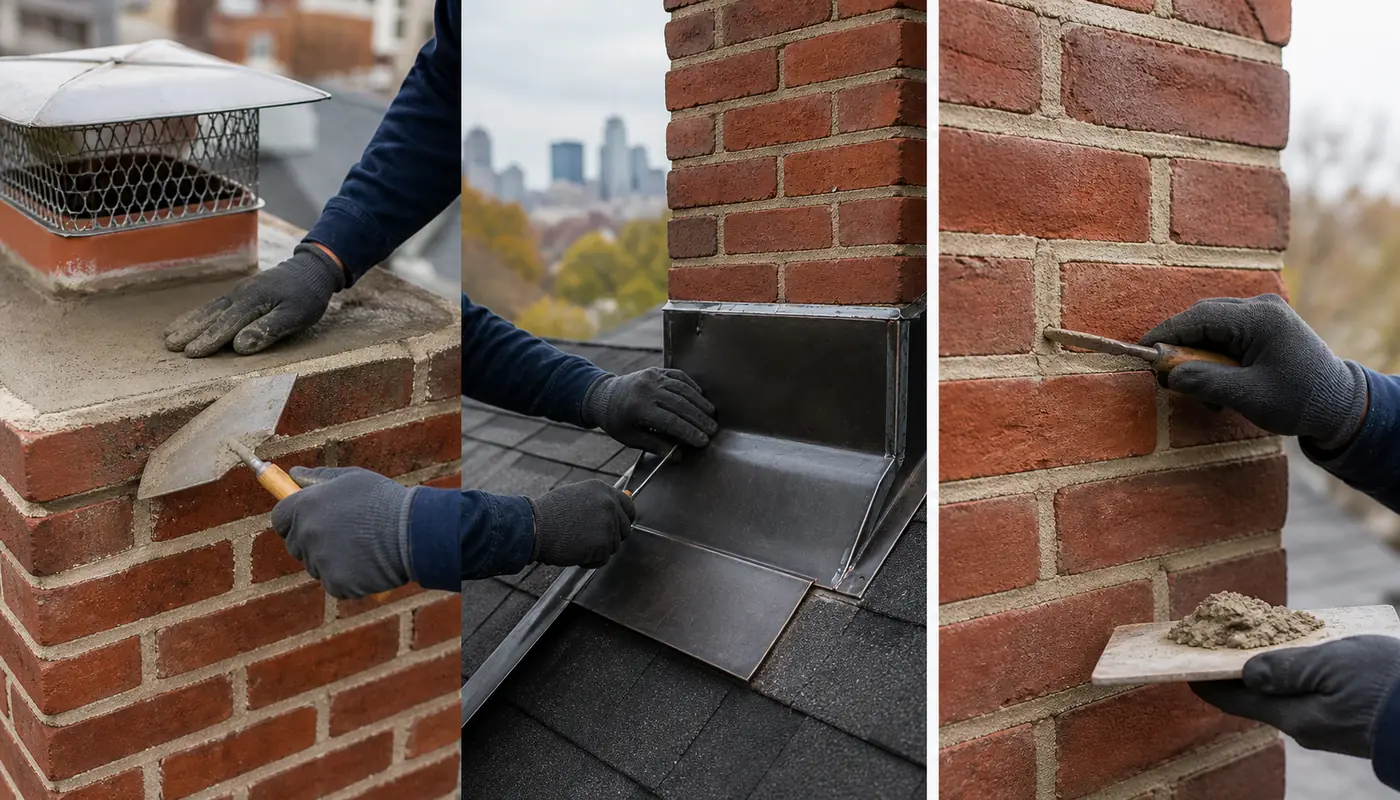
Most Boston chimney repairs fix one of four water-entry points: the cap or chase cover, the crown, the flashing, or the mortar and brick joints. Many focused jobs fall between $300 and $2,500, and larger projects can go above that. The right repair depends on where water or smoke is actually getting in, not on the symptom you notice first.
The usual repairs and their price ranges
| Repair | Boston price |
|---|---|
| Chimney cap, standard | $300 to $700 |
| Crown repair | $300 to $900 |
| Flashing repair | $200 to $400 |
| Partial repointing | $300 to $700 |
| Basic masonry repair | $300 to $700 |
| Firebox repair | $350 to $900 |
| Damper repair or replacement | $199 to $1,200 |
| Smoke chamber repair | $500 to $1,500 |
| Liner repair | $1,200 to $2,500 |
Bigger versions of these jobs cost more, and the details are on our chimney repair cost page. Final prices are written down after an inspection, never guessed over the phone.
Repairs at the top of the chimney
The top takes the weather first, so it is where most repairs start.
Cap or chase cover
A cap keeps rain, debris and animals out of the flue. On a framed chimney, a chase cover does the same for the whole box. Rusted, loose or missing covers are among the most common reasons for a damp firebox.
Crown
The crown is the slab that caps the masonry. Hairline cracks open into wider ones after repeated freezing, and water then reaches the bricks below. Repair is $300 to $900.
Flashing
Flashing is the metal seal where the chimney meets the roof. When it lifts, rusts or cracks, rain runs behind it into the house. The most common sign is a ceiling or wall stain next to the chimney. Repair starts at $200 to $400. You can read more on chimney flashing repair.
Repairs to brick and mortar
Mortar joints wear faster than brick. As they recede, water gets deeper into the wall. Repointing, also called tuckpointing, rakes out the loose mortar and refills the joints. A partial job is $300 to $700, and a full job is $700 to $2,500. Our chimney repointing page explains the steps.
When bricks themselves are cracked or flaking, individual units are cut out and replaced. Basic masonry repair of this kind is $300 to $700, with standard jobs from $700 to $2,500 and major work from $2,500.
Doing the mortar work early matters. Water that gets into joints freezes, expands and widens the gap, and the next storm pushes more in.
Repairs inside: flue, firebox, damper and smoke chamber
- Liner. The flue liner carries smoke up and out. Cracked or missing tile can let heat and gases reach the wall around it. Repair runs $1,200 to $2,500, and replacement $1,500 to $4,500. See chimney relining.
- Firebox. Cracked firebrick and open joints inside the burn chamber cost $350 to $900 to fix.
- Damper. A damper that sticks, will not seal or has rusted away can be repaired or replaced, $199 to $1,200 depending on the type.
- Smoke chamber. The sloped area above the damper often has rough or damaged walls. Repair is $500 to $1,500.
These are less visible, so a camera or a good flashlight check is how they are found.
The symptom is not the repair
A symptom can point to several different causes, so be careful with a quote that names a fix before it finds the cause.
- Water stain on the ceiling. Flashing, crown, cap or masonry. Each one costs a different amount.
- Musty smell in damp weather. Water in the flue, a missing cap, or a damper that does not close.
- Smoke in the room. A blocked flue, a cap clogged with debris, a poor draft, or an undersized flue. Cleaning may fix it, or it may not.
- Loose brick or sand on the hearth. Mortar loss or failing brick higher up.
- Rust on the firebox or damper. Moisture coming down from above.
The inspection finds which one it really is, and the photographs show you the same thing.
Why Boston weather shapes the repair list
Greater Boston swings across freezing many times each winter. Wet masonry that freezes expands, and the cycle repeats until small cracks become large ones. Coastal air adds salt, which attacks metal parts, and nor'easters push rain sideways into joints and under flashing. Many homes here are older brick buildings, so earlier repairs may fail differently from the original work.
That is why the same few items keep showing up. A chimney that has been patched once is not necessarily finished, and a repair done with the wrong material can fail sooner than the original did.
A few examples show how this plays out. Mortar that is much harder than the surrounding old brick can force the brick to take the freeze damage, so the bricks start to flake instead. A cap that was sized for a different flue can rattle loose in a gusty storm. And flashing that was sealed with caulk alone, with no metal tie-in, tends to open again after a few winters.
Looking at how earlier work is performing is part of any good inspection. It tells the technician what has been tried already and what the chimney is asking for now.
What a repair visit looks like
Knowing the sequence helps you spot a visit that skips steps.
- Look and listen. The technician asks what you have noticed and where, then checks the firebox, damper and flue from inside.
- Check the top. The cap, crown, flashing and brick faces are inspected and photographed from the roof, with close-ups and wide shots so each defect can be placed on the chimney.
- Explain the findings. You see the photos and hear which items are urgent, which are worth doing soon and which can wait.
- Write the price. Each repair gets its own line, and nothing starts until you approve it.
- Do the work and review the result. Afterward, walk through what was done against the written price, so the bill matches the scope you approved.
You should expect a three-hour arrival window and a call ahead, so plan for someone to be home.
How to prioritize and order the work
- Safety first. Anything that makes the fireplace unsafe to use, such as a cracked liner or a damaged firebox, should be fixed before you light another fire.
- Stop the water. Cap, crown, flashing and joints come next, because water makes everything else worse.
- Repair the damage water already did. Replace bricks, rebuild affected areas and treat stains.
- Protect the result. A breathable water repellent, discussed on our chimney waterproofing page, helps after the repairs are done.
Ask for each item on its own line with its own price, so you can approve some now and plan others. If you want a second look at a quote you already have, a free second opinion is available with a written report from a reputable local chimney company.
Start with the $49 inspection, credited toward approved repair work. Book at /contact/ or call (617) 404-9587, and see our chimney repair page for how a visit works.
Questions homeowners ask
How do I know if my chimney leak is the crown or the flashing?
Look at where the water shows up. Stains near the roofline beside the chimney often suggest flashing, while stains inside the firebox or on the chimney breast often suggest the crown or cap. A technician should confirm before you approve anything.
Which chimney repair should come first if I can only afford one?
Start with whatever lets water in or makes the fireplace unsafe. If the flue is damaged, that comes first. Otherwise the top of the chimney is usually the wisest place to spend, because it protects everything below.
Is repointing a repair I can do myself?
It requires working at height on the roof and matching the mortar to the brick, so leave it to a professional. Never climb onto the roof yourself.
Do small cracks in the crown matter?
They can. Water finds hairline cracks and widens them over a few freeze-thaw seasons. Sealing or repairing a small crack is usually cheaper than rebuilding the crown later.
Will a repair quote change after work starts?
The price is given in writing before work begins. If something new is found, it should be documented with photos and quoted separately, and you decide whether to approve it.