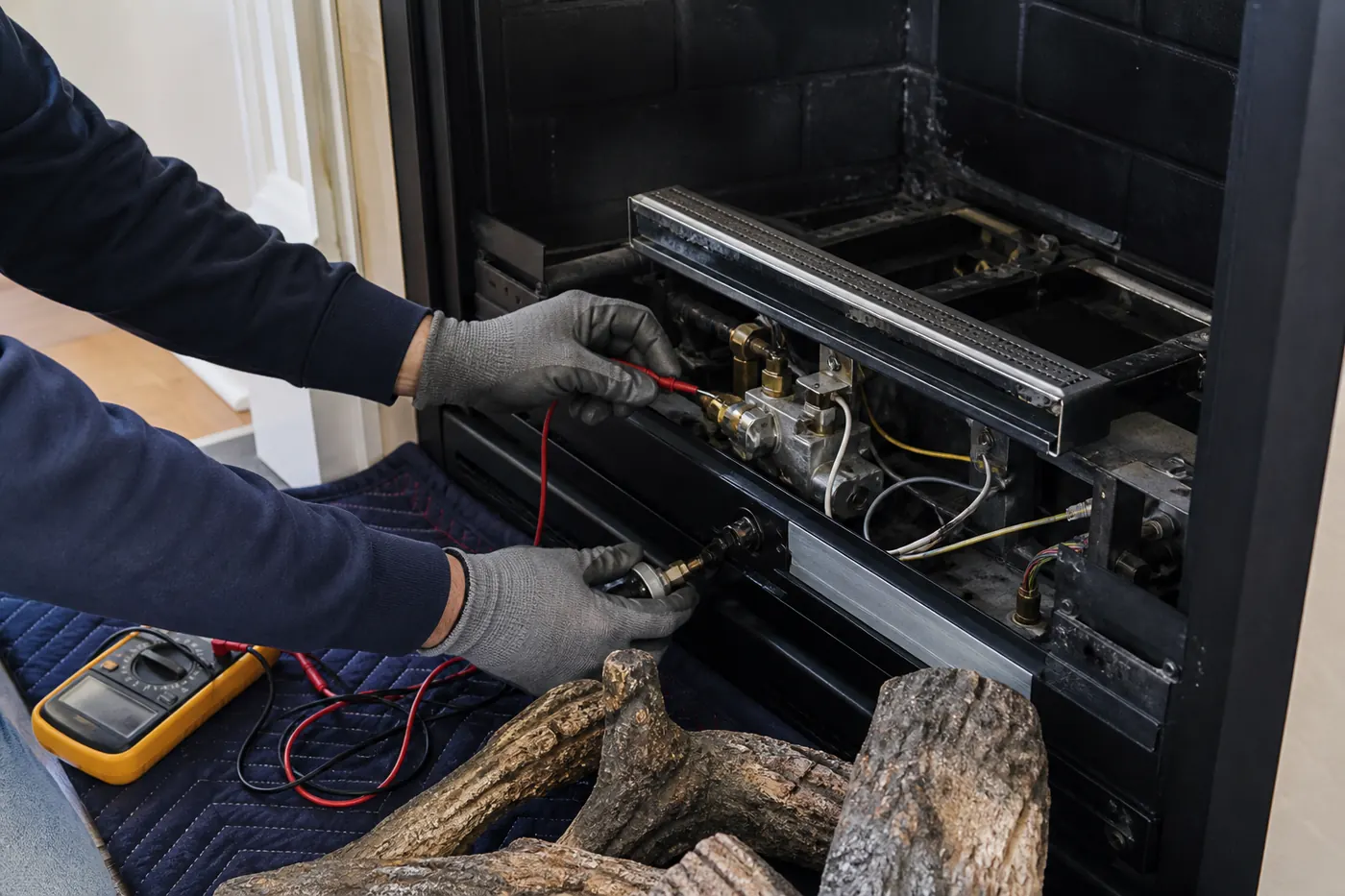
Fireplace repair in Boston costs $299 to $1,500, with gas fireplace service starting at $299 and wood-burning fireplace repair priced by what is found inside. This page covers both kinds of fireplace: the gas appliance with its pilot, burner and controls, and the traditional wood-burning fireplace with its firebrick, damper and masonry. We start with a $49 chimney inspection, credited toward approved repair work, so you know which kind of problem you have before you pay for a fix.
- Fireplace repair in Boston runs $299 to $1,500, depending on the type of fireplace and the parts involved.
- Gas fireplace repair is $299 to $900, and a full gas kit is $900 to $1,500.
- Gas line work is done by the gas utility or a licensed gas fitter, not as part of a fireplace visit.
- The $49 inspection is credited toward approved repair work.
What counts as a fireplace repair
A fireplace complaint can come from several places at once: the appliance that makes the flame, the controls that start it, the path the smoke or exhaust takes out of the house, and the masonry enclosure around it. That is why we treat the visit as a diagnosis first and a repair second.
In Greater Boston, you find two broad groups of fireplace. The first is the traditional wood-burning fireplace, common in older brick homes, triple-deckers, brownstones and rowhouses, where the repairs are mostly about brick, mortar and the damper. The second is the gas fireplace or gas log set, which may have been added to an old masonry fireplace or built in as a unit, where the repairs are mostly about the pilot, the burner, the valve and the ignition.
Some homes have a mix. A gas log set sits inside a masonry firebox, so a crumbling firebrick and a pilot that will not light can both show up on the same visit. The technician looks at both sides. The parts of a wood-burning fireplace each have their own pages, including firebox repair and chimney damper repair, and this page is the overview and the gas side of the job.
It helps to say which kind you have when you book. A gas unit with a remote and a glass front is a different job from an open masonry fireplace with a log grate, and the technician arrives with the right plan for yours. If you are not sure, a photo of the front of the fireplace is enough to settle it.
One boundary matters up front. We service the fireplace appliance and its visible components. Work on the gas supply line itself, such as the pipe in the wall, the meter or the main valve, belongs to the gas utility or a licensed gas fitter. If your problem turns out to be there, the technician says so and points you to the right person.
Signs a gas fireplace needs service
Gas fireplaces give clear warnings. These are the ones we hear about most.
- The pilot will not stay lit. You light it, hold the button, and it goes out when you let go or after a short time.
- The burner lights unevenly or shuts down. Flames come up in patches, are lazy and yellow, or the fireplace turns itself off.
- The controls do not respond. A switch, remote or wall control does nothing, or works only some of the time.
- Soot appears around the appliance. Black marks on the logs, the glass or the wall above are a sign that something is wrong with combustion or venting.
- The masonry or firebrick around it is damaged. Cracked brick, open joints or crumbling mortar behind a gas set still need attention.
- The whole set is old or deteriorating. Rusted burner parts, brittle logs and worn controls add up to a unit that is past repair.
Soot near a gas appliance deserves particular care. Gas flames are meant to burn clean. Soot means the flame is not getting the right mix, or the exhaust is not leaving as it should, and a carbon monoxide risk can come with that. If a carbon monoxide alarm sounds, leave the house and call 911.
If you smell gas, do not light anything and do not use switches. Leave the house and call the gas utility or 911 from outside. That is not a repair call, and it comes before everything else on this page.
What the technician checks on a gas fireplace
Gas service starts with knowing what you own. A repair that suits one unit can be wrong for another, so the first step is identification.
- Manufacturer and model. The technician looks for a data plate or label on the unit and notes the details. Where it can be read, it tells us which parts are right for the unit.
- The shutoff, the connection and the visible parts. The technician confirms that the appliance shutoff works, looks at the connector, and checks the condition of the burner, the pilot assembly, the controls and the logs or media.
- Appliance or venting. A fireplace that sputters can have a bad part or a bad exhaust path. The technician separates the two, because a new part will not cure a blocked vent.
- The firebox and damper relationship. In a masonry fireplace with gas logs, the damper position affects how exhaust leaves. The technician checks that the damper, the firebox and the gas set work together.
- Parts that are approved and obtainable. Repair parts must be right for the unit and available. If they are not, the conversation turns to replacement.
You see photos of what is found, and a written price follows. The work starts when you agree to the scope.
If the cause turns out to be in the gas supply, or in work that needs a licensed gas fitter, the technician stops, tells you and refers you on. We do not guess at gas line problems.
Gas fireplace repairs, from cleaning to new components
Most gas fireplace problems fall into one of three kinds of work.
Cleaning and operational service
Dust, lint, spider webs and soot build up around the burner and the pilot, and a blocked pilot port is a common reason for a flame that will not stay lit. A cleaning of the burner area, the pilot assembly and the glass often brings a unit back to normal. It also lets the technician see the parts clearly and spot what is really wearing out. A gas fireplace cleaning is $299.
Replacing a repairable control or ignition part
When the pilot will not hold or the controls do not respond, the cause is often a single worn part: a pilot assembly, an igniter, a thermocouple or a similar sensor, a valve or a control module. Replacing that part is the repair. It is a contained job, and gas fireplace repair is priced at $299 to $900, based on the parts and the labor involved.
Why a part sometimes cannot be replaced
Older units may use parts that are no longer made. The technician will not substitute a part that is not approved for your fireplace, because gas appliances depend on the right components. When the part cannot be had in an approved form, replacement of the set becomes the sensible option.
Keep the unit off between the visit and the repair if it is behaving oddly. A pilot that cuts out and relights itself, or a flame that changes shape on its own, is better watched by a technician than by you at the controls.
Gas fireplace repair for the burner, ignition and controls is one half of this page. If your unit sits inside a masonry fireplace, the other half is below.
When the gas set should be replaced
Repair is not always the answer. A set is a candidate for replacement when several things are true at once.
- The burner is rusted, warped or cracked, and a new burner is the only fix.
- The controls and valve are worn, and replacing them one at a time would add up.
- Repair parts for the model are not approved or not obtainable.
- The logs or the media are brittle or sooted past cleaning.
- The cost of repairs is approaching what a new set would be.
Approved burner or gas-log set replacement
The replacement is chosen to suit your fireplace and the way it vents, and it is installed with the connections and shutoff checked. A full gas kit is priced at $900 to $1,500. The written quote lists what the kit includes, so you can see what is covered.
Where licensed gas work extends beyond the visit
Sometimes a replacement or a new location needs gas piping to be run, moved or extended. That work is for the gas utility or a licensed gas fitter. If the job reaches that point, the technician says so and either coordinates with them or refers you, and the fireplace side of the work waits until the gas side is done. Check with your local building department about permits for gas work, because the rules are set locally.
Wood-burning fireplace repair
If your fireplace burns wood, the repair picture is different. There is no pilot, valve or burner. The problems are in the masonry and the metal parts, and they are the ones that cold winters and many seasons of fires produce.
What fails
Firebrick cracks and joints open. The damper rusts or warps. The tapered section above the damper roughens. Water from above soaks the lining and freezes. Soot and creosote build up on all of it.
Firebox masonry repair
Open joints are repaired with refractory mortar, and individual firebrick can be replaced. A wood-burning firebox repair is $350 to $900. A section of damaged lining can be rebuilt when the damage is wider. Each of these is explained in detail on the firebox page.
Related parts
If smoke spills into the room or air leaks in when the fireplace is idle, the damper and the tapered smoke chamber are the next places to look, and each has its own repair and its own page. If the fireplace is used often, a regular chimney sweep with inspection at $299 keeps soot and creosote from building up.
Check the fireplace in daylight, once it has cooled, before the first cold snap. Look for fallen mortar on the hearth, daylight through the damper and rust flakes on the metal. A few minutes with a flashlight tells you more than a smoking fire does, and it gives the technician a place to start when you call.
The wood and gas sides can overlap. A gas log set in a masonry fireplace depends on a sound firebox and a damper in the right position, so a failing firebrick wall behind a gas set is still part of the fireplace repair.
Repair or replace: how the choice is made
The question to ask is not whether something can be fixed but whether the fix will last and whether it is worth the cost.
For a gas fireplace
Repair makes sense when one part has failed and the rest of the unit is in good shape. Replace when several parts are failing, parts are not available or the unit is rusting and brittle. The technician compares the cost of the repair to the cost of a new set and tells you which is the better use of your money.
For a wood-burning fireplace
Repair makes sense when the lining is mostly sound and the damage is limited. A bigger rebuild makes sense when the damage runs through the whole firebox or the masonry behind it. You decide with the photos and the written scope in front of you.
When another opinion helps
If another company has told you to replace the whole set, or to rebuild the firebox, and you are unsure, you can bring us their report. A second opinion from us is free with a written report from a reputable local chimney company. We will tell you whether the photos support the recommendation.
Whatever you choose, ask for the scope in writing. It should name the parts, the work and the price, so there is no surprise on the day.
Fireplace repair price in Boston
The table gives the range for each kind of work. The cost page goes into what moves a job up or down, and the final price is written down before any work.
| Work | Boston price |
|---|---|
| Gas fireplace cleaning | $299 |
| Gas fireplace repair | $299 to $900 |
| Full gas kit | $900 to $1,500 |
| Wood-burning firebox repair | $350 to $900 |
| General chimney inspection, credited toward approved repair work | $49 |
Read the fireplace repair cost page for the details. Gas line work is quoted by the gas utility or a licensed gas fitter, not by us. Anything else that is not on this list is quoted in writing after the $49 inspection.
The visit and how to prepare
You can reserve a visit at /contact/ or on (617) 404-9587. You get a three-hour arrival window, and we call ahead before the technician arrives.
Before the visit
Make sure the fireplace is off and cool. For a gas unit, find the model and serial label if you can, since a photo of it speeds things up. Note what the unit does and when: the pilot goes out after a minute, the flame is yellow, the remote does nothing. Clear the area around the fireplace and put away anything breakable, then move the screen or doors aside if they are not fixed.
During the visit
The technician identifies the unit, works through the checks above and shows you what was found. You get a written price. Cleaning and many component repairs can be done on the same visit if you approve them.
After the visit
The technician tests the fireplace and shows you how to operate it. For a gas unit, ask what the pilot and flame should look like when everything is right, so you can tell if something changes. For a masonry repair, follow the wait you are given before the next fire.
When a fireplace problem is urgent
Most fireplace repairs can wait for a scheduled visit, but some situations cannot.
- You smell gas. Leave the house. Call the gas utility or 911 from outside. Do not turn anything on or off.
- A carbon monoxide alarm sounds. Leave the house and call 911.
- There is a chimney fire or a fire in the house. Leave and call 911.
- The unit is sooting up the room. Turn it off and do not use it until it has been checked.
- Smoke fills the room from a wood fire. Let the fire die, open a window and do not relight it until it has been looked at.
A pilot that will not stay lit, a flame that is uneven or a remote that does not work is not an emergency, but it is a sign of a part that is wearing out. Fixing it early keeps a small repair from turning into a set replacement.
Whether your fireplace burns gas or wood, you can book a $49 chimney inspection or call (617) 404-9587, and the technician will tell you what it needs before any work begins.
Questions homeowners ask
Can you repair my gas fireplace if I do not know the brand?
Often, yes. The technician looks for a data plate or label on the unit. If none can be read, the visit works from the visible parts and tells you what can and cannot be done safely. Photos of any label you can find help a lot.
Why does my gas fireplace pilot keep going out?
Common causes are a dirty or blocked pilot, a worn sensor, a weak control part or an exhaust problem. The visit separates a bad part from a venting issue so you pay for the right fix.
Do you work on the gas line itself?
No. Work on the gas supply, such as piping, the meter or the main valve, belongs to the gas utility or a licensed gas fitter. We service the fireplace appliance, and we refer you on when the problem is in the supply.
When is it better to replace a gas log set than repair it?
When the burner is rusted or cracked, several controls are failing, approved parts cannot be found or the logs are sooted and brittle. If repairs would approach the cost of a new set, replacement is usually the better choice.
Is soot around a gas fireplace normal?
No. Gas flames should burn cleanly. Soot points to poor combustion or a venting problem. Turn the unit off, and if an alarm sounds, leave and call 911. Then book a visit.
What does a wood-burning fireplace repair cover?
Typically the firebrick and joints, the damper and the smoke chamber above it. Which parts need work comes out of the inspection, and the written scope lists them before anything starts.
Related guidance
Start with the Boston cost guide, then read the guides below.
- Gas Fireplace Cleaning Cost in Boston: $299 in 2026
- Gas Fireplace Inspection Cost in Boston (2026)
- Gas Fireplace Repair Cost in Boston (2026 Guide)
- Gas vs Wood Fireplace in Boston: Which Fits Your Home?
- Pellet Stove vs Wood Stove for Boston Homes (2026)