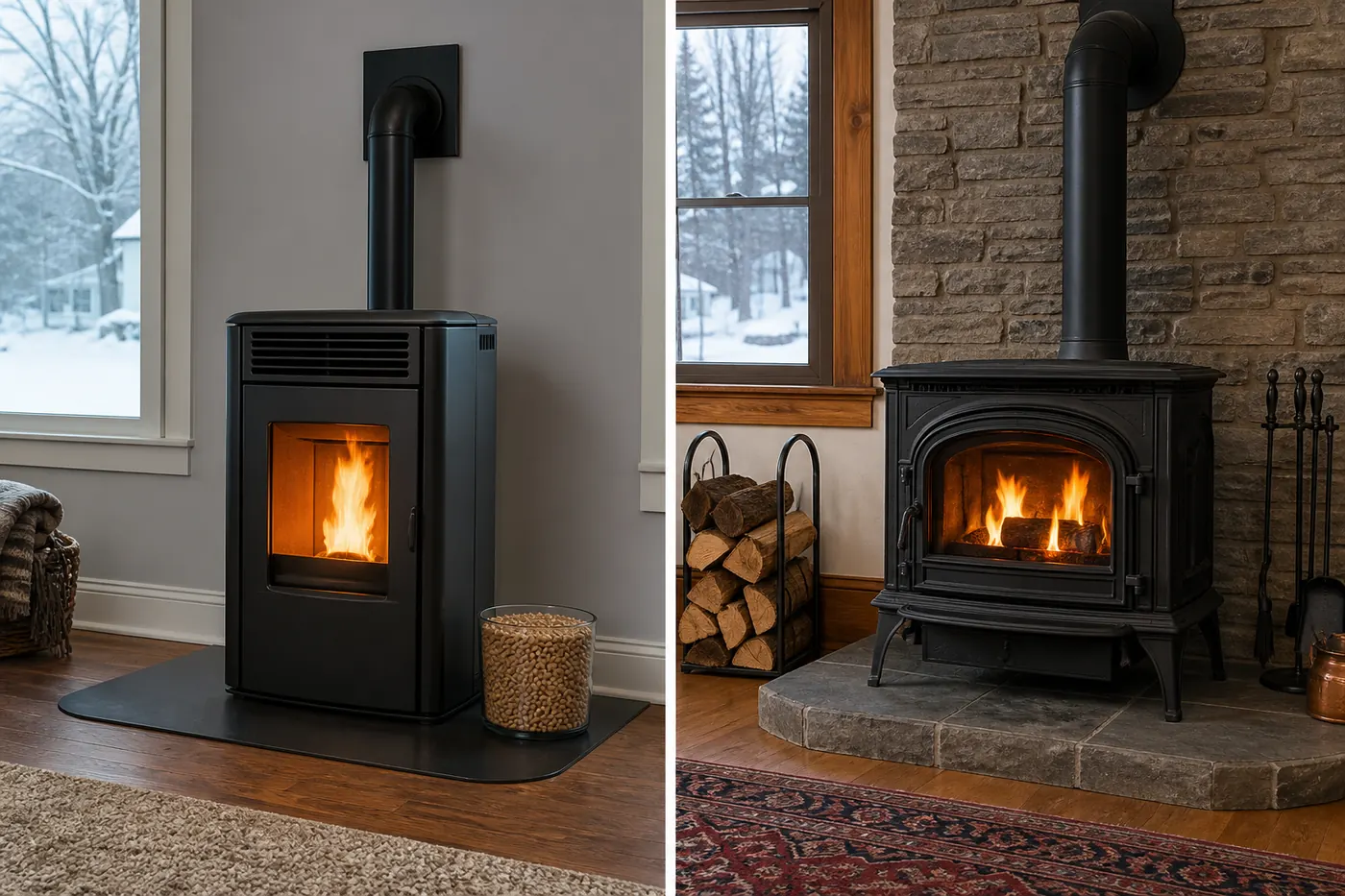
Choose a pellet stove if you want steady, automatic heat and can count on electricity. Choose a wood stove if you want a simple machine that works in an outage and you have room to store and dry firewood. Either way, the chimney or vent behind it matters as much as the stove, so start with an inspection, which is $49 and credited toward approved repair work.
How the two stoves differ
A wood stove burns split logs that you load by hand. Air flows in by natural draft, so the stove needs no power to run. A pellet stove burns small compressed pellets that are fed from a hopper by a motorized auger, with fans moving air in and out. That feed and those fans need electricity.
The result is two quite different ways to live with a stove. A wood stove is a hands-on, old-school machine with a lot of heat. A pellet stove runs more like an appliance, with a thermostat or controls and a steadier output. Neither is automatically better. It depends on your house, your habits and your tolerance for chores.
There is also the question of what you are heating. A stove is usually a room or a zone heater, not a whole-house system. In a small rowhouse or a single floor of a triple-decker, one stove in the main living space may carry a lot of the load. In a larger or divided layout, heat may stay in one room, and you may still need your regular heating system for the rest.
Side by side
| Question | Pellet stove | Wood stove |
|---|---|---|
| Fuel | Bagged pellets | Split, dry firewood |
| Power needed | Yes, for auger and fans | No |
| Heat control | Steady, set by controls | Set by how you load and run it |
| Daily effort | Fill the hopper, empty ash | Load logs, tend the fire, empty ash |
| Storage | Bags, easy to stack | A large dry woodpile |
| Venting | Often small-diameter pipe | Usually a full chimney or liner |
| In an outage | Stops without backup power | Keeps running |
Prices of the stoves themselves vary by model, so they are quoted after we see your home. The flue work behind them has clearer ranges, covered below.
What matters in a Boston home
Greater Boston has cold winters, nor'easters that can knock out power, and many older brick homes, rowhouses and triple-deckers with limited space. Those facts shape the choice.
- Power outages. A storm that cuts power also stops a pellet stove. A wood stove keeps heating. Some owners add a battery backup for a pellet stove, which you should discuss with the installer.
- Storage. Cordwood needs a dry spot with air around it. In a city lot or a small yard, that can be hard. Pellets stack in a closet or basement. Firewood needs time to dry before it burns well.
- Delivery and access. Narrow streets and no driveway can make a cord of wood a project. Bagged pellets can be carried in.
- Existing chimney. An old masonry chimney may have a damaged or unlined flue that needs work before either stove goes in.
The chimney or vent comes first
The stove label and the manufacturer's manual tell you what venting it needs. Those instructions, not a general article, decide what is allowed. In many cases a wood stove connects to a chimney with a proper stainless steel liner, and a pellet stove vents through a small sealed pipe. Some pellet stoves can vent through a wall, and some use the chimney.
Before choosing, find out:
- Whether your existing flue is sound, clear and the right size
- Whether it needs a liner, which is a metal or ceramic tube inside the chimney
- What clearances the stove needs to walls, floors and furniture
- Whether the floor needs a protective hearth pad
An old fireplace flue was built for open fires, not stoves, and a stove can run hotter and leave different deposits. A chimney inspection checks the condition and tells you what is needed. Typical liner work in Boston runs $1,500 to $4,500 for a replacement, $1,200 to $2,500 for a repair, and from $2,000 for venting. See the chimney relining cost guide.
Permits, rules and your insurer
Stove installations are often covered by local building rules and by your insurance. We do not list specific rules here because they vary by town and change over time. What you should do:
- Call your local building department before buying and ask whether a permit or inspection applies
- Check whether your town or condo association has rules about wood smoke or stove types
- Tell your insurance agent before the stove goes in, and ask what they require
- Keep the manual, labels, permit and inspection records
If you live in a historic district or a shared building, ask about those rules too. Installing a stove without confirming the rules can lead to a failed inspection or a denied claim, which is far more expensive than asking first.
Upkeep: what each stove asks of you
Neither stove is maintenance-free. A wood stove needs regular chimney sweeping because wood smoke deposits creosote, which is flammable. A pellet stove burns cleaner but still builds ash and soot, and its fans, auger and vent need cleaning on a schedule. Follow the manufacturer's directions for both.
- Wood stove: an annual sweep and inspection, dry wood only, ash removal into a metal container kept outside, and a check of the door gasket and baffle.
- Pellet stove: regular hopper and burn pot cleaning, a periodic deep clean, and a look at the vent pipe for blockage.
NFPA 211 recommends a yearly inspection for any chimney or vent. A chimney sweep with inspection is $299 fixed. If a stove needs service, see fireplace repair.
Questions to ask before you approve a stove
Whoever sells and installs the stove should be able to answer these in writing. If they cannot, pause.
- Which exact model and manual will be used, and what venting does it call for?
- Does my current chimney need a liner, repairs or cleaning first, and what would that cost?
- What clearances and floor protection are needed in my room?
- Who pulls any permit, and who schedules any inspection?
- What happens to the heat and the warranty if the stove is used outside the manual?
- What yearly maintenance does the manufacturer require?
Chimney work tied to a stove, such as a liner, is quoted in writing after the $49 inspection. We do not guess a number before the flue has been seen.
Which one fits you
A pellet stove tends to suit you if:
- You want even, thermostat-like heat
- You have little space for firewood
- You will keep power on or add backup
A wood stove tends to suit you if:
- You want heat that survives a blackout
- You have a dry place for cordwood and the time to tend a fire
- You like a simple machine with few parts to fail
If you are not sure, the chimney can settle some of the question for you. A sound, correctly sized flue leaves both options open, while a damaged one may push you toward one type or add cost to both.
Book the $49 inspection first, then choose the stove. Call (617) 404-9587 or book at /contact/, and the written price comes before any work.
Questions homeowners ask
Can I put a pellet stove in my existing fireplace?
Sometimes. Many pellet stoves vent through a small pipe that runs up the chimney, but the flue must be inspected first. The manufacturer's manual decides what is allowed, and your building department may need to approve it.
Which stove is cheaper to run?
That depends on local fuel prices, how much you burn and how efficient the stove is. We cannot give a figure. Compare the cost of pellets by the ton and firewood by the cord at the time you buy.
Does a wood stove need a liner?
Often, yes, when it connects to an older masonry chimney. A liner helps keep smoke and heat inside the flue. The inspection shows whether yours has one and whether it is in good shape.
Do pellet stoves need a chimney sweep?
They need cleaning, and the vent pipe should be inspected too. How often depends on the model and how much you burn. Follow the manual and have the vent looked at yearly.
What happens to a pellet stove in a power outage?
Most stop feeding pellets and cool down, and the fans stop. Some owners add a battery backup. Ask the installer about options before you buy, since a Boston nor'easter can cut power for a while.