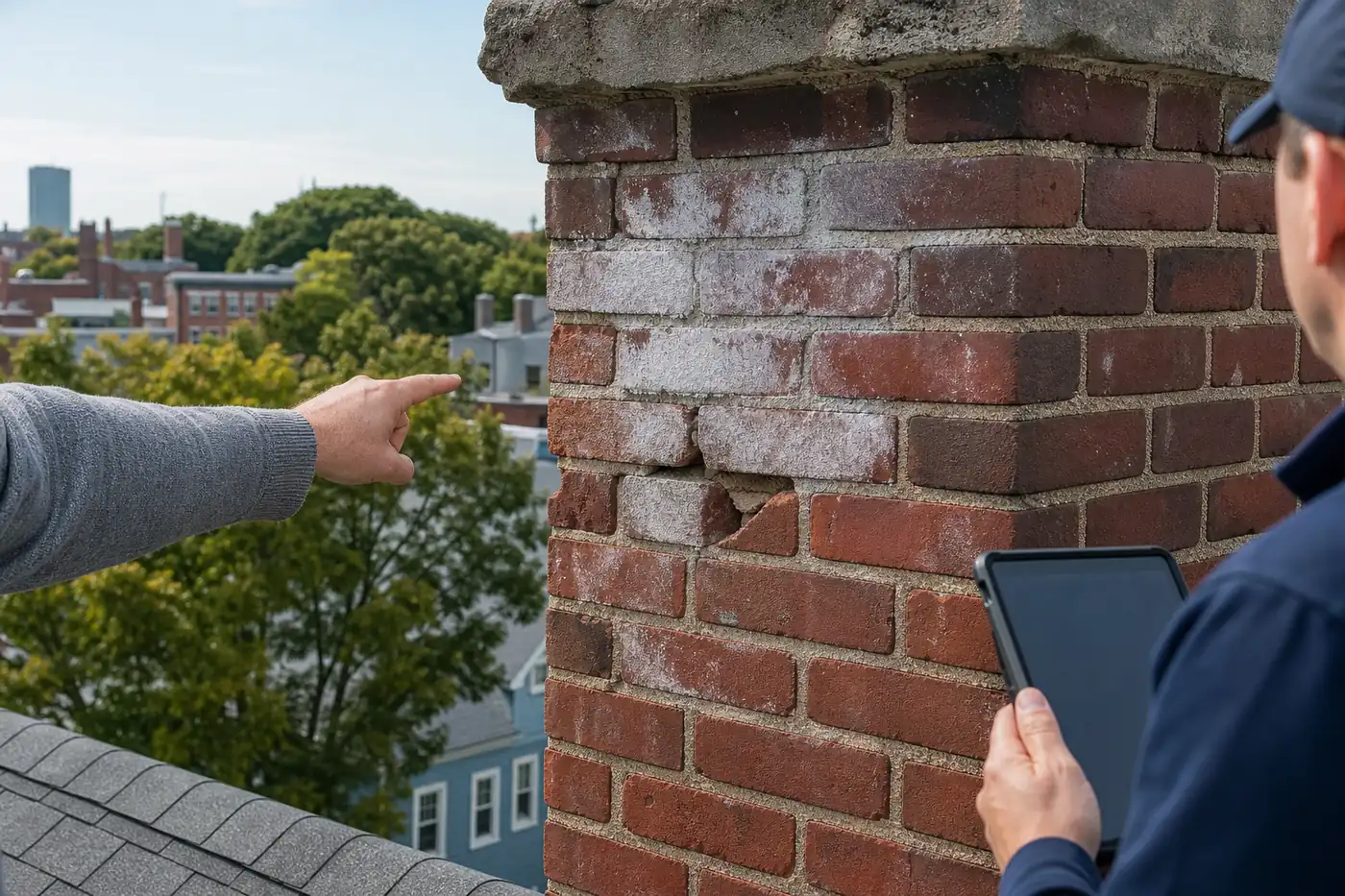
The most common signs are crumbling mortar, flaking brick, water stains near the chimney, rust, a cracked crown, a musty or smoky smell, and smoke entering the room. Some can wait for a scheduled visit. Others mean stop using the fireplace now. A general inspection is $49 and is credited toward approved repair work.
Sort what you see into urgent and not urgent
Not every flaw is an emergency, but a few are. Sorting them first tells you how fast to act.
Stop using the fireplace and call
- Smoke coming into the room while a fire burns
- A carbon monoxide alarm going off. Leave the house and call 911.
- A chimney that has visibly shifted, leans, or has bricks falling from it
- Signs of a chimney fire, such as roaring noise or flames at the top. Leave and call 911.
Book an inspection soon
- Water stains on a ceiling or wall near the chimney
- Crumbling mortar, loose bricks or a cracked crown
- Rust on the cap, damper or firebox
- A damp or musty smell that gets worse after rain
Keep an eye on it
- A hairline crack in mortar with no other symptoms
- A small patch of white powder on the brick
When in doubt, photograph what you see and have it looked at. It is easier to fix a small problem than a big one.
Remember that several signs often travel together. A cracked crown can let water into the joints, the wet joints erode, the brick flakes, and a few months later a stain appears on the bedroom ceiling. By the time the stain shows, the damage may already have been underway for a full winter, so a visible sign is a reason to look sooner rather than later.
Warning signs you can see from the yard
Your first look should be from the ground, with binoculars or a phone zoom. Do not go on the roof.
- Mortar that is sandy, recessed or missing. The lines between bricks should be firm and flush. When they erode, water gets into the wall. This is what repointing fixes.
- Bricks with flaking or peeling faces. This is called spalling. It usually means water is freezing inside the brick.
- A stack that leans or bows, or a gap between the chimney and the house.
- White, chalky streaks or patches. These are mineral salts left behind as water dries out of the brick, a sign of too much moisture.
- Rust stains running down the side. The cap, a metal chase cover or a pipe above may be failing.
- Plants or moss growing on the chimney. Constant dampness feeds them.
Our chimney repair page walks through the typical fixes for each of these.
Signs at the top: crown, cap and flashing
The top of the chimney takes the most weather, so trouble often starts there.
The crown
The crown is the sloped slab that caps the brick and sheds water. Cracks in it let water run down inside the masonry. A crown repair is $300 to $900, and a rebuild is $900 to $2,500.
The cap
A cap that is tilted, rusted, missing or has a torn screen no longer keeps rain and animals out. Standard caps are $300 to $700.
The flashing
Flashing is the metal seal where the chimney meets the roof. If it lifts, rusts or has gaps, water runs behind it into the house. Flashing repair is $200 to $400, partial replacement $400 to $800, and a full job $800 to $2,500.
These three parts are small compared with the whole stack, but they decide whether the rest stays dry.
Signs inside the house
Sometimes the clues show up indoors long before anything is visible outside.
- Water stains or bubbling paint on the ceiling, wall or attic around the chimney. See chimney leak repair for how leaks are traced.
- A damp, earthy or musty smell from the fireplace, especially after rain or on humid days.
- A strong tar-like odor. That can be creosote warming up in summer.
- Soot or smoke stains on the wall above the fireplace opening, which can mean poor draft.
- Debris in the firebox, such as bits of brick, tile pieces or mortar crumbs.
- A damper that rusts, sticks or will not close, letting cold air or water in.
- Poor draw, where the fire is hard to start or smoke rolls into the room.
If the stain spreads, grows after storms or smells worse over time, treat it as more than cosmetic.
What each sign usually points to, and what it costs
This table gives Boston planning ranges. The real price comes in writing after the technician sees your chimney.
| What you notice | Likely cause | Typical repair range |
|---|---|---|
| Crumbling mortar | Worn joints | Repointing $300 to $700 partial, $700 to $2,500 full |
| Flaking brick | Freeze-thaw damage | Masonry repair $300 to $700 basic, $700 to $2,500 standard |
| Cracked top slab | Crown wear | Crown repair $300 to $900 |
| Leak at the roof line | Flashing failure | $200 to $2,500 by scope |
| Damp or musty smell | Water entering | Leak repair $400 to $3,000 |
| Tar smell, heavy soot | Creosote buildup | $299 to $450 for stage 1 |
| Broken flue tile | Cracked liner | Liner repair $1,200 to $2,500 |
Our chimney repair cost guide explains how scope changes these ranges.
Why Greater Boston chimneys show wear early
Our climate puts steady stress on masonry. Winters bring repeated freezing and thawing, snowmelt that keeps brick wet, and wind-driven rain from nor'easters. Coastal air brings salt, which can speed up deterioration.
Many homes here are older brick buildings with soft mortar and tall exposed chimneys. Triple-deckers, rowhouses and brownstones often have several flues in one stack, so a single failing area can affect more than one unit.
Water is the root of most chimney trouble. A small opening in the crown, joint or flashing might look minor outside but cause much larger damage in the attic and walls. That is why we ask you to treat staining and dampness seriously, even if the fireplace works fine. If you rent or own one unit in a shared building, tell your landlord, co-owners or association as well, since the chimney is often common property and a repair may need everyone's agreement.
What to do today
- Photograph everything you notice with the date and conditions, such as after rain or during a freeze.
- Do not use the fireplace if smoke enters the room or an alarm has sounded.
- Check that smoke and carbon monoxide alarms work.
- Do not climb on the roof and do not try to patch it yourself.
- Write down when the sign appears: only after rain, only when the fire is going, or all the time.
- Book an inspection.
The timing detail in step five helps the technician a great deal. A stain that shows only after storms points to water. A smell that shows only with the fire points to venting.
The $49 general inspection is credited toward approved repair work, and you get photos and a written price before you decide. Book at /contact/ or call (617) 404-9587.
Questions homeowners ask
Is a small crack in my chimney mortar something to worry about?
A hairline crack alone is usually something to watch. Photograph it and check it again after winter. If it widens, crumbles or comes with stains inside, have it inspected.
Why does my fireplace smell worse when it rains?
Rain can push damp air and moisture down the flue, which brings up the smell of old creosote and wet masonry. It can also mean water is getting in. An inspection can find the source.
Are white stains on my chimney bricks dangerous?
The stains themselves are not dangerous. They show that water is moving through the brick, and that water can cause damage over time. Have the source found.
Can I use my fireplace if the chimney has a leak?
It depends on the cause. If smoke enters the room or the flue is damaged, stop. If you are unsure, do not use it until it has been inspected.
How often should I have my chimney checked for these signs?
NFPA 211 recommends a chimney inspection at least once a year. Also look it over after severe storms and hard freezes, since new damage often shows up then.