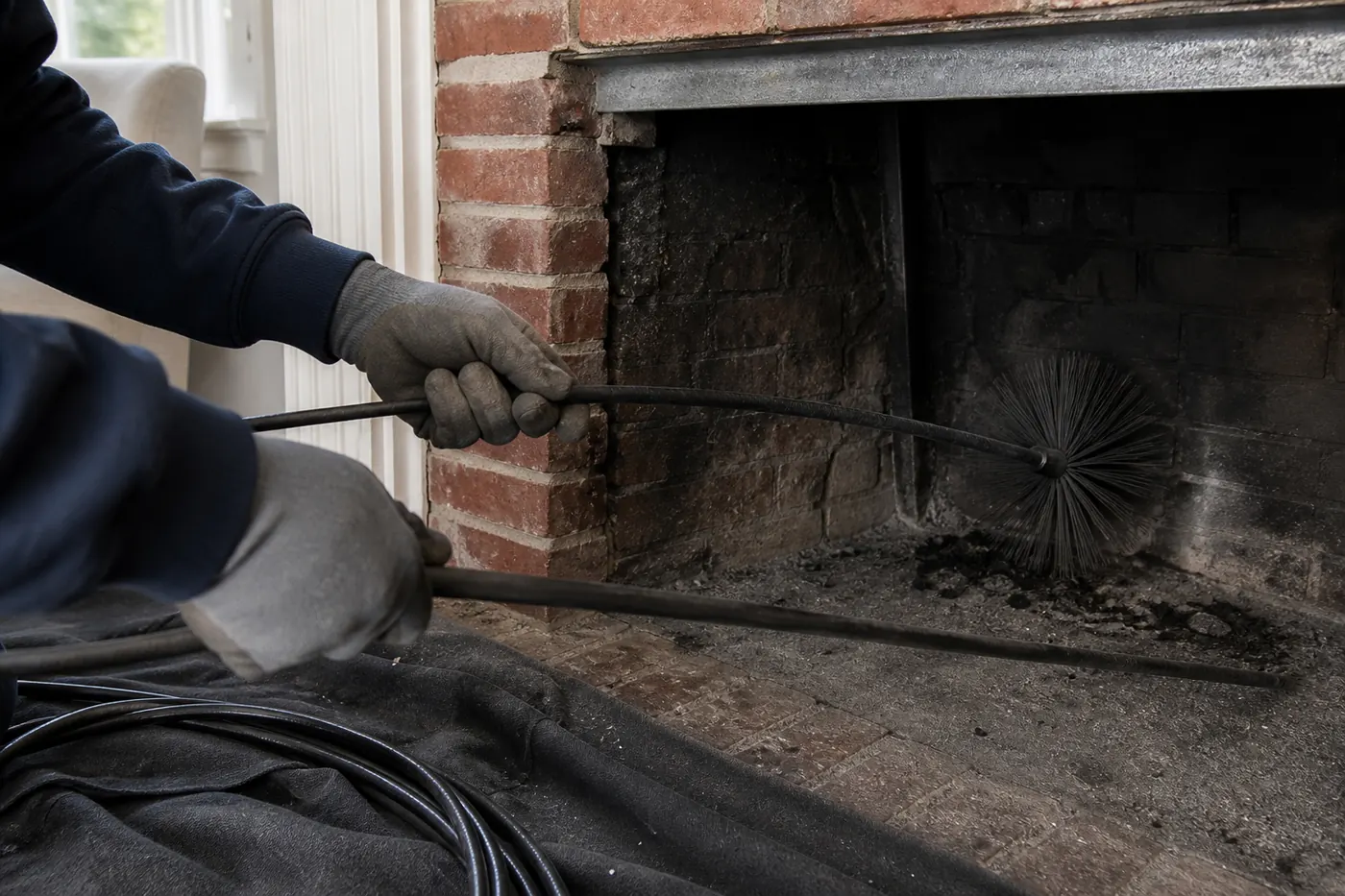
You repair an antique chimney by matching it, not by modernizing it. Soft old brick and lime mortar need gentle, compatible repairs, and the flue hidden inside usually needs more attention than the bricks you can see. A $49 inspection, credited toward approved repair work, shows which parts are worth saving and gives you a written price before anything starts.
Why an old chimney is not a small new one
Many antique homes were built around a large central chimney, often with several fireplaces stacked on a single mass of brick. The fireplaces were designed for open fires, not for the stoves, inserts and gas appliances people install today. That mismatch is the root of most surprises.
Old masonry also moves differently. Brick fired at lower temperatures is softer and absorbs more water. Mortar made from lime is softer still, and it was meant to be. It flexes a little and gives up its surface before the brick does. When you understand that design, repair choices make sense: you protect the brick by letting the mortar be the sacrificial part.
Greater Boston adds weather on top of age. Cold winters, freeze-thaw cycles and wind-driven rain all work on soft brick. A chimney that stood for generations may now be failing because of one bad repair made decades ago, not because the whole structure is tired.
Reading the age of the masonry from what you can see
You can learn a lot from the ground or from a window before anyone climbs a ladder. Look at the brick faces, the joints, and the top of the chimney, and notice where the material changes.
- Uneven, softly colored brick with wide, sandy joints usually points to original work.
- Hard gray mortar smeared over old joints is a later patch, often cement-heavy.
- A different brick color near the top suggests the upper section was rebuilt at some point.
- Shiny metal at the flue opening means a liner or a cap was added more recently than the brick around it.
Then build a timeline. Collect old receipts, past inspection reports, listing photos and anything the previous owners left behind. Write down when you first noticed stains, crumbling or smoke, and what changed shortly before: a new roof, a new furnace, a new stove. That history helps separate a slow old problem from a recent cause, and it keeps you from paying to fix the wrong thing.
Why the wrong mortar does so much damage
The most common harm to antique brickwork is a well-meant repair with the wrong mortar. Modern cement-rich mortar is harder than old soft brick. Water still has to leave the chimney, and when the joints will not let it out, it exits through the brick faces. The faces then flake and pop off, the damage known as spalling.
The fix is to test before you commit to broad work. A careful contractor looks at the hardness of the existing mortar, the condition of the brick, and the pattern of the joints, then chooses a mix that is the same strength or softer than the brick. They also match joint width and tooling so the chimney still looks like itself.
Plan on chimney repointing being done in stages if the problem is limited. Partial repointing runs $300 to $700 and full repointing runs $700 to $2,500.
The flue behind the old brick
Antique chimneys often have no liner at all, or a clay tile liner that has cracked over the years. A flue like that may have been fine for an open fireplace and unsafe for what is now connected to it. Do not assume the original construction suits a modern appliance.
What the flue needs to be checked for
- Cracked or missing tile, and gaps between sections.
- Loose mortar joints inside the flue where smoke or fumes could reach wood framing.
- A size that does not match the stove, insert or boiler hooked up to it.
- Old patches that were never recorded.
What a fix looks like
A stainless steel liner is the usual answer when a flue is cracked or oversized. Liner repair is $1,200 to $2,500, and replacement is $1,500 to $4,500. Our chimney relining page explains the options, including how each type is installed.
If smoke enters a room, or you smell smoke when the fireplace is not in use, stop using the fireplace and have it checked. If you see flames or smoke from anywhere other than the top of the chimney, leave the house and call 911.
Preserve, repair or rebuild: where to draw the line
The honest answer is usually the smallest scope that solves the cause. Broad replacement should not be the default. Here is how the three levels differ on an antique chimney.
Preserve
Sound brick and sound mortar stay as they are. You keep the chimney clean, keep water out with a cap and a good crown, and monitor it. This is the right call for brick that is stable, even if it looks worn.
Repair
Limited areas of loose joints, cracked brick or a failing crown are repaired and matched to what remains. Basic masonry repair is $300 to $700, standard is $700 to $2,500, and major work starts at $2,500. See masonry repair for what the work includes.
Rebuild
When brick is loose, displaced or crumbling through its thickness, rebuilding the damaged section is safer than patching it. A partial rebuild is $2,000 to $4,500 and a full rebuild is $4,000 to $10,000 or more. Ask whether sound brick can be saved and reused so the chimney keeps its character.
What antique chimney work costs around Boston
These are Boston prices for the work most old chimneys need. Anything not listed is quoted in writing after the $49 inspection.
| Work | Typical price |
|---|---|
| Inspection (credited toward approved repairs) | $49 |
| Cleaning with inspection | $299 |
| Partial repointing | $300 to $700 |
| Full repointing | $700 to $2,500 |
| Masonry repair, basic to standard | $300 to $2,500 |
| Liner repair | $1,200 to $2,500 |
| Liner replacement | $1,500 to $4,500 |
| Partial rebuild | $2,000 to $4,500 |
| Full rebuild | $4,000 to $10,000+ |
Where a price lands inside a range depends on height, roof pitch, access, how much sound material can stay, and how closely new brick and mortar must match the old. For a wider view of repair pricing, see the chimney repair cost page and the general chimney repair service.
What to ask before anyone touches the brick
A few questions protect an old chimney from a quick, wrong fix.
- What mortar will you use, and how will you confirm it is not harder than my brick?
- Which parts are you proposing to keep, and which to take down?
- Will new brick or mortar be matched to the old in color and joint width?
- What will the flue look like after the work, and is it suited to the appliance I use?
- What is in writing, with photos, before work begins?
If your house sits in a local historic district or carries a preservation restriction, confirm with your local historic commission and building department whether exterior chimney work needs approval before you schedule. Rules differ from town to town and change over time, so ask rather than assume. Your insurer or agent can tell you how an older chimney affects coverage.
When you are ready, book the $49 inspection at our contact page or call (617) 404-9587, and you will get photos of what the technician finds and a written price before any work starts.
Questions homeowners ask
Can I use a fireplace in a house that is a couple of hundred years old?
Often yes, but only after the flue has been inspected. Old chimneys can have cracked or missing liners and loose mortar inside, and those defects are not visible from the room. Start with a $49 inspection before the first fire of the season.
Is it better to rebuild a crumbling antique chimney than to repair it?
Not automatically. Repair is reasonable when the surrounding brick is stable. Rebuilding makes more sense when units are loose, displaced or crumbling through their thickness. The inspection photos should show which situation you have.
Why did my repointed joints fail so quickly?
Mortar that is harder than the brick, or joints filled without removing enough of the old mortar, can fail early or push damage into the brick faces. A proper repair uses a compatible mix and cuts the joints out to a proper depth first.
Do I need to keep original bricks when the top of the chimney is rebuilt?
No rule says you must, but reusing sound brick can keep the chimney's look. If you want that, ask for it in the written scope. If your home is in a historic district, check with the local historic commission first.
Will a new stove work in my old chimney?
It depends on the flue. A stove usually needs a liner sized to it, and an old unlined flue is not suitable. Have the flue evaluated before you buy any appliance, and follow the appliance maker's venting instructions.