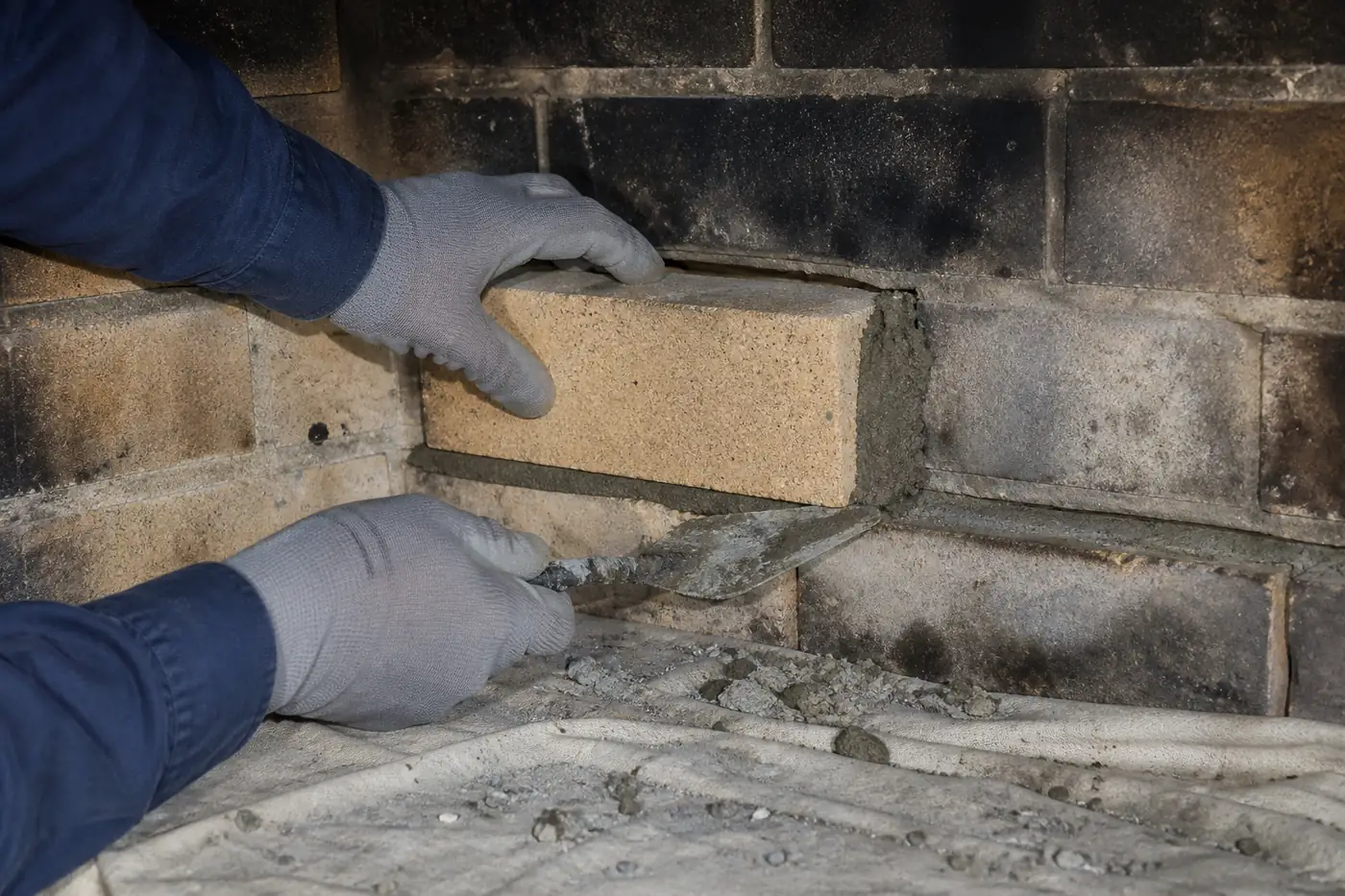
Firebox repair in Boston costs $350 to $900, depending on whether the work is a few joints, a handful of replaced firebrick, or a section of wall rebuilt. The firebox is the brick-lined chamber where the fire actually burns, and its job is to hold that heat away from the framing and masonry around it. A cracked or open firebox is easier and cheaper to fix early, and a $49 chimney inspection, credited toward approved repair work, shows you where it stands.
- Firebox repair in Boston runs $350 to $900, with the scope and price written down first.
- The firebox is the lined chamber where the fire burns, so its brick and joints take the most heat.
- Open joints and cracked firebrick are common, and small ones are the cheapest to fix.
- The $49 inspection is credited toward approved repair work.
What the firebox does and how it wears out
The firebox is the part of the fireplace you look at every time you light a fire. Its floor and walls are made of firebrick, a dense brick made for high heat, laid with thin joints of refractory mortar. Its job is to take the flame, hold the heat and keep it away from the structure that surrounds it.
That is a hard job, and it wears the lining. Every fire heats the brick and every cool-down shrinks it again, and over many winters that cycle opens joints and cracks bricks. Logs thrown in hard, poker blows and dropped tools chip faces. Moisture from a leaking crown or missing cap soaks into the lining and expands when it freezes, which is a real issue in Greater Boston, where freeze-thaw cycles are part of every winter. Past repairs done with the wrong mortar fall out because ordinary mortar is not made for this kind of heat.
A firebox does not fail all at once. It loosens slowly. A joint opens, a brick cracks, a small piece falls out, and the damage gets a little bigger with each fire. That is why a modest repair now is usually worth more than waiting for a larger one later.
The firebox sits next to the damper and the smoke chamber above it, and the three often share problems. This page covers the lower chamber, and the two parts above have their own pages: chimney damper repair and smoke chamber repair.
Signs your firebox needs repair
Firebox damage is visible, which makes it easier to catch than damage higher up. Look at the back and side walls and the floor with a flashlight when the fireplace is cold.
- Open joints between firebrick. You can see a dark line, or you can slide a thin object into the gap between two bricks.
- Loose or missing mortar. Grit on the hearth, or a joint that is hollow where mortar used to be.
- Cracked or spalled firebrick. A crack that runs through a brick, or a face that has flaked off in layers.
- A wall panel that has shifted. Part of the back or side wall sits out of line with the rest, or leans.
- Patches that keep falling out. A previous repair with ordinary mortar has cracked and dropped.
- Damage that runs up toward the throat or the lintel. The cracking is not staying in the lower bricks but reaching the area above the opening.
Hairline cracks are common and not always a problem. A fine crack in a brick that is firmly in place can stay as it is for a long time. What deserves attention is a gap you can see through, a brick that moves when touched, and any crack that is growing or is paired with loose material.
Do not scrape or dig at a crack to see how deep it goes. Prodding a sound crack can turn it into a loose one. Photograph it with your phone instead, and the technician will examine it properly.
What the technician checks in the firebox
A firebox inspection is hands-on, and it starts with cleaning, because soot hides cracks.
- Clean enough soot to see the joints. The walls and floor are brushed back so the joints and the faces of the bricks are visible. A heavy soot layer can make sound joints look bad and hide bad ones.
- Probing loose material. The technician tests suspect spots by hand, working carefully. The goal is to remove what is already loose without enlarging a crack that was holding.
- Replaceable firebrick or structural masonry. The firebrick lining is a replaceable skin. The masonry behind it carries load. The technician tells you which one you are looking at, because the repair is completely different.
- The lintel and the throat transition. The lintel is the beam above the fireplace opening. If damage runs toward it, or toward the point where the firebox narrows into the smoke chamber, the problem may be larger than the lining.
- Cure time. Before the work starts, the technician defines when the fireplace can be used again, so you can plan around it.
You get photos of the findings and a written price. If the lining is sound and only needs a light touch, you hear that too.
Repairing open and loose joints
The first repair level is the mortar joint, and it covers the most common firebox complaint.
Localized refractory joint repair
The loose or crumbled mortar is raked out of the joint to a firm edge. The gap is cleaned and then filled with a refractory mortar, one that is formulated for fireplace temperatures. The patch is shaped to match the surrounding joints so that it does not leave a ridge that catches ash or wood.
Why the mortar type matters
Ordinary mortar is fine in a garden wall. In a firebox it shrinks, cracks and falls out within a short time. If you have had a patch fail before, the likely reason is that the wrong material went into it. Using the right mortar is the difference between a repair that holds through winters of use and one that has to be done again.
When joint repair fits
This is the right job when the bricks themselves are sound and the problem is confined to the joints. It is the least expensive path and sits at the lower end of the $350 to $900 range. It also pairs well with repointing the outside of the chimney, if that needs the same treatment, since a failing joint outside can mean water reaches the lining inside.
The repair is quiet work. The technician rakes, brushes, fills and tools each joint by hand, and the fireplace looks better afterward because the lining reads as one surface again instead of a wall with dark seams. You can see the result right away, even though the mortar still needs time before it takes heat.
Replacing cracked or spalled firebrick
When the brick itself has failed, joint repair is not enough. A brick with a crack through it, or a face that has flaked away, no longer protects what is behind it.
Individual brick replacement
The damaged brick is carefully cut and chipped out, the cavity is cleaned and a replacement firebrick is set in a bed of refractory mortar. The joints around it are finished to match. Because firebrick is a standard material, replacing one or several bricks is a contained job that does not disturb the wall around it.
Why the neighbors matter
One bad brick is often a sign of its neighbors. The technician checks the bricks around it and the joints between them before deciding whether to replace one or several. Replacing a single brick in a wall of tired ones can look like a fix and then fail, as the next brick over cracks in the same way.
Matching and fit
Firebrick comes in standard sizes, but fireplaces are not always standard. An older firebox may have bricks laid in a pattern or at a slight angle, and the replacement has to fit that. The written scope names how many bricks are being replaced, so you can see what the price covers.
Rebuilding part of the firebox
Sometimes the damage is bigger than a few bricks. A section of wall has shifted, or an area of the floor has broken up, or a patch of lining has lost its bond to the masonry behind.
Partial wall or floor rebuild
The affected section is taken apart, the base is checked and the area is rebuilt course by course with firebrick and refractory mortar. This is more labor and more materials than a repair, and it lands in the middle to upper part of the $350 to $900 range.
Full firebox reconstruction
If the bricks are unsound across the whole chamber, patching section by section only delays the full job. In that case the technician will recommend rebuilding the lining. That is a larger project and it may be quoted outside the range on this page, in writing, after the $49 inspection. It is the exception, not the usual case.
Tie-in to the smoke chamber
A rebuilt firebox has to meet the smoke chamber above it cleanly. If the join is rough or open, smoke and heat find the gap. The technician checks the transition as part of the work, and the lining is tied in so the two parts form one passage.
Planning matters on a bigger job. The fireplace cannot be used while the rebuilt section cures, so it is better to schedule it for the warm months or before the cold weather sets in. The technician tells you the wait before work starts, and you can decide whether the timing suits you. A rebuild is also the point where the written scope matters most, because it lists exactly which walls or floor sections are being taken down and what stays.
If your problem started with a smoking fireplace and you see firebox damage as well, ask whether both need work, because they can feed each other.
Is the damage cosmetic, or does it affect safety
Not every crack is an emergency, and not every sound joint is safe. The way to tell is to ask what the damage lets heat do.
- Cosmetic: hairline cracks in firmly set brick, light surface flaking, soot stains and discoloration. These can be watched and photographed.
- Worth repairing soon: open joints, loose mortar, a cracked brick that moves, and patches that keep falling out. These let heat past the lining and get larger with use.
- Serious: a shifted wall panel, a gap you can see through, or damage reaching toward the lintel or the throat. The firebox is no longer doing its job of holding the fire, and you should not use the fireplace until it has been looked at.
Why does it matter? Behind the firebrick is common brick and then framing in many houses, and those parts were never meant to take flame or direct heat. A firebox with open joints can pass heat through to them. The effect builds up slowly and you may not notice it, which is the reason to look at the lining before the problem shows up in a wall.
If you see scorch marks on the wall beside the fireplace, a smell of smoke from the wall when the fireplace is in use, or heat on a surface that should be cool, stop using the fireplace and book a visit. If anything smoulders or you see flames outside the firebox, leave the house and call 911.
Firebox repair price in Boston
This is the price range for the service, and no work starts before you approve the written scope.
| Service | Boston price | Notes |
|---|---|---|
| Firebox repair | $350 to $900 | Joint repair, replacement of damaged firebrick, or a section of the lining rebuilt |
| General chimney inspection | $49 | Credited toward approved repair work |
Where you land in the range depends on how many joints or bricks are involved, how far into the fireplace the technician has to reach and whether the damage is limited to the lining. A whole-firebox reconstruction, or damage that extends into the masonry behind the lining, is quoted in writing after the $49 inspection rather than guessed at here.
If your fireplace needs several repairs, the technician can put them on one written estimate so that you see the whole picture and can decide the order.
The visit, preparation and cure time
Scheduling is at /contact/ or on (617) 404-9587. You get a three-hour arrival window, and we call before the technician heads to you.
How to prepare
Do not burn a fire for a day or two before the visit, so the firebox is cool and the soot is dry. Take out the grate, the screen and any logs. Clear the hearth. Move furniture and rugs back from the opening. If you have noticed specific damage, point it out so the technician can start there.
During the visit
The technician cleans enough to see, examines the lining and shows you photos. You receive a written price. If you approve the work, small repairs are often done during the same visit.
Cure time before the next fire
Fresh refractory mortar has to harden before it takes heat. The technician defines the wait for your job before work starts, since it depends on the material and how much was repaired. Keep to it. A fire lit too soon can crack new joints, and you will pay for the repair again.
Ongoing habits
Build fires on the grate rather than dropping logs in hard, and keep ash in check so it does not trap moisture against the brick. Have the fireplace looked at once a year, which is what NFPA 211 recommends for chimneys, and small joint problems get caught early.
Firebox repair or a wider fireplace problem
If the firebox is in trouble, it is worth asking whether something else is the cause. Water from a failing crown or an open flue top can soak the lining from above. A fireplace that is used for a long time with a poor damper or a rough smoke chamber can see heat behave in odd ways. In older Boston houses, a lining may also have been repaired many times with the wrong material.
The technician looks at the whole fireplace on the visit so the repair does not treat a symptom. If the firebox repair is part of a larger set of masonry repairs, the page on masonry repair covers the outside and structural side.
Gas fireplaces and gas log sets have their own repair path, which is covered under fireplace and gas fireplace repair. Gas line work belongs to the gas utility or a licensed gas fitter.
If you have open joints, a cracked brick or a patch that will not stay put, book a $49 chimney inspection or call (617) 404-9587, and you will see photos of the firebox and a written price before any repair begins.
Questions homeowners ask
Is it safe to burn a fire with cracks in the firebox?
Hairline cracks in firmly set brick are common and often acceptable. Open joints, loose brick or a gap you can see through are different, because they let heat reach the structure behind the lining. Stop using the fireplace until it has been inspected.
Can I patch firebox joints myself with hardware store mortar?
Ordinary mortar breaks down under repeated fires and will fall out again. The joints need a refractory mortar made for fireplace heat, and they need to be raked and cleaned first. A failed home patch is a common reason people call us.
What is the difference between firebrick and regular brick?
Firebrick is a dense, heat-resistant brick used to line the firebox. Regular brick is used in the surrounding chimney structure and is not made for direct flame. That is why the lining matters and why it is repaired with different materials.
How do I know if a firebrick needs replacing or just a joint repair?
If the brick is solid and only the mortar around it has failed, a joint repair is enough. If the brick is cracked through or its face is flaking away, it no longer protects what is behind it and should be replaced.
How long should I wait before using the fireplace after a repair?
The wait depends on the mortar used and how much was repaired, so the technician sets it before the work begins. Lighting a fire early can crack fresh joints, so follow the wait you are given.
Does my firebox need to be repaired every year?
No. A sound lining can go many winters without work. What it needs is a yearly look so that small joint problems are caught before they spread.
Related guidance
Start with the Boston cost guide, then read the guides below.
- Chimney Scam Warning Signs for Boston Homeowners
- How to Choose a Chimney Company in Boston, MA
- Is a $49 Chimney Inspection Legit in Boston?