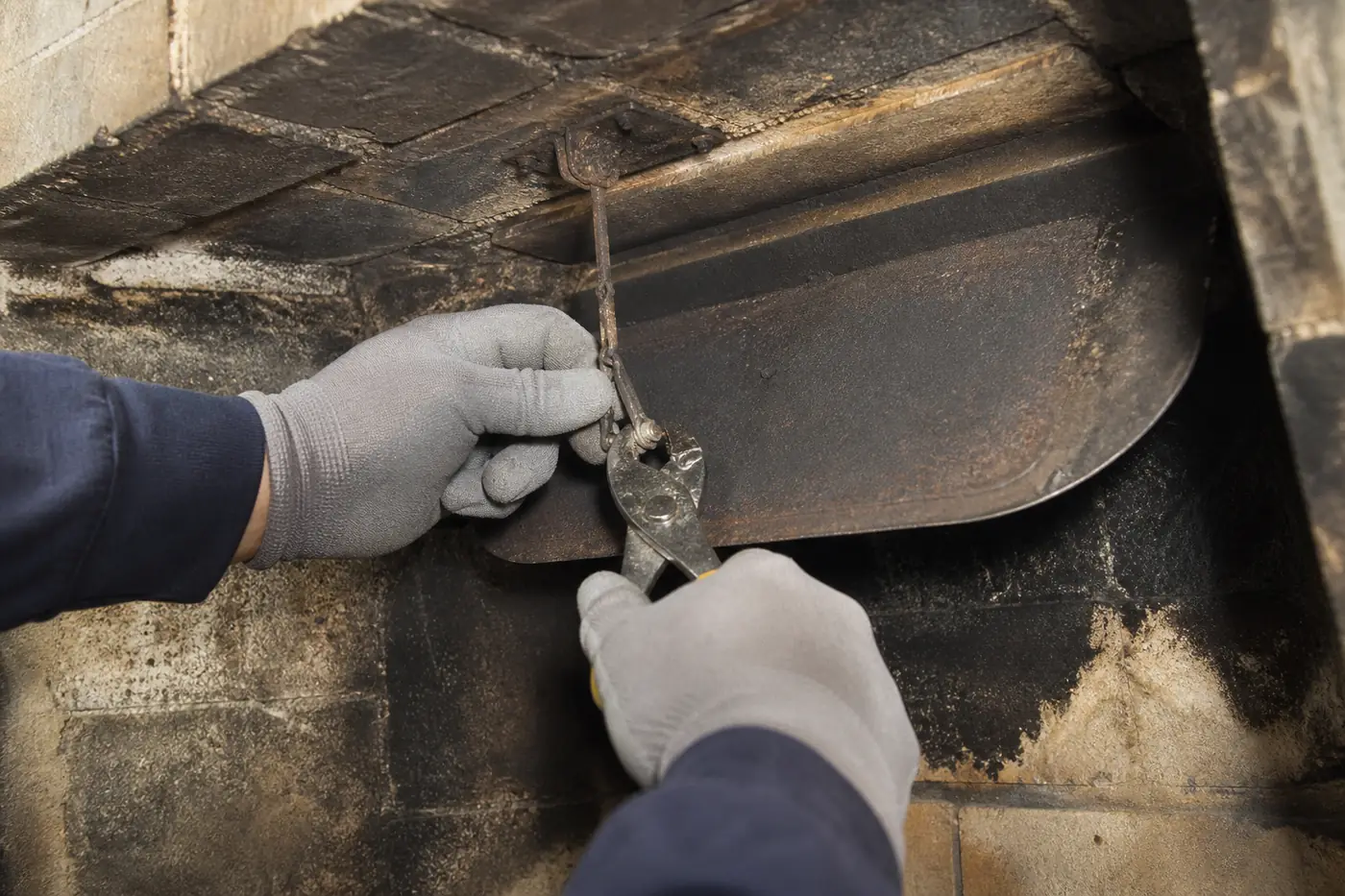
Chimney damper repair in Boston costs $199 to $1,200, and the price depends on whether your damper needs cleaning and adjusting, a new control, or a full replacement. The damper is the metal door that opens the flue for a fire and closes it when the fireplace is idle. If it sticks, leaks air or will not move, the fix is usually smaller than people fear, and we start with a $49 chimney inspection that is credited toward approved work.
- Damper repair in Boston runs $199 to $1,200, set in writing before any work starts.
- A damper that will not close lets heated air out of your house all winter.
- Many damper jobs are a cleaning, an adjustment or a new control, not a full replacement.
- The $49 inspection is credited toward approved repair work.
What a chimney damper does and how it fails
A damper is a movable plate that sits in the flue path of a wood-burning fireplace. Open, it lets smoke and hot gas climb the chimney. Closed, it seals the opening so your warm indoor air does not drain up the flue and cold outdoor air does not fall down it. In a Greater Boston house with a fireplace, that seal matters from November through March.
Dampers fail for ordinary reasons. Heat from the fire warps the plate and the frame around it. Soot and creosote build up on the pivot points and the plate edges and glue the parts together. Rust forms where moisture reaches the metal, which happens often in a chimney with no cap or with a worn one. Mortar from a deteriorating throat can drop onto the plate and jam it. Controls wear out too: a pin shears, a chain snaps, a spring loses its tension.
The result is one of two problems. Either the damper will not open properly, and smoke has nowhere to go but into the room, or it will not close properly, and the fireplace acts like an open window. Both are worth fixing. The first is a safety matter. The second is a comfort and heating cost matter that keeps getting worse.
The damper is also one part of a group of parts that all sit inside the fireplace opening. If the problem turns out to be the masonry above the plate, you may be reading about the wrong page, and our guide to smoke chamber repair covers the tapered section right above the damper.
Throat dampers and top-sealing dampers: which one do you have
There are two common designs, and the repair path depends on which one you own.
The throat damper
This is the older and more common type. It sits low in the chimney, just above the firebox, where the fire opening narrows into the smoke chamber. You work it with a handle, a lever or a rotating knob at the front of the fireplace, usually just inside the opening. Many brownstones, rowhouses and older brick homes around Boston have one. It is a cast or fabricated plate in a metal frame, set into the masonry.
The top-sealing damper
This type is mounted at the top of the flue, under or in place of the cap. A cable or chain runs down the flue to a handle in the firebox. Pull the cable and a spring-loaded lid with a rubber or silicone style seal lifts open. Release it and the lid presses shut against the top of the flue. Because the seal is out in the weather, it also keeps rain and animals away from the flue, and because it sits at the top it closes off the whole chimney, not just one point inside it.
How to tell without climbing
Look up the fireplace with a flashlight. If you see a flat metal plate or a thin gap with a frame, you have a throat damper. If you see an open flue with a small cable or chain hanging down the side, you have a top-sealing one. Do not go on the roof to check. If you are unsure, say so when you book, and the technician will identify it during the visit.
Signs your chimney damper needs attention
Damper trouble announces itself in the room. These are the signs that point to the damper, and each one is worth a call.
- The handle moves but the plate does not. The link between handle and plate has come apart, or a pin or chain has failed.
- The plate is stuck open or closed. Rust, soot or distortion is holding it in one place.
- Cold air comes into the room through the fireplace. The plate no longer meets its frame, or the top seal is worn out.
- Smoke spills into the room when you light a fire. The plate is not opening fully, or something is obstructing the passage.
- You hear rattling or scraping when you operate it. Parts are loose, bent or dragging on the frame.
- Rain or animals get in through the flue. On a top-sealing damper, the lid or its seal has failed.
One caution about smoke spilling. A damper is a common cause, but not the only one. A blocked flue, a cold flue that needs to warm up, a crown or cap problem, a negative pressure issue in a tight house and a smoke chamber defect can all push smoke back. That is why the visit looks at the whole path, not only the plate. Do not keep burning fires while smoke is entering the room. Open a window, let the fire die, and book a visit.
What the technician checks on a damper visit
The visit is a series of simple checks, and you can follow along. Here is what we look at and why.
- Which design it is. Throat or top-sealing, because the parts and the repair are different.
- Full plate travel. The technician works the control gently and watches the plate move from shut to open. A damper that has to be forced is a damper that can be broken by forcing it, so nothing gets muscled.
- The frame and the masonry around it. A frame that has bent or pulled loose, or mortar that has pushed in against the edge of the plate, will stop it moving even when the plate itself is fine.
- The control hardware. Handle, linkage, chain, cable, spring and pivot points. These are the parts that wear, and they are often the cheapest part of the repair.
- The closed position. With the plate shut, the technician looks for daylight, a gap around the perimeter and signs of air movement. A damper can look closed and still leave a wide gap at the edges.
- The opening size. If replacement is on the table, the opening is measured so the new plate or frame actually fits the existing throat, rather than being ordered by guesswork.
You get photos of what is found. If we need to see further up the flue, we say so and explain what extra look would be needed, and the price for it is written down before it is done.
Cleaning, adjusting and control repairs
The least expensive damper jobs are also the most common. They are repairs to the existing parts, and they sit at the lower end of the $199 to $1,200 range.
Debris removal and adjustment
If soot, rust flakes or fallen mortar are jamming the plate, the first step is to clear them. Once the plate and frame are clean, the technician can see whether the plate sits properly and whether anything is rubbing. Often a good clean and a gentle adjustment of the pivots is enough to bring a sticky damper back to normal.
Control and linkage repair
When the handle moves and the plate does not, the failure is usually in the link between them. Possible fixes include a replacement pin, a new chain, a new handle or a re-attached rod. These parts are small, and replacing them is a modest repair compared with replacing the whole assembly. If the plate and frame are healthy, there is rarely a reason to replace them just because a control part gave out.
What a repair cannot fix
If the plate is badly warped, cracked or rusted through, adjusting it will not make it seal. A repair also cannot correct a frame that has moved because the masonry around it has failed. In those cases the technician says so at the visit and explains the next step, rather than selling a fix that will not hold. If you have a gas appliance in the fireplace, damper position also affects venting, so read our guide to fireplace and gas fireplace repair before changing how the damper is set.
When the damper plate or frame is replaced
Replacement is the right call when the metal itself has failed. Heat distortion is the main reason. After many fires, a plate can curve or twist so far that it never meets its frame again. Rust can eat through a plate, and a cracked cast plate cannot be welded back into a reliable seal. A frame that has dropped or shifted will not give any plate a good seat.
What replacement involves
The old plate, or the plate and the frame together, is removed from the throat. The opening is measured. A new throat damper of the right size is fitted and the new plate is tested through its full travel. The technician also checks that the new assembly leaves the passage free and that nothing in the surrounding masonry will interfere with it.
Access matters here. A fireplace with a deep, narrow throat or an old, fragile surround takes more careful work than an open, easy one, and that difference is part of why the range is wide. The handle or control also has to reach into the fireplace opening in a sensible place, and in some older homes the original position of the control constrains which replacement will work.
Top-sealing dampers and converting an old damper
A top-sealing damper is a different kind of repair. The parts sit at the top of the chimney, so the work involves the cap area and the flue top, and it is usually quoted differently from a throat damper repair.
Repairing or replacing a top-sealing damper
When one of these fails, it is usually the seal, the spring or the cable. A cable that has frayed or snapped means the handle is moving nothing. A seal that has hardened or cracked means the lid no longer presses tight. A rusted spring means the lid no longer closes with force. Depending on the part, the technician may replace one component or the whole assembly. Because the lid sits in the weather, replacement often goes together with checking the top of the chimney, and if the cap or the crown also needs work the two jobs can be combined. Our page on chimney cap installation explains what a cap does and how it sits with a top damper.
Converting from a throat damper
If a throat damper keeps leaking, some homeowners move to a top-sealing type. The advantage is a tighter seal and a cap that also keeps rain and animals out. The old throat damper is typically blocked open so it no longer interferes. This conversion is a reasonable choice when the existing damper and its frame are in poor condition, and it is a poor choice if the flue top is damaged in ways that would need other repairs first. The technician explains which situation you are in, and the conversion is only recommended when it fits.
Whether you choose a repair, a new throat damper or a conversion, the written price is based on what is found during the inspection.
Repair or replace: how the decision gets made
People often ask whether to fix the damper they have or replace it. The answer comes from the evidence, not from a preference.
- Repair when the plate is straight, the frame is sound and the problem is a control, a pivot or debris. The cost stays low and the original assembly keeps working.
- Replace when the plate is warped, cracked or rusted through, the frame has moved or the parts cannot be had in a size that fits. Repairing a failed plate only postpones the problem.
- Convert when the throat damper cannot be made to seal and you want the cap and top seal as one system.
- Look elsewhere when the damper works, but smoke still spills or air still leaks. The cause is then somewhere else in the system, and paying for a new damper would not fix it.
If your fireplace also shows cracked or crumbling firebrick, the damper may be only one of several repairs. The firebox is covered in our guide to firebox repair, and the technician can quote the damper and the firebox together if both need attention.
Damper repair price in Boston
The table below is the price range for this service. The final figure depends on the damper type, how hard the opening is to reach, which parts are replaced and what else is found. It is written down and sent to you before any work begins.
| Service | Boston price | Notes |
|---|---|---|
| Damper repair or replacement | $199 to $1,200 | Cleaning, controls, a new throat damper or a top-sealing unit |
| General chimney inspection | $49 | Credited toward approved repair work |
The lower end covers jobs where the existing damper is cleaned, adjusted or given a new control. The upper end covers a new damper with more difficult access or work that goes beyond the plate. Anything that falls outside this list, such as repairs to the flue itself or the masonry around it, is quoted in writing after the $49 inspection.
What the visit and the work day look like
Book through /contact/ or by phone at (617) 404-9587. We give you a three-hour arrival window and call ahead before the technician arrives, so you are not waiting around all day.
Before the visit
Clear the area in front of the fireplace. Move furniture, rugs and anything breakable at least a few feet back. If the fireplace has been used recently, let it cool fully. Do not light a fire on the day of the visit, because a cold, clean firebox is easier and safer to work in.
During the visit
The technician covers the floor, then inspects the damper as described above. You receive photos of what is found and a written price. No repair starts without your approval. If you approve the repair on the same visit, the work often begins right away.
After the work
The technician tests the damper through its full range and shows you how it should feel and sound. You should be able to open and close it without force. If the new damper has a different handle style, ask for a quick demonstration so you know how to use it before the next fire.
When a damper problem is urgent
Most damper problems can wait a few days for a visit. Some cannot.
Stop using the fireplace right away if smoke is entering the room and does not clear, if the damper is stuck closed and you cannot open it, or if the room fills with a burning smell when you light a fire. Open a window, let the fire go out on its own and do not light another.
Call 911 and leave the house if you see a chimney fire, if flames or sparks are coming from anywhere other than the fire opening, or if a carbon monoxide alarm sounds. These are not damper repairs. They are emergencies, and you should be outside before you do anything else.
If you smell gas near a gas fireplace, leave the house and call the gas utility or 911 from outside.
A leaky damper is not urgent in the same way, but it is costly. Warm air leaves and cold air enters all season, and an open flue with no cap lets in rain and sometimes animals. If you notice any of that, the sooner you book, the less you lose.
If your damper is sticking, will not close, or you are not sure what is wrong, you can book a $49 chimney inspection or call (617) 404-9587, and the technician will tell you what your damper needs before anything is done.
Questions homeowners ask
Can I use the fireplace if the damper will not close?
You can burn a fire as long as the damper opens fully, but when the fire is out the flue stays open to the weather. Warm indoor air leaves, and rain or animals can enter. Get it repaired before the next cold stretch.
What if the handle moves but nothing happens?
This usually means the link between the handle and the plate has failed, such as a broken pin, a snapped chain or a loose rod. Do not force it. A control repair is often a smaller job than replacing the whole damper.
Is a top-sealing damper better than a throat damper?
A top-sealing damper closes off the whole flue at the top and doubles as a weather seal. A throat damper works well when it is in good shape. Which one suits you depends on the condition of your existing damper and the top of your chimney.
Why does smoke come into the room when I light a fire?
A damper that is not fully open is one cause. Others include a blocked flue, a cold flue, a smoke chamber defect or a tight house that pulls air down the chimney. The visit checks the whole path so you pay for the right repair.
Can a damper be repaired without being replaced?
Yes, when the plate and frame are sound. Cleaning, adjusting the pivots and replacing a worn control are common repairs. Replacement is needed when the plate is warped, cracked or rusted through.
How long before I can use the fireplace after a damper repair?
If no mortar or sealant was used, you can often test the damper at once. If it was used, the technician tells you how long to wait. We do not give a fixed number because it depends on what was done.
Related guidance
Start with the Boston cost guide, then read the guides below.
- Fireplace Damper Stuck Open or Closed? Boston Fix Guide
- Fall Chimney Checklist for Boston Homeowners
- How to Make a Fireplace More Efficient in Boston