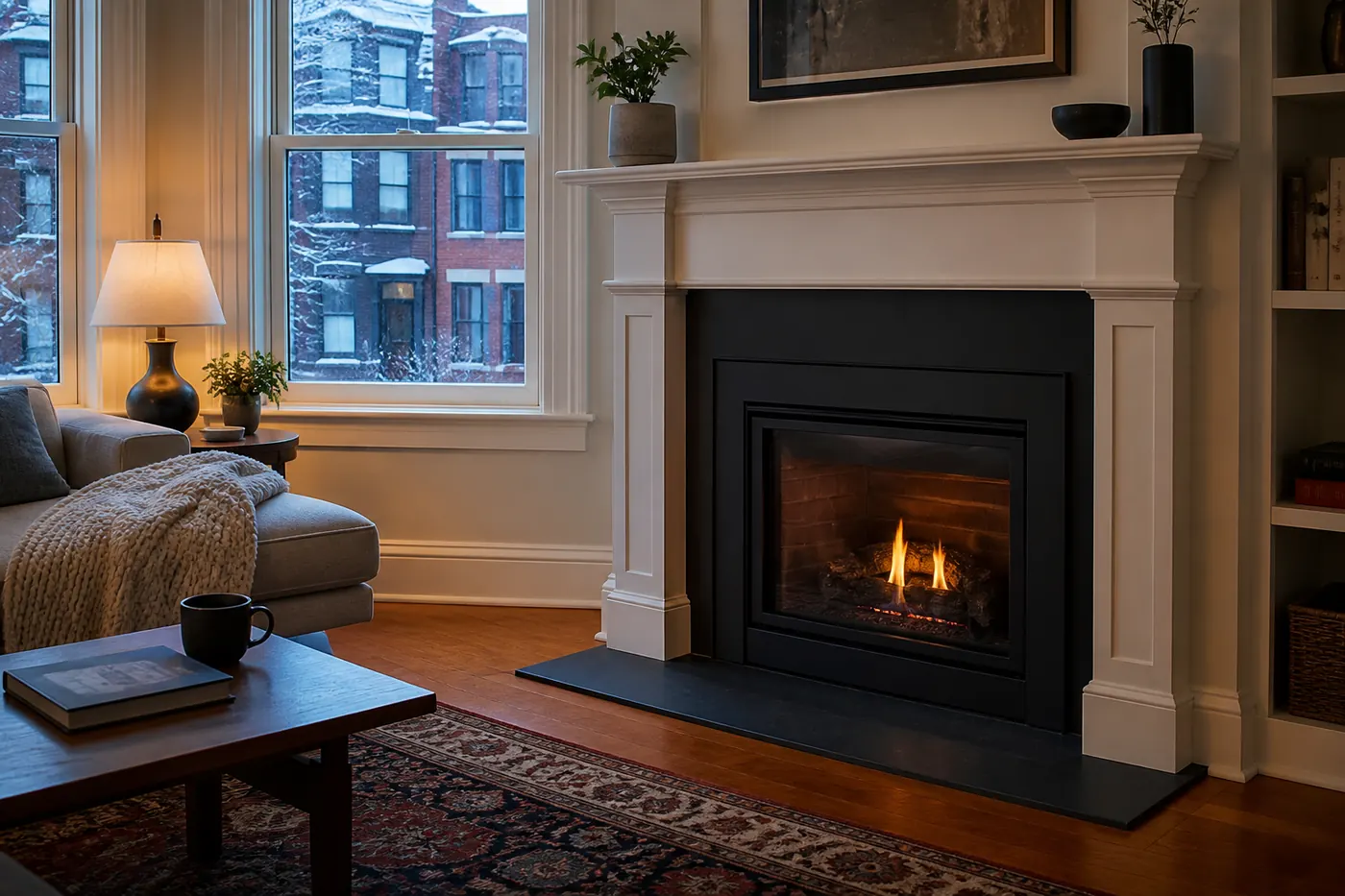
You get more heat from a fireplace by burning dry wood, keeping the damper working and sealed when idle, and, if you want real heating, moving to an insert or stove that suits your flue. An ordinary open fireplace is built for atmosphere, and much of its warmth leaves up the chimney. A $49 inspection, credited toward approved repair work, tells you which upgrade fits your setup.
Why an open fireplace loses so much heat
A fire needs a steady supply of air, and an open firebox gets it from your room. The fire pulls room air through the house, up the flue and outdoors. Warm air you paid to heat goes with it. Meanwhile the fire radiates heat only from the front, and the chimney itself carries away most of the rest.
That is why a fireplace can feel cozy within a few feet and still leave the rest of the room cold. In a Boston winter it can even pull cold air in through gaps around windows and doors as it pulls warm air out.
Before spending money, decide what you want. A fire for atmosphere on weekends needs different fixes than supplemental heat for a chilly living room. If you want dependable heating, a change of equipment is the honest answer, not an accessory.
Free and cheap fixes: fuel and how you burn
Start where it costs the least.
- Burn dry, seasoned wood. Wet wood wastes energy boiling off water and makes smoke and creosote. Seasoned wood burns hotter and cleaner. Firewood that has dried for months under cover, with cracks in the ends and a light, hollow sound when two pieces are knocked together, is ready to burn.
- Build a smaller, hotter fire. Several split pieces stacked loosely burn better than one large smoldering log.
- Open the damper fully before you light, and keep it open until the ashes are cold.
- Use a grate so air can reach the underside of the fuel.
- Keep the firebox clean and leave only a thin bed of ash, which helps insulate the coals.
None of these changes the basic design, but together they make the fire cleaner and slightly more useful.
One more habit costs nothing: close the doors to rooms you are not heating and let the warm air gather where you sit. A fireplace works well as a spot of warmth in one room, and trying to heat a whole open floor plan with it only pulls more cold air in from elsewhere.
Stop the leak when the fireplace is not in use
Most of the heat you lose to a fireplace is lost when no fire is burning. A damper that does not seal, or one that is stuck open, creates a chimney-sized hole in the top of your house.
How to tell if the damper leaks
On a windy winter day, you may feel a draft at the fireplace opening, hear whistling, or notice cold air spilling into the room. A rusted, warped or missing damper plate is a common cause.
What helps
- Repair or replace the damper. Damper work is $199 to $1,200 depending on the type and condition. The chimney damper repair page explains the options.
- Install a top-sealing damper that closes tightly from the chimney top.
- Check that the cap is intact, since a missing cap also lets cold air and moisture in.
Never close a damper while embers are still glowing. Carbon monoxide can build up in the house. Wait until the ashes are completely cold.
Glass doors and combustion air
Glass doors reduce the amount of room air pulled up the chimney while the fire burns, and they stop heated room air escaping when the fire dies down. They do not turn a fireplace into a heater, and they can overheat if misused, so follow the maker's instructions about when doors may be closed.
Combustion air is the other piece. A fire needs to draw air from somewhere. In a very tight house, a fire may struggle or smoke because there is not enough air, or because fans compete for it. Cracking a window slightly near the fireplace can help, and so can closing nearby exhaust fans. Boston homes range from drafty antiques to tightly sealed renovations, and the same fireplace can behave differently after the house is air sealed.
If you do notice smoke entering the room, stop using the fireplace and have it checked. Our guide on fireplaces that do not draw goes through the common causes.
Inserts, stoves and gas: the real upgrades
If you want the fireplace to heat the room, the choice is an enclosed appliance. Here is how the main options compare.
| Option | What it does | What must be checked |
|---|---|---|
| Wood insert | Closed firebox that radiates and circulates heat | Liner sized for the insert, clearances, listed installation |
| Gas log or gas kit | Convenient fire with less heat loss and no wood | Gas line, venting type, local rules |
| Sealed or glass-front unit | Reduces room air use and heat loss | Manufacturer's venting instructions |
A full gas kit is $900 to $1,500, and a new liner for an insert or other venting is $1,500 to $4,500 for replacement. Insert prices depend on the model and are quoted in writing after the inspection. Our insert versus open fireplace guide goes deeper.
Do not install an insert without verifying that the venting and clearances match the manufacturer's listed requirements. Local building rules may also apply, so ask your building department what permits or approvals are needed.
What the upgrade path costs
These are Boston prices that apply to fireplace efficiency work. Anything else is quoted in writing after the $49 inspection.
- Chimney inspection: $49, credited toward approved repair work.
- Cleaning with inspection: $299.
- Damper repair or replacement: $199 to $1,200.
- Standard chimney cap: $300 to $700.
- Firebox repair: $350 to $900.
- Liner replacement: $1,500 to $4,500.
- Full gas kit: $900 to $1,500.
Repairs to the fireplace itself are covered on the fireplace repair page. Often the cheapest efficiency gain comes first: a clean, working damper and a clean flue cost far less than a new appliance and give you most of the benefit if you only burn occasionally.
Before you buy anything: an order of operations
A sensible sequence avoids buying equipment your chimney cannot support.
- Have the chimney inspected. Learn the flue's condition, size and liner type.
- Fix the damper, cap and any smoke or draft problems.
- Choose your goal: atmosphere, supplemental heat or main heat.
- Pick an appliance that is listed for your flue and clearances.
- Have it installed according to the manufacturer's instructions, and confirm any permit needs locally.
- Have it inspected and cleaned every year.
If anything seems off, such as smoke in the room, a strong smell of gas or an alarm sounding, stop using the fireplace. For a gas smell, leave and call the gas utility or 911.
To start with a clear picture of your flue, book the $49 inspection at our contact page or call (617) 404-9587.
Questions homeowners ask
Do fireplace heat reflectors or blowers actually work?
They can add a modest amount of warmth near the fireplace by moving or reflecting heat. They do not fix the main losses up the flue, so treat them as small add-ons, not a substitute for sealing the damper or changing equipment.
Is a gas fireplace more efficient than a wood fireplace?
Often yes, particularly sealed or vented units, because they pull less room air and have no ash to manage. A full gas kit is $900 to $1,500. Check the venting and local rules before you commit.
Will a chimney balloon or plug help?
Plugs can stop a draft when the fireplace is never used, but they must be removed before every fire and they are easy to forget. A repaired or top-sealing damper is a more reliable answer if you use the fireplace.
Does cleaning the chimney improve efficiency?
A clean flue drafts more reliably and burns more cleanly, which helps performance and safety. It will not turn an open fireplace into a heater. Cleaning with inspection is $299.
Can I put an insert into any fireplace?
No. The firebox size, flue, clearances to combustibles and liner all have to suit the insert. A flue inspection comes first, and the appliance's listed instructions decide what is allowed.