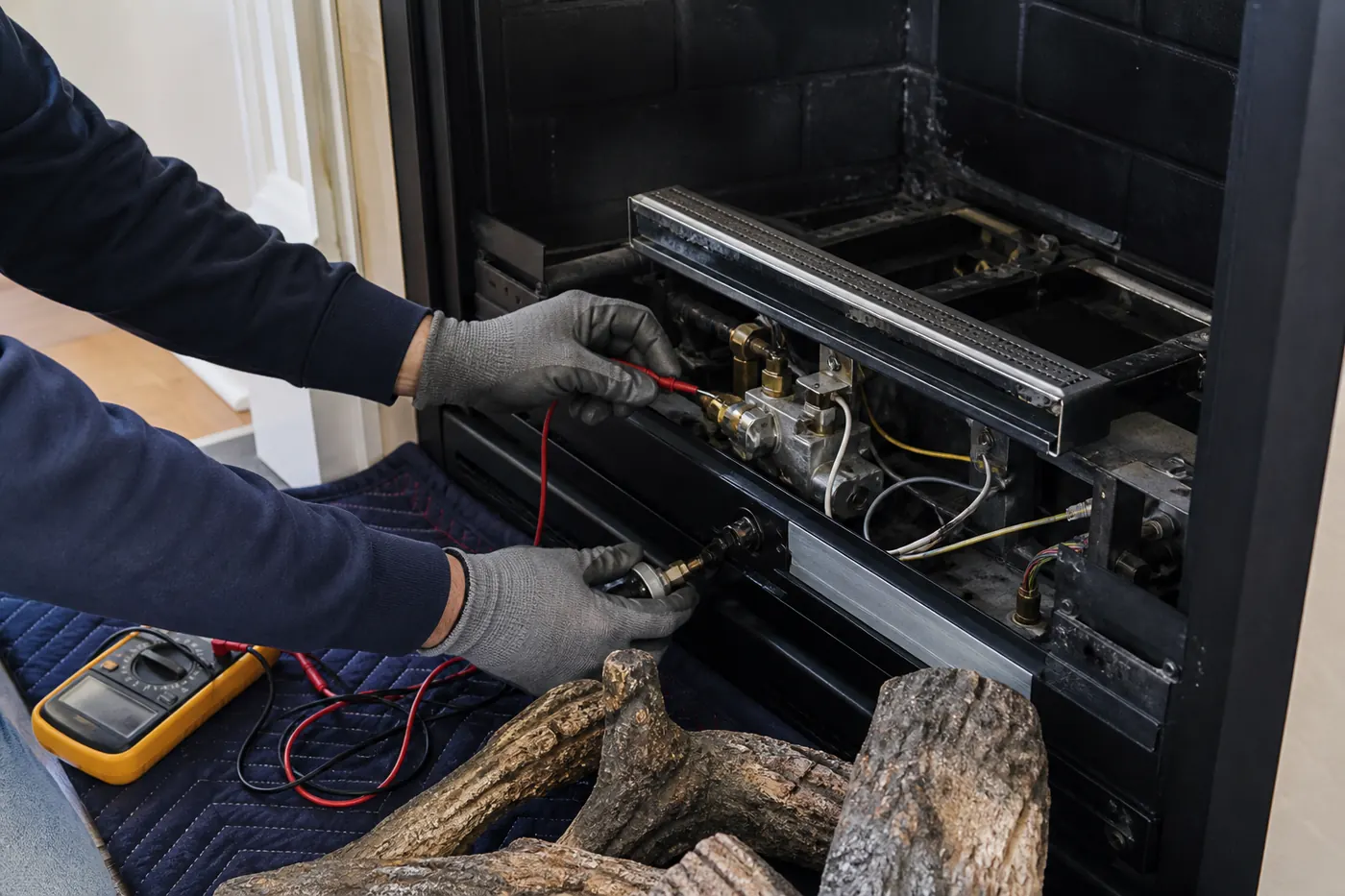
Wood gives you real flame, crackle and a fire that works in a power outage, but it needs a clean chimney, dry fuel and regular work. Gas gives you flame at the flip of a switch with far less mess, but it needs its own service and venting. In Boston, gas fireplace cleaning is $299, repair is $299 to $900, and a full gas kit is $900 to $1,500.
The main differences at a glance
| Question | Wood fireplace | Gas fireplace |
|---|---|---|
| Starting a fire | Kindling, dry wood, a draft check | A switch or remote |
| Mess | Ash, soot, bark, smoke smell | Very little |
| Fuel | Seasoned firewood you buy, stack and store | Natural gas or propane |
| Chimney buildup | Creosote from smoke | Little creosote, but moisture and corrosion are possible |
| Yearly service | Sweep and inspection, $299 | Gas fireplace cleaning, $299 |
| Power cut | Works | Depends on the model |
| Feel | Real fire, crackle, smell of wood | Steady, controllable flame |
Neither option is automatically better. The right choice depends on how you live, what is already in the house, and how much work you want to do each season.
It also helps to be honest about how often you will use it. A fireplace that lights on a Saturday night three times a year does not need the same setup as one that heats the living room all winter. Think about the cold months in Greater Boston, when the fireplace may run several evenings a week, and choose for that pattern rather than for the best-case picture.
First, find out what you already have
Before comparing, identify your starting point. A fireplace can be one of three things, and the answer changes your options.
- A masonry fireplace: A firebox built of brick or stone with a masonry chimney, common in older Boston houses, brownstones and rowhouses.
- A factory-built fireplace: A metal firebox and pipe made as a unit, often inside a framed chase in newer homes and additions.
- An insert or stove: A closed unit set into an existing opening. Our post on fireplace inserts versus open fireplaces covers this choice.
Each one has rules about what can go inside it. A factory-built unit is tested only with its own parts and approved fuels, so you cannot swap in whatever you like. A masonry fireplace is more flexible, but the flue must still suit the new appliance.
If you are unsure which you have, an inspection answers it with photos.
How venting differs, and why it matters for safety
Venting is the hidden difference. Wood smoke needs a big, tall, warm flue to pull it up and out. Gas exhaust is cooler and wetter, and gas units are built to vent in specific ways.
Wood
The flue carries smoke, heat and creosote. It needs a clean, intact liner, a working damper and a cap.
Gas
Some gas units vent up an existing chimney, some use a small liner pipe, and some vent straight out through a wall. The venting method must match the unit and follow the manufacturer's instructions. Putting a gas appliance into an old flue without checking that flue can lead to leaks and carbon monoxide.
Safety note: if you smell gas, leave the house and call your gas utility or 911 from outside. If a carbon monoxide alarm sounds, leave and call 911. Do not stop to investigate.
What each one costs to keep up
A fireplace is not just the purchase price. Think about the cost of owning it for a typical year.
- Wood: Firewood is a recurring cost and takes storage space. The chimney needs a yearly sweep and inspection, $299. Repairs depend on wear: firebox repair is $350 to $900, damper work $199 to $1,200, and smoke chamber repair $500 to $1,500.
- Gas: No wood to buy or stack. A gas fireplace cleaning is $299, and repairs run $299 to $900. If you switch from wood, a full gas kit costs $900 to $1,500.
A full gas kit is a planning range for the unit itself and typical set-up. Items like a new gas line, a liner for the flue, or changes to the firebox are not in that range and are quoted in writing after the $49 inspection. See our fireplace repair cost guide for how repairs are priced.
Gas is cheaper in daily effort. Wood can be cheaper per fire if you cut your own, but only when you count nothing for your time.
Thinking about converting from wood to gas?
Many Boston homeowners ask about swapping a wood-burning fireplace for gas. It can work, but it is not a one-hour job.
- Inspect the chimney. A flue that served wood for decades may have cracks or buildup that must be dealt with first.
- Choose the setup. Gas log sets, burners and inserts all differ in how they vent and how they look.
- Plan the gas supply. Gas piping must be done by a qualified gas fitter, and the work may need a permit.
- Check the rules. Local building and gas codes, and sometimes condo or historic rules, can apply. Confirm the current requirements with your building department and gas utility.
Converting also means you give up wood-burning, and in some units you cannot go back. Think about whether you will miss a real fire before you commit. For repairs to an existing fireplace of either kind, our fireplace repair page explains the process.
Which one suits your home and habits
Use these rules of thumb to narrow down the choice.
- Choose wood if you love the ritual, have space to store dry wood, and want a fire that works when the power is out.
- Choose gas if you want quick warmth, hate the mess, travel often, or have a smaller house where a big fire is too much.
- Consider a gas log set in an old masonry fireplace if you like the look of your hearth but not the work, provided the flue passes inspection.
- Think carefully about wood in a tight space like a small condo or a unit shared with others, where smoke and ash matter to neighbors.
Your chimney type matters too. A masonry stack with a sound liner has the most options. An old, damaged flue may need work whichever fuel you pick, and you can read about that on our chimney repair page.
Safety habits that apply to both
Whichever you choose, a few habits keep the fireplace safe.
- Have it inspected every year. NFPA 211 recommends a yearly inspection for chimneys and vents.
- Install smoke and carbon monoxide alarms on every level.
- Keep curtains, rugs and furniture clear of the opening.
- Use a screen or glass doors as designed, and keep children and pets back.
- Never burn trash, painted wood or treated lumber in a wood fireplace.
- Do not use a gas fireplace if it will not light cleanly, or if you notice soot, odors or yellow, lazy flames. Turn it off and book service.
- Keep a record of each service visit, including the date and what was found, so the next technician sees the history.
To find out what your fireplace needs, book a $49 inspection at /contact/ or call (617) 404-9587, and you will get photos and a written price.
Questions homeowners ask
Does a gas fireplace still need a chimney sweep?
Gas units still need a yearly service. They make little creosote, but the burner, vent, glass and liner can collect dust, moisture or corrosion. A gas fireplace cleaning is $299.
Can I put a gas log set in my old brick fireplace?
Often yes, but the flue must be checked first, and the set must be approved for your fireplace and vented the right way. A technician can tell you whether your chimney is suitable.
Will a gas fireplace heat my house?
Some units give off a good amount of heat and some are mostly decorative. Ask for the heat output and compare it to the room you want to warm.
Is a gas fireplace safer than wood?
They have different risks. Wood brings creosote and sparks, while gas brings gas leaks and carbon monoxide if venting fails. Both are safe when installed correctly, inspected yearly and used with working alarms.
Do I need a permit to switch from wood to gas?
Gas piping and appliance changes often fall under local rules, and requirements vary. Check with your local building department and your gas utility before work begins.