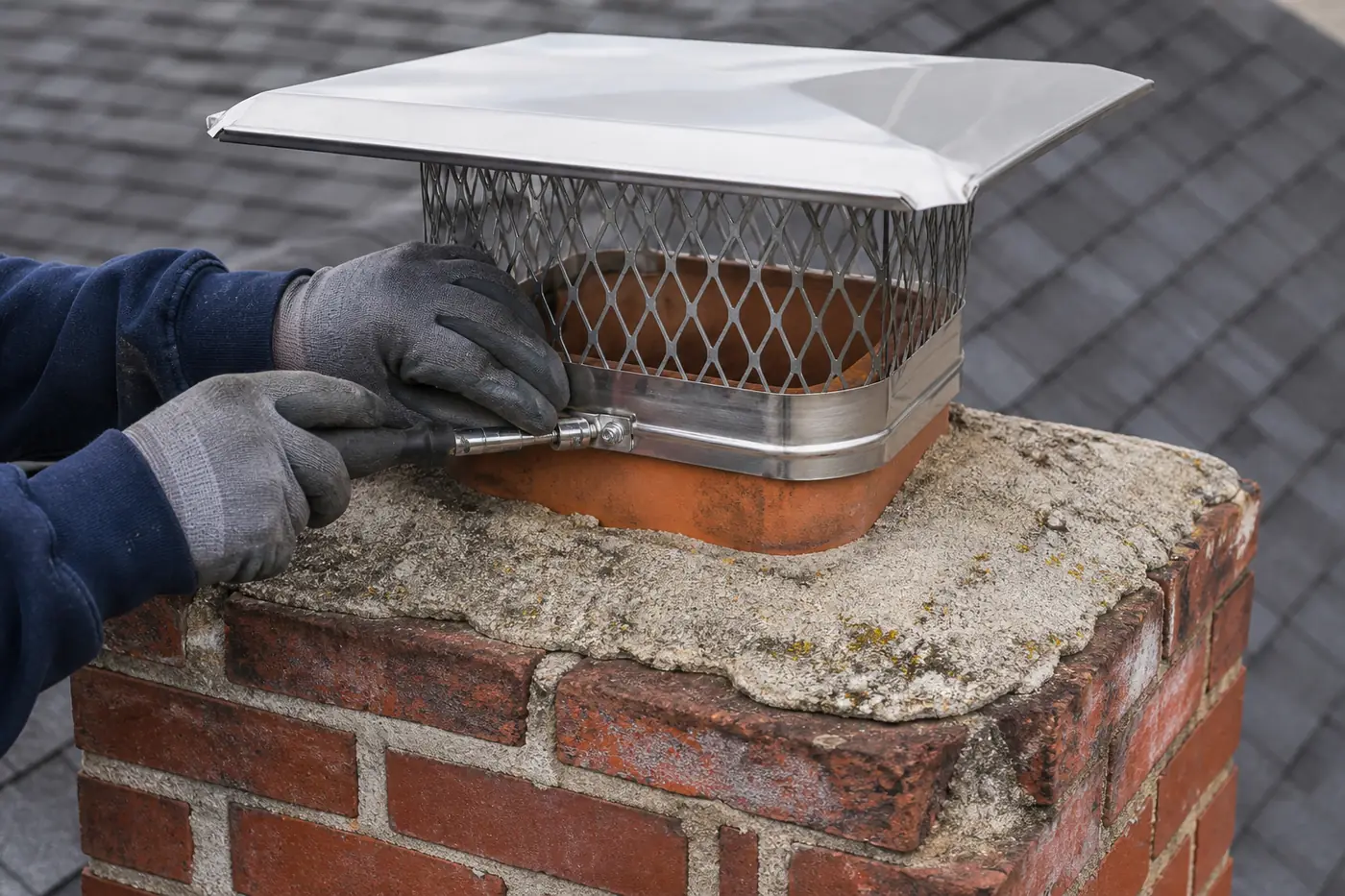
A chimney cap installation in Boston costs $300 to $700 for a standard cap and $800 to $1,300 for a premium one. The cap is the metal cover with a mesh screen that sits over the flue opening, and it is what keeps rain, birds and raccoons out of your chimney. If yours is missing, rusted through or rattling loose, a $49 inspection, credited toward approved work, confirms the size and style before any price is written.
- A cap covers the flue opening with a lid and a screen, so rain and animals stay out while smoke still gets out.
- A standard cap runs $300 to $700 and a premium cap runs $800 to $1,300.
- The cap has to fit your flue or flues exactly, so the first step is measuring, not ordering.
- The $49 inspection is credited toward approved work, and the written price comes before any work begins.
What a chimney cap does and why it stops working
A chimney cap is a lid with a mesh screen around the sides. It sits on top of the flue, the passage that carries smoke out of the house. The lid sheds most of the rain that would otherwise fall straight down the flue. The screen blocks birds, squirrels and raccoons, and it catches large sparks and debris. The sides stay open, because smoke and combustion gases still need a clear path out.
Caps stop working for plain reasons. Metal rusts through after enough wet seasons. A cap that was too small for the flue never covered it fully. Fasteners loosen, and wind then lifts or twists the lid. A screen with the mesh too wide lets small animals pass, and a screen clogged with soot or leaves slows the draft. In Boston, salt air near the coast and heavy rain in a nor'easter are hard on the metal, and ice can bend a thin lid.
The mesh size matters more than most people expect. Too wide, and a chimney swift or a squirrel can slip through. Too fine, and soot and creosote clog it quickly on a wood-burning fireplace, which chokes the draft and can push smoke back into the room. A good fit is a screen that blocks animals and still stays clear when the fireplace is used regularly.
An open flue is also an invitation. Birds and animals nest in it, and nests and leaves burn easily. Rain that runs down an uncovered flue also wets the firebox and the damper and can stain the room.
The cap does not protect the brick around the flue. That is the crown's job, and you can read how a cracked one is dealt with on the chimney crown repair page. A cap and a sound crown work together.
Signs you need a new chimney cap
You can often check these from the ground or a window. Do not climb up to look at the cap yourself.
- The flue is open to rain. You see no cover on top at all, or the water marks inside the firebox show rain is coming straight down.
- Birds or animals get in. You hear scratching or chirping in the fireplace, find twigs and debris in the firebox, or smell something musty.
- The screen is broken. A torn, bent or missing section of mesh leaves a gap just big enough for a squirrel.
- The lid or fasteners are loose. A cap that rattles in the wind, sits crooked or has been blown partly off is no longer attached properly.
- The cap is heavily corroded. Flaking rust, holes or orange runs down the brick mean the metal is giving out.
- A replacement no longer clears every flue. If a newer cap leaves one flue partly uncovered or too tight, it has to be re-measured and replaced.
Each of these points toward a cap job, but none proves it alone. A rusty cap can also be sitting on a cracked flue tile, which only a close look reveals.
What gets measured and checked before a cap is chosen
A cap is not a one-size part. The technician measures first and then picks the style, so the cap you approve is the cap that fits.
- The flue tile outside dimensions. The cap has to fit the actual tile, which may be round, square or rectangular, and which often is not the size the old cap suggests.
- Mounting area. The space on the crown or the tile where the cap attaches, and whether it is level and solid enough to hold fasteners.
- The kind of chimney. A masonry chimney, a multi-flue stack and a factory-built metal system each need a different cap, and a factory-built system calls for parts listed for that system.
- Stability of the crown and tile. A cap cannot be anchored to a crumbling crown or a loose tile, so those get checked first.
- Clearances. The lid and screen have to leave enough open space around the flue for the exhaust to leave freely.
- Wind exposure. A stack standing high above a roof, or on a corner exposed to open air, may need a different attachment than a sheltered one.
Photos of the measurements and the condition of the top are part of the written quote.
The reason for all this measuring is that cap problems often start at the order stage. A cap picked from a catalogue by eye may be a little too small, and it will either rattle in the first gust or leave a gap an animal can use. Measuring the actual tile removes the guesswork. It also shows early if the tile itself is chipped, which would change what the cap can be fastened to.
Standard or premium: which cap fits your chimney
The two price tiers on this page, standard at $300 to $700 and premium at $800 to $1,300, differ in the build of the cap and how it is mounted. Your flue size and your roof decide which one makes sense, not a sales preference.
Standard caps
A standard cap is a ready-made single-flue cover that matches a common tile size and clamps or bolts into place. If your flue is a common size and the mounting area is solid, this is usually all the chimney needs.
Premium caps
A premium cap uses heavier metal and a more substantial lid and screen, and it is chosen where weather exposure is harder, the opening is larger or an ordinary cap would not fit the mounting area well. Heavier does not mean better for every chimney. A premium cap on a small, sheltered flue can be more than the job needs.
How the choice is made
The technician lays out the options that suit your measurements, with the price of each in writing. If a standard cap does the job, that is the quote you get. You are never asked to approve a premium cap without seeing why the flue calls for it.
How a single-flue cap is installed
One flue means one cap, and the work is quick compared with most masonry jobs.
- The old cap and its fasteners are removed, and the top of the flue tile is cleaned so the new cap seats properly.
- The new cap is test-fitted to the tile to confirm it covers the opening with the correct gap around it.
- The cap is secured to the tile or the crown with the fasteners that suit that mounting surface, and the screen and lid are checked for movement.
- The technician looks at the finished cap from several angles and photographs it, so you can see how it sits.
When a flue gets its first cap, the same steps apply without the removal. If the tile top is chipped or cracked, that is noted on the quote, because a cap on a damaged tile will not hold well.
Some chimneys also need a sweep once the old cap is off, since nests and debris fall into the flue as the cap comes away. A chimney sweep clears the flue and is $299 with inspection.
How a multi-flue cover is installed
Many older Boston homes have a wide brick stack with two or more flues rising through one crown. These can take either a cap on each flue or a single larger cover over the whole group. The technician explains which suits the stack.
Why multi-flue is different
The flues are different heights and sizes, and each has to stay open to the air. A cover that spans several flues must clear the tallest one with room to spare, and it needs to attach to the masonry around them, not to one tile. Wind pushes harder against a larger cover, so the attachment points matter more.
Why measurement matters most here
This is where a replacement most often fails to clear every flue. A cover that was ordered from a single measurement may leave one flue partly shut or poorly screened. Every flue is measured separately, and the quote lists each one.
A stack that serves a fireplace and a furnace flue together also has to keep the two exhaust paths open. If the layout is unclear, the inspection sorts out which flue serves which appliance before a cover is chosen.
Replacing a failed cap or its fasteners
Not every loose cap needs a new one, and not every old cap is worth saving.
When tightening or re-fastening is enough
If the lid and screen are sound but a fastener has worked loose or backed out, re-fastening may do the job. The technician looks at whether the mounting surface is still solid, because a fastener cannot hold in a crumbling edge.
When the whole cap goes
Replacement is the right call when the metal is rusted through, the screen has torn open, the lid is bent so it no longer sheds water, or the size was wrong from the start. Patching a cap that is already corroded only buys a short time, and the new cap costs little more than repeated visits.
Ask what the new cap is attached to
A good cap on a weak base fails again. Before a cap is bolted or clamped on, ask what it will grip: a sound flue tile, a solid crown, or the masonry around a multi-flue stack. If the answer is a chipped tile or a cracked edge, the quote should say so and show a photo. That one question tells you whether the price covers a lasting fix or only a cover that will loosen after the first hard windstorm.
When the problem is below the cap
Sometimes the cap is fine and the staining or rain entry comes from elsewhere. Water in the firebox can also come from flashing at the roof line or a cracked crown. The technician traces the path so you do not pay for a cap when the leak is somewhere else. Notes on that tracing are on the chimney inspection page.
Custom caps, odd shapes and factory-built chimneys
Most flues take a standard or premium cap. A few do not, and these are handled differently.
- Custom fabrication. If your flue tile or stack is an unusual size or shape, or the mounting area is non-standard, a cap can be made to the measured dimensions. This is priced in writing after the $49 inspection, because the work depends on what the measurements show.
- Factory-built chimneys. A metal prefabricated chimney is a listed system, and its cap is a listed component made for that model. A masonry cap should not be forced onto it. The technician identifies the system and tells you what part is needed.
- Gas appliances. If a gas fireplace or appliance vents through the flue, the cap has to leave the exhaust path fully open. Any work on the gas line itself belongs to the gas utility or a licensed gas fitter, not to the cap installer.
If you smell gas at any point, leave the house and call the gas utility or 911.
A standard or premium cap is a clear tier on the price list. Custom work is deliberately not, because quoting a number before measuring would be a guess.
What the visit and the install day look like
The inspection visit
You get a 3-hour arrival window, and the office calls ahead. The technician measures the flue or flues, looks at the crown and tile where the cap will mount and photographs the existing cap and the surroundings. You then receive the price in writing, with the cap style named, before anything is ordered or installed.
Installation day
Fitting a standard cap is usually a short visit once the right part is in hand. A multi-flue cover, a custom piece or a repair of the surface it mounts on takes longer. We do not promise an hour count, because height, access and the condition of the tile decide it.
After the work
You see photos of the finished cap and how it sits on the flue. If you approved the work, the $49 inspection is credited toward it. If animals were in the chimney, the cap goes on only after they are out, and animal removal is a separate job priced at $299 to $900.
Chimney cap installation price at a glance
Cap work on this page runs $300 to $1,300, depending on the cap tier.
| Cap job | Price |
|---|---|
| Standard cap | $300 to $700 |
| Premium cap | $800 to $1,300 |
| Custom or unusual sizes | Quoted in writing after the $49 inspection |
| General inspection, credited toward approved work | $49 |
The number of flues, the height of the stack and the way the cap mounts move a job within its tier. For what to look for in a written quote, see the chimney cap cost page.
How to prepare, and when a missing cap is urgent
Before the visit
- Write down what you noticed: rain in the fireplace, sounds from the chimney, or a cap you can see is damaged.
- Keep the area under the chimney clear of cars and furniture.
- Mention any animal noises when you book, so the plan accounts for them.
When it should not wait
A flue with no cap during fall and winter is open to rain, snow and nesting animals, so book promptly if you can see that yours is gone or crushed. If you hear animals, do not light a fire. A blocked flue can push smoke and carbon monoxide into the house. If a carbon monoxide alarm sounds, leave and call 911.
To get a cap measured and priced, book the $49 inspection on our contact page or call (617) 404-9587.
Questions homeowners ask
Does every chimney need a cap?
Any open flue should have one. Without a cap, rain falls straight down the flue and animals can nest in it. A cap with a screen also catches large sparks and debris, while still letting smoke out.
Can I buy a cap online and have it installed?
You can, but the fit is the hard part. Flue tiles come in many sizes and shapes, and a cap that is even slightly wrong will not seat or clear the opening. Measuring first avoids paying for a part that has to be returned.
Will a cap stop my chimney from drafting properly?
A correctly sized cap leaves open space around the flue so exhaust can leave freely. Problems come from a cap that is too small, or from a screen clogged with soot or leaves. Those are checked at the inspection.
Why is a multi-flue cover priced differently from a single cap?
A multi-flue cover is larger, has to clear flues of different heights and attaches to the surrounding masonry instead of one tile. Each flue is measured separately. The final price is written after the $49 inspection.
My cap is rusty but still in place. Do I have to replace it?
Surface rust on a sound cap can wait for the next inspection. Flaking metal, holes, a torn screen or a loose lid mean replacement is the better choice, since patching a failing cap buys little time.
Is a chimney cap the same as a chase cover?
No. A cap covers the flue opening on a chimney. A chase cover is a large metal lid over the top of a framed chimney enclosure, with openings for the flues. Some homes need only one, and a few need both.
Related guidance
Start with the Boston cost guide, then read the guides below.
- Animals or Birds in Your Chimney? Boston Guide
- Chimney Cap vs Chase Cover: Boston Homeowner Guide
- Chimney Cap Installation Cost in Boston (2026)