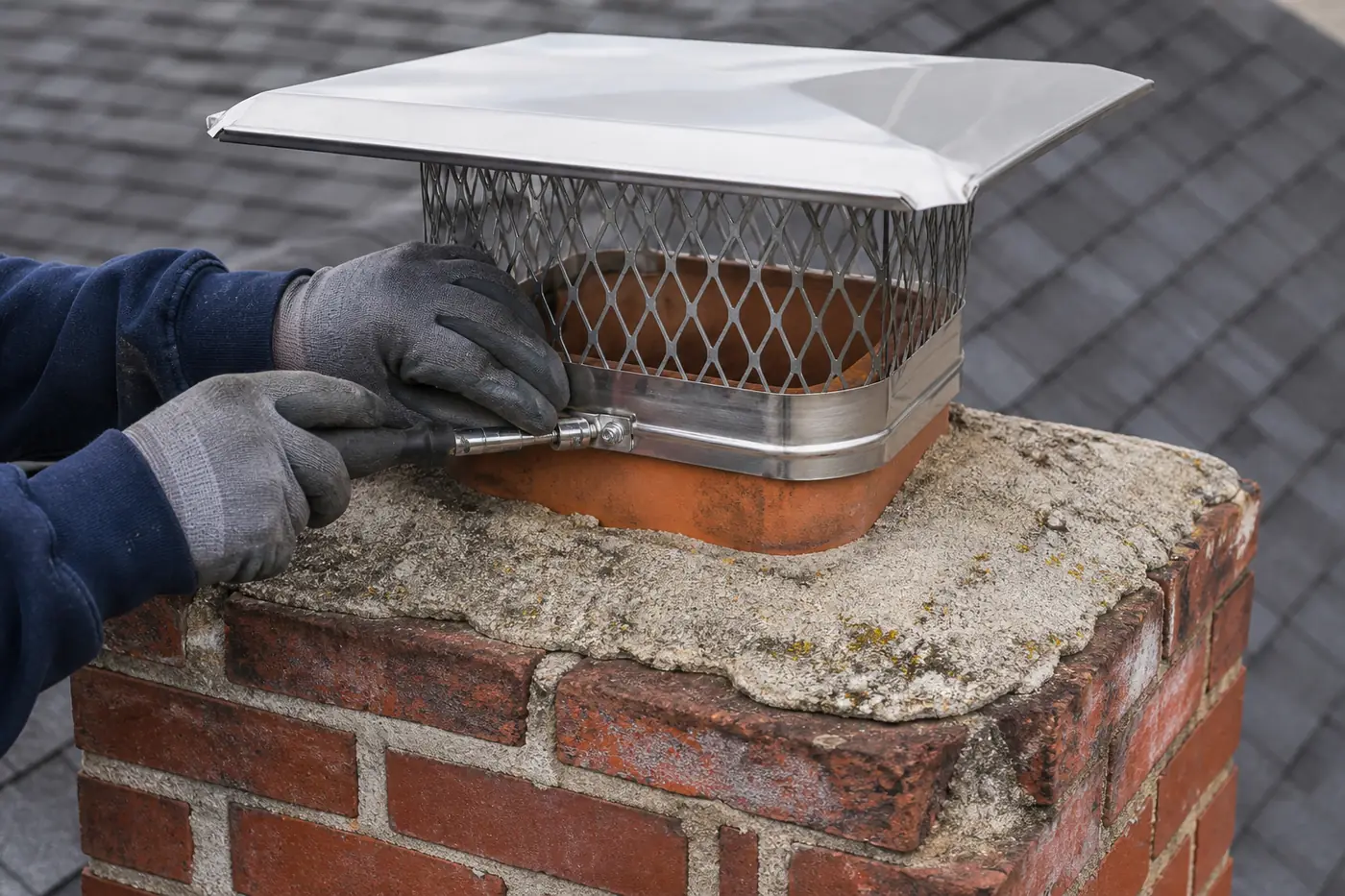
A chimney cap is a small cover that sits over the top of a flue to keep out rain, birds and sparks. A chase cover is a large metal pan that seals the top of a wood-framed chimney enclosure. In Boston, a standard cap runs $300 to $700, a premium cap $800 to $1,300, and a custom chase cover $800 to $1,500.
Two parts that get mixed up on the same roof
People use the words cap and cover as if they mean the same thing. They do not. Both sit at the top of a chimney, but they protect different surfaces, and a contractor who blurs the two can hand you a quote for the wrong job.
A cap sits on top of one flue opening. It usually has a mesh screen on the sides and a lid above. Its job is to stop rain from dropping straight down the flue, keep squirrels, raccoons and birds out, and catch stray embers before they land on a shingle roof.
A chase cover is different. It spans the whole top of a framed enclosure, called a chase, which is the wood box built around a factory-made metal chimney. The cover is one sheet of metal, folded and sealed at the corners, that sheds water off the entire top of that box. A cap and a cover often live together: the cap protects the flue, and the cover protects everything underneath it.
Brick chimney or framed chase: which do you have?
The simplest way to tell which part your home needs is to look at the chimney from the street or from a window above.
- Brick or stone stack: The top is usually a cement crown, a sloped slab that covers the brick. You may have one cap per flue sitting on it. There is no chase cover because there is no framed box.
- Siding-clad or stucco box: If the chimney looks like a tall wooden tower wrapped in siding, vinyl, stucco or sheet metal, it is probably a framed chase. The top should have a metal chase cover, and a round or square cap should stand above it.
- Both in one house: Many Greater Boston homes with an addition, a dormer or a newer fireplace have a brick chimney on the original house and a framed chase on the newer part. Each needs its own protection.
If you are unsure, do not guess from the ground. A technician can confirm the system and show you a photo of the top, which saves you from paying for the wrong part.
Side by side comparison
This table sums up how the two parts differ in practice.
| Question | Chimney cap | Chase cover |
|---|---|---|
| What it covers | One flue opening | The entire top of a framed chase |
| Usual material | Stainless steel, galvanized steel, copper | Stainless steel, galvanized steel, copper |
| Made to order? | Often off the shelf, sized to the flue | Almost always built to the chase |
| Boston price range | $300 to $700 standard, $800 to $1,300 premium | $800 to $1,500 custom |
| Main failure | Bent, rusted or loose lid, torn screen | Rust, open seams, water pooling on top |
| What a leak looks like | Rain in the firebox, animals inside | Wet framing, stained ceiling around the chase |
Notice the last row. A failed cap tends to show up at the fireplace. A failed chase cover tends to show up in the wall or ceiling around the chimney, because the water is soaking the wood frame.
How each part is measured, and why that changes the quote
Measurement is where the two parts really part ways.
Measuring for a cap
A cap is sized to the flue tile or the pipe it sits on. The technician checks the outside dimensions of the flue, whether it is round, square or rectangular, how much of the tile sticks above the crown, and whether the cap will clamp on, slide in or bolt to the masonry. If a flue is cracked at the top, that gets noted too, because a cap cannot hide a damaged liner.
Measuring for a chase cover
A chase cover is measured across the whole top of the chase, from outer edge to outer edge, with the drip edge hanging out over the siding. The technician records every pipe, flue or vent that pokes through the pan, because each opening needs its own collar and sealant. A chase with two flues is a bigger job than one with a single pipe, and a slightly out-of-square box needs a pan folded to match.
This is why a phone quote for a cover is rarely reliable. The price follows the shape of your roof detail, not just the size of a flue.
If your chimney is brick, look at the crown too
On a masonry chimney, the cap does not work alone. Under it sits the crown, the sloped cement collar that sheds water away from the flue and keeps rain out of the brick. A cap can be brand new and the chimney can still leak if the crown beneath it is cracked.
Freeze-thaw winters make this common in Greater Boston. Water gets into a hairline crack, freezes, widens it, and repeats until pieces break loose. If your technician finds a cracked crown while replacing a cap, ask for the crown work to be listed on its own line. Crown repair runs $300 to $900 and a full rebuild $900 to $2,500, and you can read how that decision gets made on the chimney crown repair page.
The takeaway: a cap covers the flue, a crown covers the brick, and a chase cover covers the wood. Three parts, three jobs, three separate line items on a fair estimate.
What each replacement costs in Boston and what moves the number
Boston planning ranges are $300 to $700 for a standard cap, $800 to $1,300 for a premium cap, and $800 to $1,500 for a custom chase cover. Our chimney cap cost guide breaks these down further.
Several things push a job toward the high or low end:
- Metal: Stainless steel and copper cost more than galvanized steel and last longer in damp coastal air.
- Number of flues: Two flues in one chase means more cutting, collars and sealant.
- Height and pitch: A tall chimney on a steep roof takes more time and more protective setup.
- Condition of what is underneath: Rotted framing or a damaged flue tile found under an old cover is a separate repair, not part of the cap or cover price.
- Extras: Larger mesh for a wood stove, a spark arrestor, or a matching color finish.
A written price should name the part, the metal, the size and the number of openings. If the quote just says cap, ask whether it means a flue cap or a full chase cover.
Warning signs and what to do next
Look for these clues, and photograph them if you can do so safely from the ground or through a window:
- A lid that sits crooked or has blown off after a nor'easter
- Rust streaks running down the side of the chimney
- Birds, leaves or nesting material in the fireplace
- A brown stain on the ceiling or wall beside a framed chimney
- Daylight visible between the cover and the siding
Never climb onto the roof to check. A ladder and a wet slate or asphalt roof are a bad mix, and a technician can inspect the top with proper equipment. The chimney cap installation page explains what the work involves.
If your fireplace is drafty or sooty and you suspect a bigger problem that needs chimney repair, a general inspection at $49 is credited toward approved repair work. Book it at /contact/ or call (617) 404-9587, and you will get a written price along with photos of what the technician finds.
Questions homeowners ask
Can I just put a cap on my framed chimney and skip the chase cover?
No. A cap only shelters the flue opening. The wooden chase around it still needs a metal pan on top to shed water, otherwise rain soaks the framing. The two parts work as a pair on a framed chimney.
Does a stainless steel chase cover really last longer than a galvanized one?
Stainless steel and copper resist rust better than galvanized steel, which matters in Boston's damp, salty and freeze-thaw weather. Galvanized costs less up front but may need replacement sooner. Your technician can show you each option on the written price.
How can I tell if my chase cover is leaking without going on the roof?
Look inside, not up. Brown stains or bubbling paint on the ceiling or wall beside the chimney, damp insulation in the attic, or a musty smell near the fireplace can all point to water getting past the cover. Photograph what you see and book an inspection.
Will a new cap fix a leaking brick chimney?
Only if the cap was the problem. Water also enters through a cracked crown, open mortar joints and failed flashing. An inspection should check all of these before you pay for a cap, so you do not buy the wrong repair.
Why is a custom chase cover priced higher than a standard cap?
A cap is often a stock part sized to a flue. A chase cover is built to match your enclosure, with folded edges, sealed corners and a collar for every pipe. More metal, more labor and a precise fit explain the higher range.