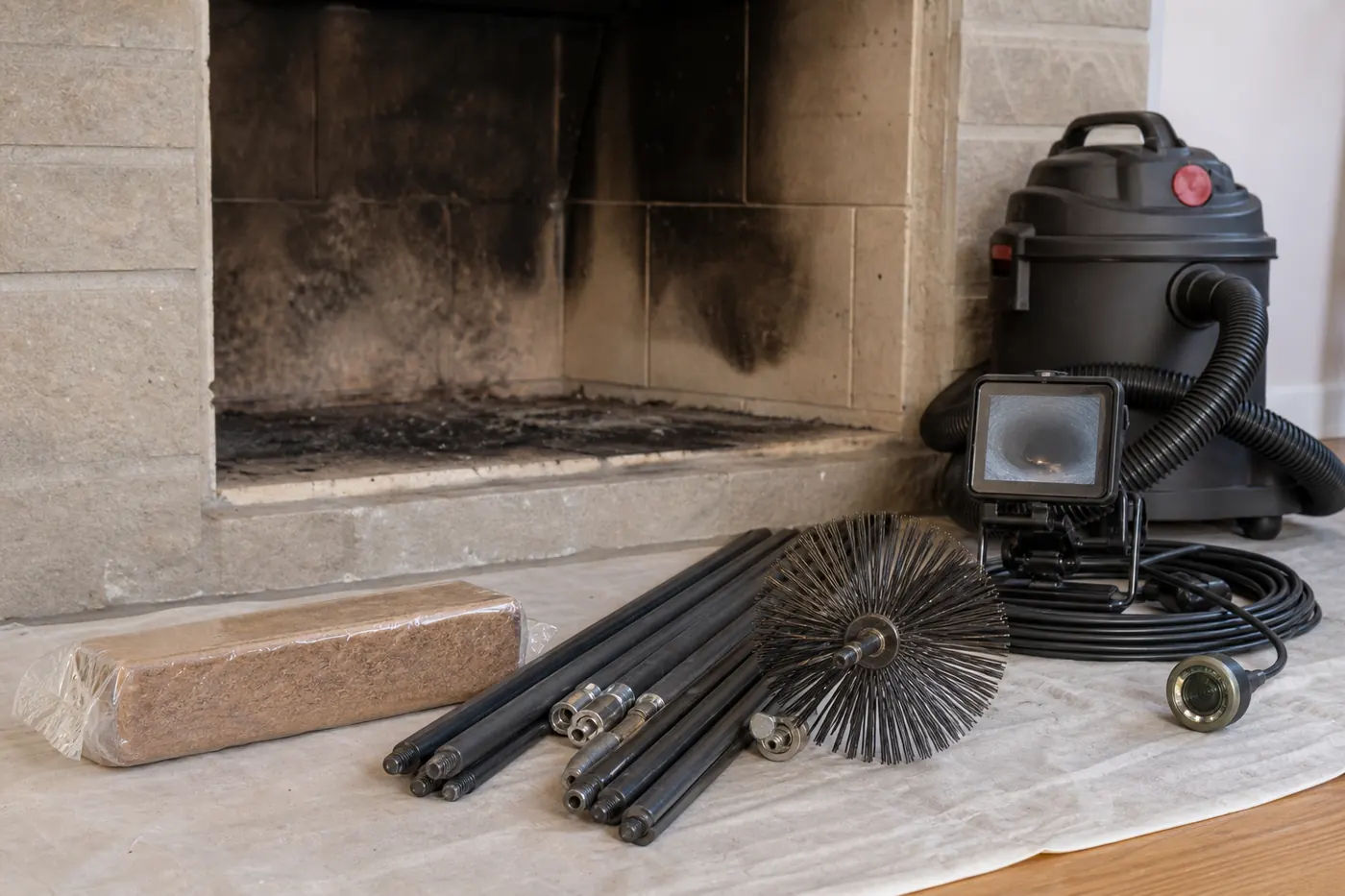
Only partly. A cleaning log may change some of the soft deposits in a flue when you use it exactly as the label says, but it cannot inspect the chimney, sweep out debris or fix damage. Think of it as a small supplement. A professional chimney sweep with inspection is $299 fixed in Boston.
What a cleaning log is supposed to do
A cleaning log is a pressed block of wood fibers or wax mixed with chemical additives. You burn it in the firebox like a normal log. As it burns, the additives travel up the flue with the smoke and settle on the soot and creosote lining the walls.
The idea is that the treated deposits become drier, flakier or easier to loosen, so some of them fall away or burn off in later fires. Different products make different claims, and the instructions on the package control how and when you may use them.
That is the whole job. A log works on the surface of deposits it can reach. It does not touch the parts of the chimney that are not coated in smoke residue, and it does nothing at all to the structure.
What a log cannot do
The gap between a log and a sweep is wider than the boxes suggest.
- It cannot see anything. Nobody looks at the liner, the smoke chamber, the damper or the crown. Cracks and gaps stay hidden.
- It cannot remove hard, glazed creosote. The shiny, tar-like buildup in the worst chimneys does not simply fall off.
- It cannot clear a blockage. Leaves, bird nests, animal debris and fallen mortar stay where they are.
- It cannot repair damage. A cracked flue tile is still cracked after a log burns.
- It cannot catch what already went wrong. Signs of an old chimney fire need a trained eye.
A log can also dislodge loose material that then sits in the smoke chamber or on the smoke shelf. If nobody sweeps afterward, that debris just moves to a new place.
Log, brush or professional sweep: how they compare
| Option | What it does | What it leaves out |
|---|---|---|
| Cleaning log | May loosen some soft deposits | No inspection, no physical removal, no repairs |
| Do-it-yourself brush | Scrapes accessible flue walls | Needs roof or clean-out access, and it still has no trained inspection |
| Professional sweep | Physically removes deposits and checks the system | Does not replace repairs the inspection turns up |
The professional chimney sweep is $299 fixed and includes an inspection. Heavier buildup is priced under creosote removal: stage 1 runs $299 to $450, stage 2 runs $450 to $700, and stage 3 starts at $700.
Nobody should go up on the roof to sweep a chimney themselves. If you want a brush, ask a professional what is safe to reach from inside the house.
When a log is a reasonable extra
A log can be a sensible add-on if all of these are true.
- Your chimney was swept and inspected recently and nothing was flagged.
- You burn only well-seasoned wood and use the fireplace now and then.
- You read the product label and follow it exactly, including any limit on how often you may use one.
- You still plan to book a sweep and inspection every year.
Used that way, a log is a low-cost habit between visits. It is not a reason to skip the visit, and it should never be used to justify burning in a chimney that has a known problem.
The fuel matters a great deal too. Damp wood makes far more smoke residue than dry wood, and no additive can undo that. Our guide to the best firewood in New England explains how to choose and store it.
Signs a log will not solve
Do not reach for a product when you see these. Stop using the fireplace and call.
- Smoke coming back into the room, or a smoky smell that lingers after a fire.
- Black, shiny or tar-like buildup you can see near the damper.
- Flakes of crunchy, honeycomb-like material falling into the firebox.
- Debris, twigs or a nest at the base of the flue.
- Any history of a chimney fire, even a small one.
- A carbon monoxide alarm going off. If it does, leave the house and call 911.
If you ever see flames or hear roaring from the chimney, get everyone out and call 911 from outside. Do not try to put it out yourself.
Heavy deposits have their own pricing and process, which you can read about on the creosote removal page.
Powders, sprays and other no-sweep products
Logs are only one of several products sold as easy chimney cleaners. You will also see powders you sprinkle on a fire, liquid sprays and chemical treatments meant for woodstoves. They share the same basic limits.
- They act on deposits, not on the chimney's condition.
- Results depend on how hot the fire burns and how thick the buildup already is.
- The label controls safe use, including which appliance the product is designed for.
- None of them replaces someone looking inside the flue with a light or a camera.
Before you buy any of them, ask what the product is meant to do, what it leaves out and whether it suits your fireplace type. A product made for a woodstove is not automatically right for an open masonry fireplace, and the reverse is true as well.
If a package promises that you never need a sweep again, treat that as a warning sign. No product can make a chimney safe to use without anybody checking it.
How often a Boston fireplace needs a real cleaning
There is no single schedule that fits every house, because the amount of buildup depends on what you burn and how. A fireplace used every weekend through a New England winter collects deposits faster than one lit a few times a season.
NFPA 211 recommends that chimneys be inspected at least once a year, and a sweep is done when the inspection shows buildup that needs removing. That puts the decision on what the technician actually sees, not on a count of fires or on a product you burned.
Greater Boston has long, cold winters, and cold air outside a chimney cools the smoke inside it, which leaves more residue on the flue walls. A chimney on an exterior wall is the most exposed. If you burn most nights from November to March, plan the visit for spring so any repairs can be done in dry weather.
Things that speed up buildup:
- Burning unseasoned or wet wood.
- Letting fires smolder with the damper partly closed.
- An oversized firebox with a weak draft.
- A flue that runs cold along an outside wall.
If you want to check what level of inspection suits your chimney, see the explanation of inspection levels.
What to do this week
Decide first whether a log is a supplement or a substitute. If you have been using logs in place of a sweep, the safer move is to get the chimney looked at before the next fire.
- Look at the firebox and damper area with a flashlight for black buildup or flaking.
- Think back to the last time the chimney was swept.
- Check that your smoke and carbon monoxide alarms work.
- Book a sweep and inspection and ask for photos of what is found.
Book the $299 sweep with inspection at /contact/ or call (617) 404-9587, and we will give you a written price before any extra work starts.
Questions homeowners ask
Can a cleaning log replace my yearly sweep?
No. A log cannot inspect the flue or remove most of what builds up inside it. The sweep also checks for cracks, blockages and damage that a log will never reveal.
Are cleaning logs safe to burn?
They are made to be burned, but only as the label directs. Follow the package instructions on fuel, quantity and how often to use them, and never burn one in a fireplace that smokes, has a known problem or has not been inspected.
Will a log get rid of hard black creosote?
Unlikely. Hard, glazed deposits stick tightly and usually need mechanical removal. That is priced as creosote removal, from $299 to $450 for stage 1 up to $700 and more for stage 3.
Does a log help a chimney that smells?
It might lessen some odor from soot, but a smell can also come from damp masonry, animals or draft problems. Find the cause first. A sweep and inspection shows whether a log is even relevant.
What is the difference between a sweep and an inspection?
A sweep removes deposits from the flue. An inspection looks at the condition of the chimney and fireplace. Our $299 sweep includes an inspection, and a stand-alone general inspection is $49, credited toward approved repair work.