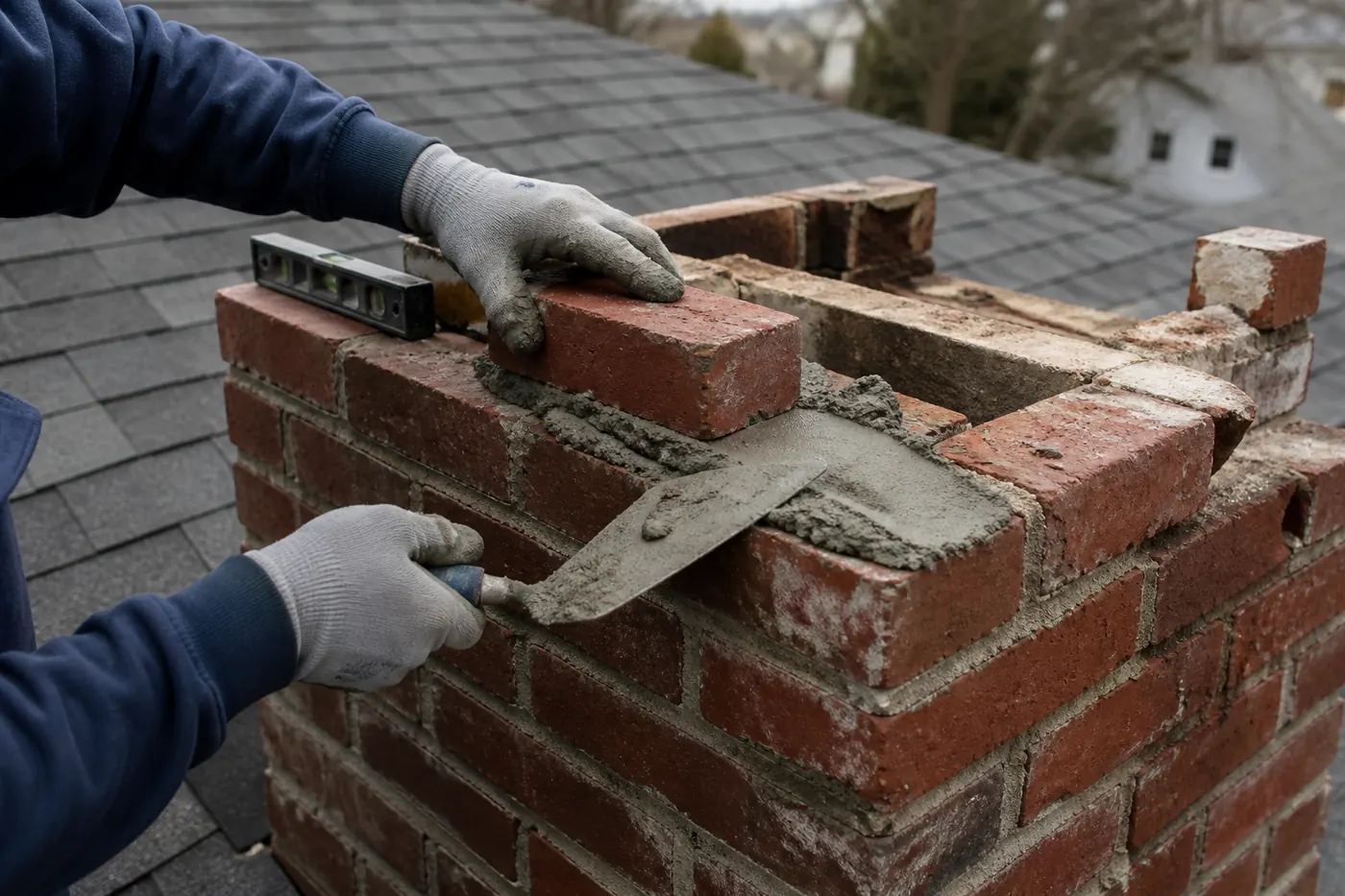
A chimney rebuild in Boston costs $2,000 to $4,500 for a partial rebuild and $4,000 to $10,000 or more for a full one. It is the job for a stack that is too broken to patch: the failed masonry is taken down and built again. A $49 inspection shows where sound masonry ends and removal should begin, and the $49 is credited toward the work if you approve it.
- A Boston chimney rebuild is $2,000 to $4,500 for a partial job and $4,000 to $10,000+ for a full one.
- Rebuilding comes after repair has stopped being enough: loose units, deep loss, lean or repeated failed patches.
- The biggest question is where to stop taking material down, and the inspection answers it.
- The $49 inspection is credited toward approved work, and you receive photos and a written price first.
What a chimney rebuild is, and what it is not
A rebuild means taking down part or all of the chimney's masonry and building it back with new or reused brick, new mortar and a new top. It is the largest of the masonry jobs. It is not a repair with a bigger bill. It is a different kind of work, because the old material is removed and the new work stands on whatever sound masonry is left.
That last point is the heart of the matter. A rebuild is only as good as the base it is built on, and that is why the technician spends time on the base before talking about the new brick. If the stack is taken down to a level where the old masonry is solid, the new work can be tied into it and act as one piece. If the cut is made too high, you build on weak material. If it is made too low, you pay to demolish brick that was fine.
Most chimney problems never reach this stage. If your damage is limited, a smaller repair is the right job, and the chimney repair page helps you decide. This page is for the cases where repair has run out of road.
Signs that the chimney has moved past repair
No single sign settles it. A technician reads these together and looks at how widespread each one is.
- Several loose or displaced bricks at once. One loose brick is a repair. A cluster, or bricks that have shifted out of line, means the bond in that part of the stack has gone.
- Deep face loss across a number of courses. If layers of brick have flaked away over many rows, there may be too little thickness left to hold a new joint.
- A leaning or visibly displaced stack. A chimney that tilts, or sits off the line it once had, is a structural concern and a reason to act soon.
- Repeated patches that keep failing. When the same area has been fixed more than once, the surrounding masonry is usually too weak for patches to hold.
- Mortar and brick both broken down. New mortar needs sound brick to grip, and sound brick needs sound mortar to sit on. Without either, repair has nothing to work with.
- A top that cannot carry a new crown. If the upper rows are too poor to support a new crown or the termination above the flue, the top has to come down.
If several of these describe your chimney, ask for the inspection before the next storm season. Photos from the visit make the case clear, whichever way it goes.
What a failing stack does to the rest of the house
A chimney that is breaking down is not only a problem for the chimney. It is a hole in the top of the house, and the damage spreads along the path the water takes.
Rain that enters a broken stack runs down through the masonry and into the framing around it. It can stain ceilings, soften the wood around the chimney and damp the walls of the rooms beside it. Where a stack passes through an attic, you may find dark marks or a musty smell long before you see anything on the outside.
Falling pieces are the second risk. Bricks and mortar that drop from a high stack land on the roof, the gutters, a deck or the ground, and they can crack shingles or hurt someone. The cost of those secondary repairs belongs in the decision. A rebuild done in time may be smaller than the roof, ceiling and framing repairs that follow a long delay.
Smoke and draft matter too. When the top of a stack is broken, the way gases leave the flue can change, and a damaged termination may let rain and animals in. If you notice smoke entering a room, the fireplace drawing poorly or a smell near the hearth, stop using it until it has been looked at.
How a rebuild decision is made
An honest rebuild recommendation is built on evidence you can see. Here is what the technician works through.
Mapping the height and the faces affected
The first step is to find how much of the stack is involved. Damage may be limited to the top few rows, or it may run from the cap down to the roof. The technician records which faces and which heights are poor, so the scope can be sized to match.
Checking below the roofline
Damage seen above the roof can continue into the part of the chimney you reach from the attic or the upper floors. The technician checks whether it does. A stack that is sound at the roof but poor above it is a different job from one that is poor all the way down.
Looking at the liner and the top
The flue liner and the way it ends at the top are part of the picture. If the top rows come down, the liner's finish and the crown must be dealt with as well, and that affects the plan. A damaged liner is its own question, and it is quoted separately in writing after the inspection.
Setting the line of demolition
The scope names exactly where taking down will stop and how the new work will tie into what remains. You are shown the line in photos, so you can see why it was chosen.
Partial rebuild, rebuild from the roofline and full reconstruction
Rebuilds come in three sizes. The right one is the smallest that leaves you with a sound chimney.
Partial rebuild of the upper courses
This is the most common. The top rows of the stack, which take the worst weather, are taken down and laid again, and the lower masonry stays. It suits a chimney where the damage is high up and the part below is still solid.
Rebuild from the roofline
If the whole stack that stands above the roof is unsound, it is taken down to the roofline and built again to its full height. The part inside the house, below the roof, stays if it is in good order.
Full reconstruction
The whole chimney is rebuilt only when the retained structure cannot perform. This is the biggest and most costly job, and it is the last choice, not the first. Where a chimney is no longer wanted at all, chimney removal is a different route, and it is priced after inspection.
In every case, sound brick that matches the rest can be reused where it is in good condition. Reuse helps the new work look like the old, and it also cuts the amount of new material needed. Brick that has lost its face, or that crumbles when handled, is not worth saving, and the scope should say so.
How the rebuild work is carried out
A rebuild is a construction job with a plan. Here is what it generally involves, so nothing surprises you.
- Setup and protection. Staging or access equipment is arranged, and the roof, gutters, siding and nearby plants are protected against falling debris.
- Weather cover. The open chimney is kept covered where needed, so rain does not enter the house while the work is under way.
- Controlled takedown. The failed masonry is removed down to the agreed line, and the debris is lowered or collected, not dropped.
- Preparing the tie-in. The top of the retained masonry is cleaned and made level so the new courses bond to it.
- Building back up. Brick is laid in fresh mortar, course by course, with joints tooled to match the style of the house.
- Finishing the top. A new crown goes on, along with the cap or termination, and the flashing is set where the chimney meets the roof if it is in the agreed scope.
- Clean-up and review. Debris is cleared, and you are shown the result with photos.
Mortar needs mild, dry conditions to set, so rain, cold or high wind can move the work. Ask what the plan is if the weather turns, and what the cover arrangement will be at the end of each day.
The new crown, flashing and cap that come with a rebuild
A rebuilt stack is only as durable as its top and its roof joint. These parts are where most future leaks begin, so they belong in the rebuild scope, not in a later job.
The crown is the slab that caps the masonry. Built fresh, it can be shaped to overhang the stack and shed water well clear of the brick. The cap above the flue keeps rain and animals out. The flashing, where the chimney meets the roof, is the metal that seals the joint. If the old flashing is reused on a new stack it may not line up, so it is commonly redone.
Each of these has its own page if you want the detail: chimney flashing repair explains how the roof joint is sealed. Ask the written scope to say clearly whether each part is included, replaced or left alone, so the price is complete and you do not meet a second bill at the end.
It is also worth asking how the top of the flue liner will be finished. The way the liner ends affects how the crown is shaped and how well the flue vents.
When repair is the better choice
A rebuild is expensive, and it should not be sold when a smaller job will do. These are the situations in which a repair is the better fit.
- The damage is on one face or in one small area, and the brick beneath is solid.
- The joints are worn but the brick is healthy, which points to repointing, not rebuilding.
- The cause is a cracked crown or open flashing, and the brick has only just started to suffer.
- The stack is straight, firm and not shifting.
The reverse is also true. A repair that is stretched past its limits can cost more over time than a properly sized rebuild, because you pay for the repair, then for the repeat, and then for the rebuild anyway. Think of it as a choice between paying once for the right size of job and paying several times for the wrong size. The inspection should give you a fair comparison, with photos of the failed areas and a written reason for the recommendation.
If another company has told you a rebuild is needed and you are not sure, a second opinion is free when you bring a written report from a reputable local chimney company.
Rebuild price bands in Boston
Two bands cover most rebuilds. The number depends on how much of the stack comes down, how tall and how hard to reach it is, and what the top and the roof joint need. Your price is written after the inspection. For the full breakdown, see the chimney rebuild cost page.
| Rebuild | What it covers | Boston range |
|---|---|---|
| Partial | Upper courses taken down and laid again | $2,000 to $4,500 |
| Full | Whole stack above the roof, or more, rebuilt | $4,000 to $10,000+ |
What moves a job up or down inside a band includes how many faces are taken down, the height of the stack above the roof, how easy it is to set up access, and whether the crown, cap and flashing are included. A narrow chimney on a low roof sits at the lower end of its band, and a tall, wide stack on a steep roof sits at the upper end.
Anything that falls outside these descriptions, such as work on the liner or the firebox, is quoted in writing after the $49 inspection.
Preparing your home for a rebuild
A rebuild is a bigger disturbance than a repair, so a little preparation helps.
- Clear vehicles, grills and furniture from the area under and around the chimney.
- Cover or move valuables in rooms next to the chimney, and expect some dust inside from the work.
- Ask whether the fireplace should stay unused during the job, and for how long.
- Tell the technician about attic, upper-floor or ceiling stains you have noticed.
- Check with your insurer and with your local building department about whether they need to be told, since requirements vary by town.
It helps to have a short conversation with neighbours if the stack sits near a shared wall, as in many triple-deckers and rowhouses. Work at height makes noise, and some debris may land on a neighbouring roof if protection is not planned. Raise this at the inspection so it is part of the written plan.
A rebuild plan should also tell you how the chimney will be left at the end of each working day, so that rain cannot get into the open stack overnight.
When a chimney problem is urgent
Most rebuilds can be planned, but a few signs should not wait. Bricks that have fallen, or are about to fall, can injure someone below or damage the roof. A chimney that is visibly leaning is not stable, and it should be looked at as soon as it can be, with the area beneath kept clear. Water that enters the house with every storm is damaging the structure while you plan.
Delay also changes the cost. When a stack is only partly failed, a partial rebuild may do. If you wait while freeze-thaw cycles keep working on the masonry, the damage can spread down the stack and turn a partial job into a full one.
In an emergency, act first. Any suspected fire, chimney or otherwise, means leaving the house and calling 911. When a carbon monoxide alarm goes off, step outside and dial 911. If gas is in the air, get out and call the gas utility or 911. Never climb onto the roof to check the chimney yourself.
To find out whether your chimney needs a rebuild or something smaller, book the $49 inspection at the contact page or call (617) 404-9587.
Questions homeowners ask
How do I know a chimney needs rebuilding and not just repair?
Look for loose bricks in groups, deep loss across several rows, a lean, or patches that keep failing. The inspection photos should show these and explain why a smaller job would not hold. If they do not, ask for a clearer explanation.
Is a leaning chimney dangerous?
It can be. A lean means the masonry may no longer be bonded or supported properly, and bricks could fall. Keep people and pets away from the area under it and book an inspection promptly. Do not go on the roof to look.
Can the old bricks be reused?
Often some can. Sound bricks that match the rest of the wall can be cleaned and set again, which helps the new work blend in. Damaged bricks are replaced. The written scope should say which will be reused.
Do I need a permit for a chimney rebuild?
That depends on your town and the size of the job. Check with your local building department and your insurer before the work starts. The company can describe the scope to give them, but the requirement is set locally.
Will I be able to use the fireplace during the rebuild?
Plan not to. The chimney is open, covered or partly down while the work happens. Ask the technician how long to leave it unused and when it is safe to use again. Have the chimney checked before the first fire after the work.
How is a rebuild different from chimney removal?
A rebuild builds the chimney back so it works again. Removal takes it out for good, with the roof and interior closed over. Removal is priced by inspection. If you no longer need the fireplace, ask about both.
Related guidance
Start with the Boston cost guide, then read the guides below.
- Chimney Relining Cost in Boston (2026 Prices)
- Chimney Repair vs Rebuild in Boston: How to Decide
- Chimney Removal Cost in Boston: What Sets the Price