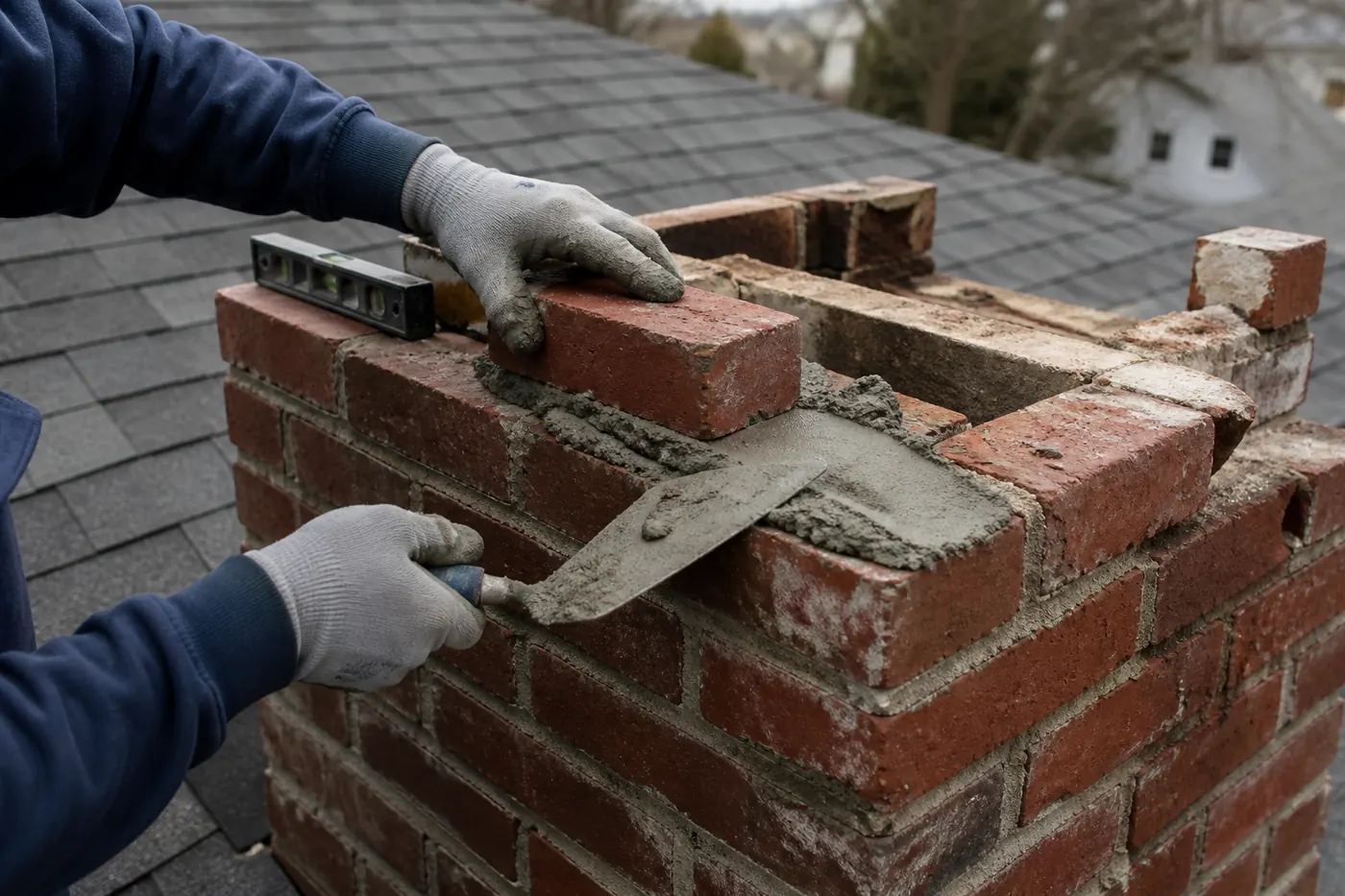
Repair when the brick is sound and the damage is in the mortar, crown, flashing or a few units. Rebuild when the brick itself is failing, or the stack is leaning or loose, across a wide area. In Boston, a partial rebuild runs $2,000 to $4,500 and a full rebuild runs $4,000 to $10,000+, while repairs usually cost a fraction of that.
The options and what they cost
| Work | Typical Boston price |
|---|---|
| Basic masonry repair | $300 to $700 |
| Standard masonry repair | $700 to $2,500 |
| Partial repointing | $300 to $700 |
| Full repointing | $700 to $2,500 |
| Crown repair | $300 to $900 |
| Partial rebuild | $2,000 to $4,500 |
| Full rebuild | $4,000 to $10,000+ |
The gap between the top of the repair list and the start of the rebuild list is small. That is why the decision should follow what the bricks and mortar are actually doing, not what the biggest number is. The chimney repair cost page has more detail on the lower rungs.
Look at the bricks first, then the mortar
A chimney is made of two materials, and they fail differently. Mortar is the softer, sacrificial joint, and it wears out first. Brick is much longer lived, but it can crumble if it stays wet and freezes.
When the problem is mostly in the mortar joints, with bricks that are hard and whole, repointing or targeted repair makes sense. When the bricks themselves are flaking, soft, cracked through or powdering across large areas, new mortar will not hold, because there is nothing solid to bond to.
A simple field test is a screwdriver and a close look. Sound brick rings and resists. Failing brick flakes off in layers or crumbles under light pressure. Failing mortar rakes out easily and leaves deep gaps.
Do not rely on a single spot. Check the top courses, the middle of the stack and the part above the roof line, because moisture and wind attack them in different ways. A technician who tests several areas and photographs each one can tell you whether the problem is local or widespread, and that single fact usually decides which way the project goes.
Also ask whether the damage is on the sides facing the weather. Brick on the north or windward side of a Boston chimney often stays wetter and freezes more, so the wear is not always even around the stack.
Signs that point toward repair
- Mortar is receding in some joints but the bricks around them are firm.
- A handful of bricks near the top are cracked or chipped, with the rest in good order.
- The crown is cracked or missing patches, but the stack is straight.
- Flashing has pulled away, causing leaks at the roof line.
- Damage is concentrated near the top, where weather hits hardest.
In these cases a focused fix is proportionate, and a rebuild would spend money replacing good masonry. Related repairs include chimney repointing, crown repair and flashing work.
Signs that point toward rebuild
- Bricks are crumbling, flaking or hollow-sounding over many courses.
- The chimney leans, bows or has stair-step cracks running through the wall.
- Sections have shifted or are loose enough to move by hand.
- Past patches have failed, and the same area keeps deteriorating.
- Water has been getting in for years, and the damage runs well below the roof line.
If you see bricks falling or the stack moving, keep people away from the area beneath it and call for an inspection quickly. For the larger option, read about chimney rebuild work, and see our chimney rebuild cost page.
How far down does the damage go?
A rebuild does not have to take the whole chimney down. In a partial rebuild, the mason removes masonry from the top down to a sound line and rebuilds it with new or salvaged brick and fresh mortar. In a full rebuild, the stack is taken down much further, sometimes to the roof or below.
The key question is where the sound brick begins. Ask the estimator to mark that line on a photo and to say what stays and what goes. If one company proposes a full rebuild and another a partial rebuild for the same chimney, the difference is usually where each of them thinks the good masonry starts.
What belongs in either quote
Whichever way you go, the top of the chimney is part of the job. A rebuilt or repaired stack that gets a poor crown, a missing cap or loose flashing will start failing again.
- Crown. New or repaired so water runs off, not in.
- Cap. Fitted over the flue to keep out rain and animals.
- Flashing. Where the chimney meets the roof, tied in so it does not leak.
- Liner top. The flue tile should extend above the crown and be sound.
- Cleanup. Debris removed, roof protected, and a plan for any weather delay.
If these items are missing from one quote and included in another, the lower price is not really lower.
Why price alone is a poor guide
A cheap quote is not necessarily a bargain, and a high one is not necessarily better. A low repair price on a chimney that needs a rebuild means you pay twice. A rebuild price on a chimney that needed repointing means you pay for brick you did not need to replace.
Ask each company to explain, with photos, why it chose repair or rebuild, which bricks are failing, and what will happen if you wait a year. Compare the same boundaries: the same height of masonry, the same crown and flashing work, the same cap. Our post on repointing vs rebuilding a brick chimney goes deeper on the mortar side of the choice.
Boston conditions that push the decision
Cold winters, freeze-thaw cycles and coastal moisture are hard on brick that stays wet. Older brick homes, rowhouses and triple-deckers often have chimneys that have been patched more than once, which makes it important to see how the past work is holding up.
A quick way to sort your own chimney
- Stand in the yard and look at the stack with binoculars. Is it straight, or does it lean or bulge?
- Look for bricks with peeled faces, white powder or pieces on the ground or roof below.
- Note where water stains show up inside the house after a storm.
- Write down how old any earlier repair is and whether it has held.
- Take photos, then let a technician confirm what you are seeing from the roof.
Never go onto the roof yourself to check. If anything is loose or falling, keep people and pets away from the base of the chimney.
A written, photographed inspection is the fair way to settle the question. The $49 inspection is credited toward approved work, and any repair or rebuild price is given in writing before work begins. Book it at /contact/ or call (617) 404-9587, and ask the technician to show you the sound line on the stack.
Questions homeowners ask
Can I repair now and rebuild later?
Sometimes, if the damage is limited and the stack is stable. A repair that treats only the symptoms of a failing chimney tends to be short-lived, so ask how long the technician expects the repair to hold and what signs would mean a rebuild is coming.
Does a leaning chimney always need rebuilding?
A lean or a stair-step crack is a serious sign, and it needs a close inspection. The cause could be foundation movement, water damage or a poorly built stack. The right fix depends on what is found.
Will repointing fix crumbling bricks?
No. New mortar can only grip sound brick. If the faces are flaking, the failed bricks need replacing first, and the water source needs to be fixed.
Do I have to rebuild the whole chimney if only the top is bad?
No. A partial rebuild takes down the damaged upper section to a sound line and rebuilds it. That is usually less than a full rebuild.
Should the flue liner be replaced during a rebuild?
Only if the inspection shows it needs it. A rebuild is a convenient time to deal with a damaged liner, but replacement is quoted separately and only when the camera or the technician finds a defect.