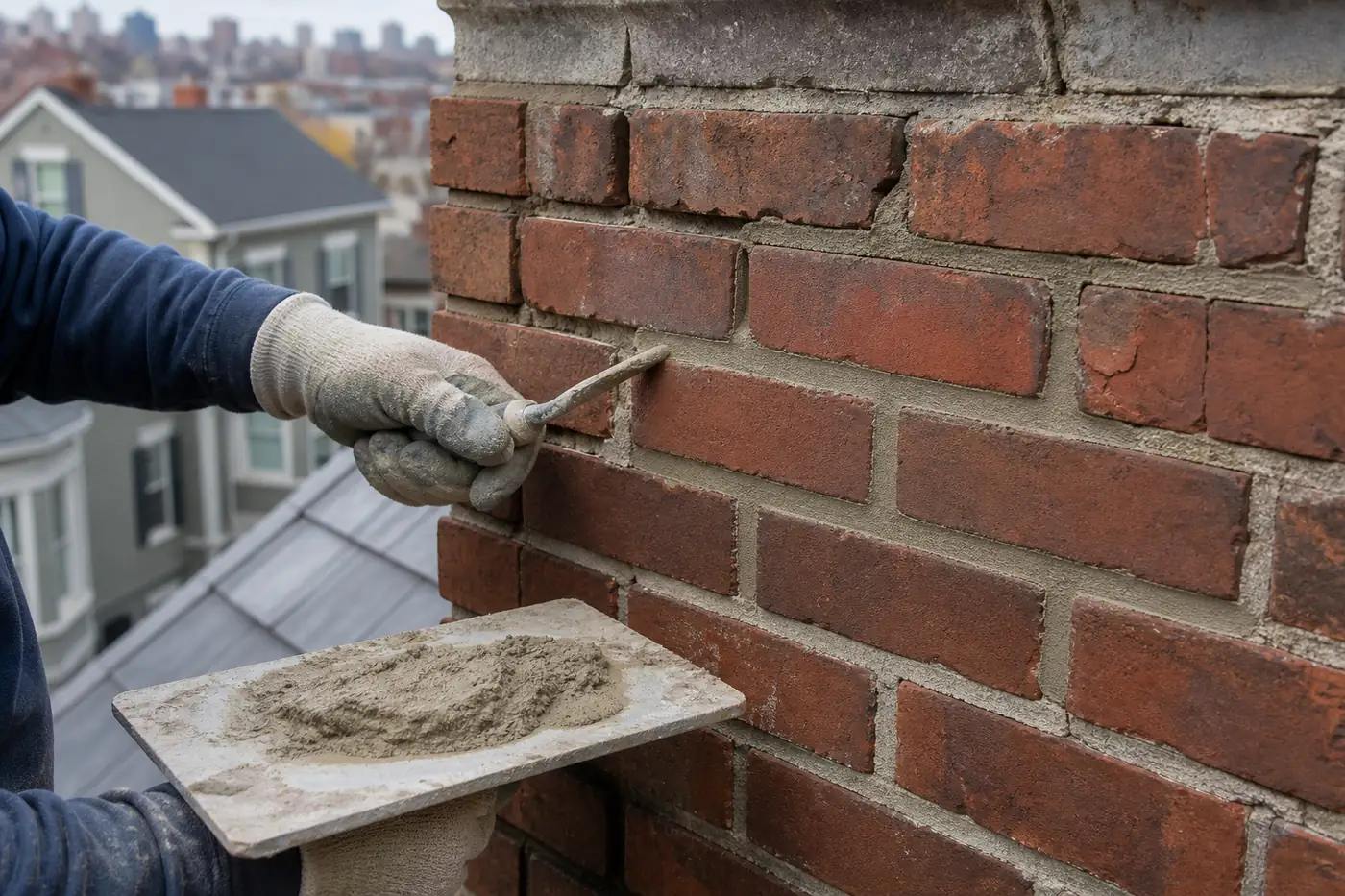
Partial tuckpointing on a Boston chimney costs $300 to $700. Repointing the whole exposed stack costs $700 to $2,500. The price follows how many feet of mortar joint need work and how hard the stack is to reach. A $49 inspection, credited toward approved repair, gives you the written number.
Tuckpointing and repointing: same job, two names
Homeowners hear both words and wonder if they are different. In a chimney quote they usually mean the same thing: removing worn mortar from between the bricks and packing in fresh mortar. Strictly speaking, tuckpointing adds a thin contrasting line to make joints look crisp, while repointing is the structural fix. In practice, Boston contractors use the terms loosely, so ask what is actually being done.
| Scope | 2026 Boston price |
|---|---|
| Partial repointing, a few areas | $300 to $700 |
| Full repointing of the exposed stack | $700 to $2,500 |
Our repointing cost page carries the same figures, and the repointing service page shows the work step by step.
Why mortar fails on Boston chimneys
Mortar is the soft, sacrificial part of a brick wall. It is meant to wear before the brick does. A chimney is the most exposed masonry on the house: wind hits it from all sides, rain soaks it, and there is no roof or wall to shelter it.
Greater Boston winters make that worse. Water enters a tiny crack, freezes, and expands. When it thaws, the crack is a bit wider. Repeat that over many winters and the joint turns sandy, then hollow. Coastal salt air and nor'easters add more stress.
You can spot the early signs from the ground:
- Grit or sand at the base of the chimney.
- Recessed joints you can see a shadow in.
- Gaps where a brick is visibly loose.
- White powdery deposits, which suggest moisture moving through the wall.
How the work is done
Good repointing is slow, careful work. Here is the usual order.
- The technician sets up on the roof, with protection for shingles and flashing.
- Failed mortar is cut out to a consistent depth, deep enough for new mortar to bond, without chipping the brick edges.
- Dust and loose bits are cleaned out of the joints.
- The joints are dampened so the old brick does not pull water from the fresh mortar too fast.
- New mortar is packed in layers, then tooled to a matching profile.
- Excess mortar is brushed off, and the area is cleaned without harsh methods.
Smearing a thin skin of mortar over shallow, crumbling joints is a shortcut that fails within a season or two. If a quote does not mention cutting out old mortar to depth, ask about it.
What decides where you land in the price range
The same chimney can land near the low or the high end of its range depending on four things.
Total length of joints
A tall double-flue stack has far more joint length than a short single chimney. Measuring linear feet is how a fair price is built.
How much mortar is actually bad
If joints are loose in a few patches, you pay partial rates. If they are failing all the way around, you are looking at full repointing.
Matching the old mortar
Old brick often needs a softer mortar than modern mixes. A hard, dense patch beside soft historic brick can crack the brick instead. Matching color and tooling also takes time.
Height and access
A steep roof, a tall stack, or a chimney that is hard to reach adds labor and safety setup.
Reading your quote: partial or full?
The line between partial and full is about how much of the stack needs work, not about how big the chimney looks. Here is a simple way to think about it.
- Partial work fits when the problem is limited to one face, a few courses near the top, or a handful of open joints. That is the $300 to $700 range.
- Full repointing fits when joints are failing across most of the exposed stack, which is the $700 to $2,500 range.
Sometimes a contractor will quote full work because it is easier to schedule one visit than two. That can be reasonable, but ask for the reasoning in writing. You should be able to see in the photos that the mortar is bad where the quote says it is.
Also ask what part of the chimney the price covers. The visible stack above the roof is the usual scope. The part inside the attic or below the roofline is often hidden, so any extra needs to be named separately rather than discovered mid-job. If the technician cannot safely see a section from the roof, that limit should be written into the quote too, along with what happens to the price if it turns out to need work.
What tuckpointing will not fix
Repointing works when the bricks themselves are sound. It cannot fix a stack that leans, bulges, or has bricks with faces broken off. It also will not stop a leak that comes from a bad crown or failed flashing.
If the inspection shows more than mortar trouble, you will see additional lines in the quote, for example:
- Crown repair at $300 to $900, or a rebuild at $900 to $2,500.
- Flashing repair at $200 to $400, partial at $400 to $800.
- Waterproofing from $300 to $500 for a standard application.
Deep brick damage may call for a partial chimney rebuild at $2,000 to $4,500. Our guide on repointing versus rebuilding a brick chimney explains where that line sits. Brick faces flaking off? Read about spalling bricks and freeze-thaw damage.
When to schedule the work
Mortar needs mild, dry weather to cure well. Late spring, summer, and early fall are the easiest windows in Greater Boston. Hard freezes and heavy rain are poor conditions, and a good contractor will say so rather than rush a job into bad weather.
That does not mean you should wait until July if you see trouble in February. Loose bricks and open joints let in more water every week. Get the inspection first, find out the scope, and then plan the repair for the right weather. If something looks unsafe, such as a visibly loose top course, keep people away from beneath it and call.
Comparing tuckpointing quotes
Ask each company the same questions.
- Roughly how many linear feet of joint are included?
- How deep will old mortar be cut out?
- What mortar type will be used, and is it matched to my brick?
- Does the price cover just the chimney above the roofline, or the portion below too?
- What is left out, such as the crown or flashing?
A technician who photographs the joints and ties each photo to a line in the estimate is easy to compare. Photos of what the technician finds come with every inspection we do.
To get your own written number, book the $49 inspection at our contact page or call (617) 404-9587.
Questions homeowners ask
How often does a chimney need repointing?
There is no fixed schedule. It depends on the mortar, the exposure, and the weather it has been through. A yearly inspection catches joints early, while repair is still small.
Can I just seal the cracks with caulk?
Caulk is not a masonry repair. It peels, traps moisture, and hides worsening joints. Mortar joints need to be cut out and refilled with mortar that matches the brick.
Will new mortar look different from the old?
Fresh mortar is usually lighter at first and weathers closer to the old over time. A good match in color and joint shape makes the repair blend in.
Is repointing the same as waterproofing?
No. Repointing restores the joints. Waterproofing is a separate step, typically a breathable sealer, that goes on afterward if it is needed. Each is quoted on its own.
Do I need repointing if only one side of the chimney looks bad?
Often the weather side wears first. Partial work on that face can be enough if the other sides are sound. The inspection shows how far the problem really goes.