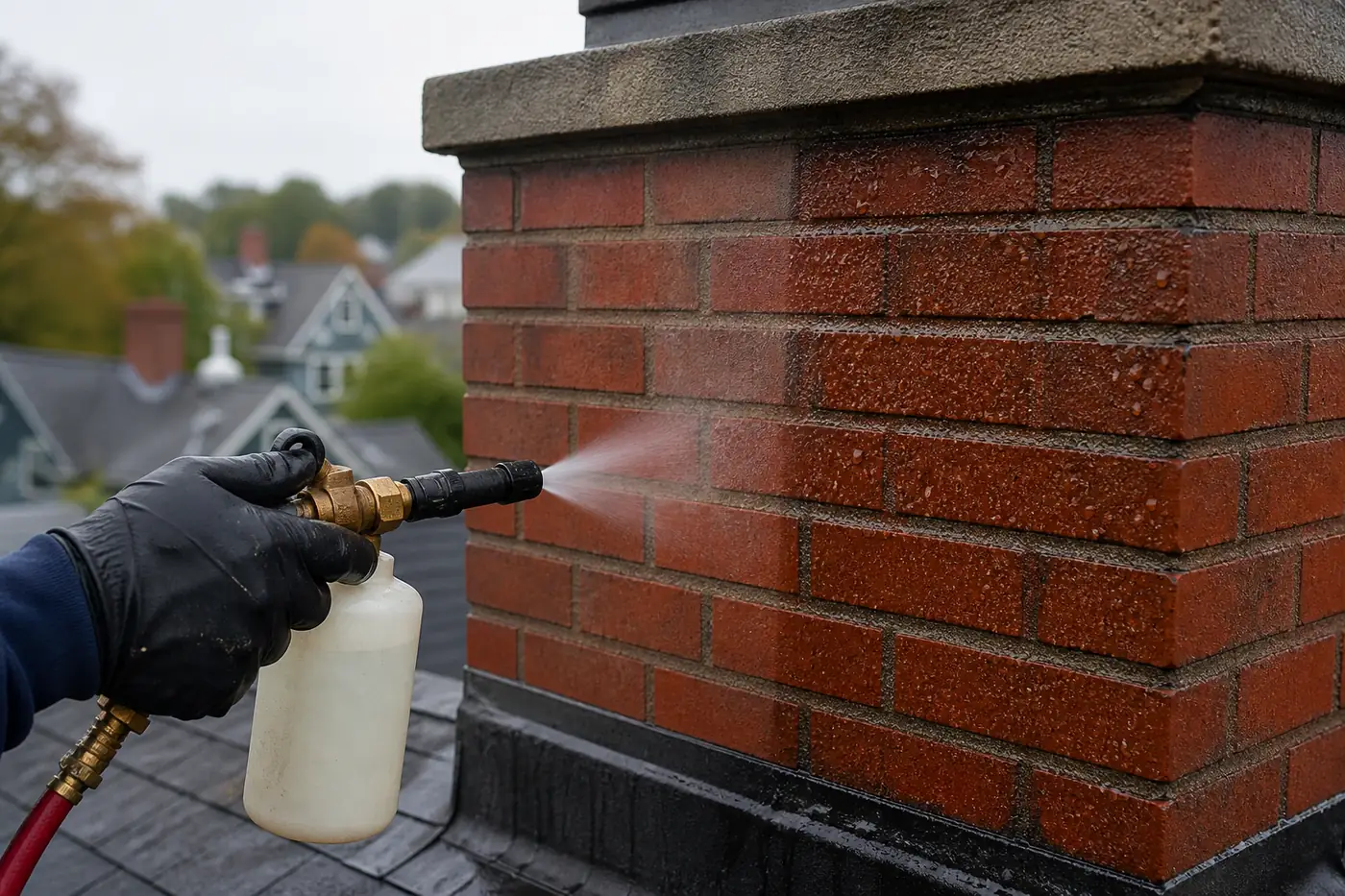
In Boston, standard chimney waterproofing costs $300 to $500, waterproofing with a crown seal costs $500 to $800, and a full system starts at $800. Where you land depends on the size of the chimney, how much prep it needs, and whether repairs have to come first. A written price follows the $49 inspection.
Three price tiers and what each one includes
| Tier | Boston price | What it generally covers |
|---|---|---|
| Standard | $300 to $500 | Cleaning the brick face and applying a breathable water repellent to the masonry |
| With crown seal | $500 to $800 | The same treatment, plus sealing the crown, the top slab that sheds water |
| Full system | From $800 | Repellent, crown seal and the added protection and prep that a larger or more worn chimney needs |
These are planning ranges, not a promise. The final number is a written price after the technician sees the chimney, because a short single-flue stack on a ranch is a smaller job than a tall stack on a three-story house with a hard-to-reach roof.
If you want to know how those tiers compare with other work, our chimney waterproofing page explains the process step by step.
A practical way to think about the tiers: standard suits a chimney in good shape that simply needs protection. The crown seal tier suits one where the top slab is sound but hairline cracks or wear are starting to show. The full system tier is for larger, taller or more weathered chimneys, or ones where several surfaces need attention in one visit.
What waterproofing actually does to brick
Brick and mortar are not solid like a pane of glass. They are full of tiny pores that soak up water the way a sponge does. A chimney is the most exposed part of a house: rain hits it from the sides, snow piles on top, and there is no roof over it.
A water repellent is a clear liquid that soaks into the surface and lines those pores so water beads and runs off instead of soaking in. The key word on the label is breathable. The product should block liquid water but still let water vapor escape from inside the masonry. A thick coating that traps moisture is a mistake, because trapped water can push the face of the brick off when it freezes.
Waterproofing does not make a chimney fully sealed or invincible. It lowers how much water the masonry absorbs, and it works only on masonry that is already in sound shape.
You can often see where a chimney needs help from the ground. Dark, damp-looking patches after rain, green moss on the north side, and brick faces that flake or powder are all signs the masonry is holding too much water. Take a photo of any patch you notice, because it helps the technician see what changes from season to season.
Why Boston chimneys take a beating
Greater Boston has the weather that masonry likes least. Winter brings repeated freeze-thaw cycles: water soaks into brick on a mild afternoon, freezes overnight, expands, and chips at the surface. Nor'easters drive rain sideways into the brick. Coastal neighborhoods add salt in the air, which can leave white deposits and speed up decay.
Older brick homes, triple-deckers and rowhouses make this worse, because soft historic brick and lime-rich mortar absorb water more easily than modern materials. Our post on freeze-thaw damage in Boston shows what that cycle does to a chimney over time.
Treating a chimney with repellent before the damage gets deep is a cheaper way to slow that wear. Treating one that is already falling apart is not.
Repairs usually come before the repellent
This is the single most important point in the guide. Repellent goes on sound masonry. If your chimney has open mortar joints, a cracked crown or loose brick, the water still has a direct path in. Those problems get fixed first, and then the surface is treated.
- Open or crumbling mortar: Repointing, partial $300 to $700 and full $700 to $2,500, comes before sealing. See chimney repointing.
- Cracked crown: Crown repair is $300 to $900, and a rebuild is $900 to $2,500. Our chimney crown repair page explains the difference.
- Failed flashing: Flashing repair is $200 to $400, partial $400 to $800, and full $800 to $2,500.
- Loose or spalled brick: Masonry repair is $300 to $700 for basic work, $700 to $2,500 for standard work, and from $2,500 for major work.
Be wary of anyone who offers to simply spray sealer over visible damage. It looks neat for a season and then the problem returns.
What moves the price up or down
Here is what shapes your written price:
- Surface area. More brick, more repellent and more labor.
- Cleaning needed. Soot, moss, white salt deposits and old stains must be removed first so the product soaks in.
- Absorbency. Soft, old brick can drink up more product than dense, hard brick.
- Height and roof access. A steep roof or a tall stack means more setup and time.
- Protection of nearby surfaces. Roofing, siding, windows and plants need covering during the application.
- Crown condition. A sound crown can be sealed. A failing one needs repair first.
- Weather window. The surface needs to be dry and the temperature in range for the product to cure, so the schedule may shift.
Notice that the repellent itself is only part of the cost. Preparation and access usually decide the final total.
When waterproofing is not the answer
Sometimes a homeowner calls for waterproofing when the real problem is something else.
You have an active leak
If water is coming into the room, a repellent will not stop it. A leak has a source: flashing, a crown crack, a failed cap or an open joint. Leak repair is $400 to $3,000 depending on the cause. Find that source first.
The brick is falling apart
If bricks are crumbling or flaking in layers, the brick has already failed. Sealing will not bring it back. The honest fix is repair or a partial rebuild.
The stains are white and powdery
White deposits are salts carried out of the masonry by moisture. A repellent can lower the moisture, but the wet source still needs to be found.
A fair inspection tells you which of these you have, so you spend money in the right order.
Questions to ask before you approve, and how to book
- Is the product breathable, and is it made for masonry?
- What repairs, if any, must happen before it goes on?
- Does the price include cleaning the surface and sealing the crown?
- How will nearby roofing, siding and plants be protected?
- What weather does the job need, and what happens if it rains?
- How can I tell later that it is working?
A simple test is the bead check: after the treatment cures, sprinkle water on a dry spot of brick. It should bead up and roll off. If it soaks in and darkens the brick, tell your technician.
Treatment wears down over time, so expect to have it looked at during future yearly visits. Your technician can tell you what to watch for. To get a written price with photos, book the $49 inspection at /contact/ or call (617) 404-9587.
Questions homeowners ask
Can I waterproof my chimney myself with a hardware store sealer?
Some products are not breathable and can trap water in the brick, which causes damage in freezing weather. Working on a roof is also dangerous. A technician picks a masonry-rated, breathable product and applies it safely.
Does waterproofing stop white stains on my chimney?
It can reduce them by cutting down the water that carries salts through the brick. If the stains keep coming back, something above, such as the crown or a joint, is likely letting water in and needs repair.
Is waterproofing worth it on a brand-new chimney?
New masonry in good shape may not need it right away. Ask your technician to look at the brick type and crown. If water is beading and the mortar is tight, you may be able to wait.
Will waterproofing change how my brick looks?
A good breathable repellent is clear and should not leave a shiny film. Test a small hidden spot if you are concerned. Cleaning before treatment can make the brick look fresher, which is a separate change.
Does the $49 inspection count toward the waterproofing job?
The general inspection is credited toward approved repair work. Ask how it applies to your written price, especially if repairs come before the repellent.