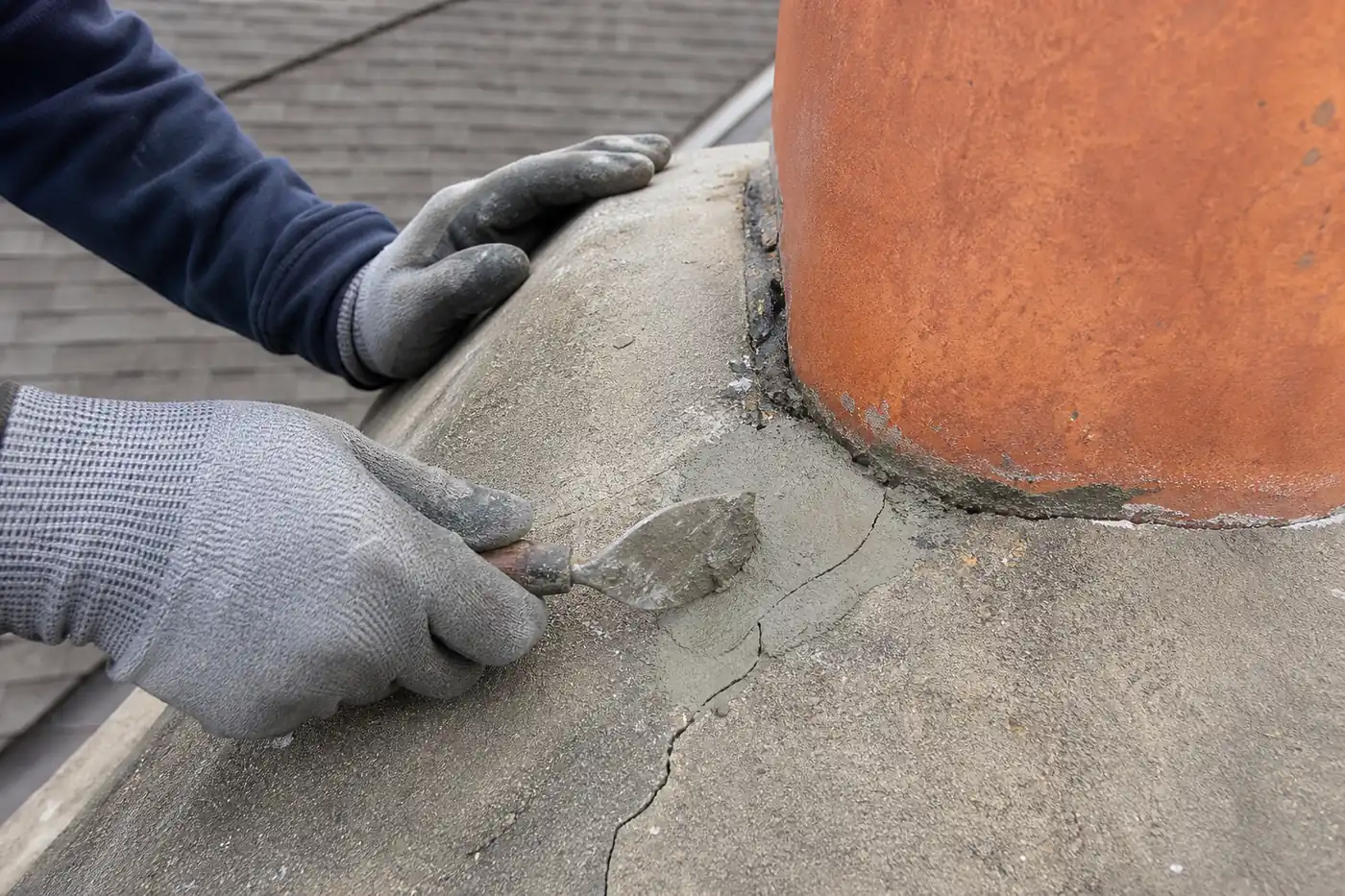
Look for hairline or wider cracks across the flat concrete top of the chimney, crumbling edges, standing water after rain, or white staining and damp on the brick below. In Boston, crown repair typically costs $300 to $900, and a full rebuild runs $900 to $2,500. A small crack is a maintenance item. A crack that lets water in is how a minor problem becomes a chimney rebuild.
What the crown does
The crown is the slab of mortar or concrete that caps the top of a masonry chimney. It sits around the flue tile and slopes outward to shed rain and melting snow away from the brick. A good crown overhangs the sides of the chimney a little, so water drips clear of the wall instead of running down the face.
It is different from a chimney cap. The cap is a metal hood over the flue opening. The crown is the masonry that covers everything else. If you want to see how the two fit together, read our post on the cap versus chase cover.
The crown takes the worst weather on the house. It is exposed to sun, rain, ice and wind all year, and it never gets the benefit of a roof overhead. Greater Boston adds freeze-thaw cycles, which are hard on any concrete that can absorb water.
Signs you can spot from the ground
You should not climb to the roof to check. Use binoculars from the yard or take a zoomed photo with your phone, and look for:
- Dark lines or branching cracks across the top surface
- Chunks missing at the edges, or pieces on the roof, gutters or ground
- Moss, algae or dark streaks that suggest water sits on top
- White powder on the brick below the crown, called efflorescence
- A visible gap between the crown and the flue tile
- A crown that looks flat, rough or patched with something like tar or caulk
Inside the house, watch for staining on the chimney breast, a damp smell near the fireplace, and rust on the damper. Those can be the downstream effect of water getting in at the top.
Timing helps
The best time to look is the morning after a rain or a thaw, when a crown that holds water still shows damp patches or a shiny film. In winter, check for icicles or ice stuck to one side of the stack, which can point to meltwater running off a cracked top. Make a note of what the weather was, because a technician can use that to separate a surface problem from a deeper one.
Which cracks are cosmetic and which are not
Not every crack means failure. A very fine hairline that does not hold water may be a shrinkage mark that has been there for years. What matters is what the crack does.
| What you see | What it usually means |
|---|---|
| Fine hairline, dry, no staining below | Often monitor and seal at the next visit |
| Wider crack with moss or stain | Water is getting in, so repair soon |
| Crack following the flue tile edge | Seal has failed, water can reach the flue |
| Loose or crumbling edges | Material is breaking down, may need a rebuild |
| Crack that has grown from last year | Movement or ongoing water damage |
Width, depth and direction all matter, and only a close look can tell them apart. Photos taken a few months apart are the easiest way to show whether a crack is growing.
How water turns a crack into a bigger problem
Water gets into the crack, soaks the crown and the brick under it, and freezes when the temperature drops. Ice takes up more room than water, so each freeze widens the crack. Then the next thaw lets in more. This repeating cycle can push the crown apart and force water into the top courses of brick.
The damage often shows up somewhere else first. It may appear as loose mortar joints high on the stack, a wet chimney breast inside, rust in the firebox or a leak at the flashing. Many homeowners spot the symptoms in the ceiling and never think of the crown.
That is the reason to fix the crown early. Compare the numbers: crown repair is $300 to $900. Repointing the brick below runs $300 to $2,500. A partial rebuild runs $2,000 to $4,500. Our guide to freeze and thaw damage explains the cycle in more detail.
Slope, overhang and flue seals
A crown can crack because of how it was built, not just its age. When we assess one, we look at a few design points:
- Slope. The top should shed water outward. A flat or dished crown holds water in a pool.
- Overhang. The edge should project past the brick with a drip edge underneath, so water falls free of the wall.
- Thickness. A thin crown is more likely to crack and flake.
- Flue seal. Where the crown meets the flue tile, there should be a flexible sealant gap, since tile and masonry expand at different rates. A rigid mortar joint there tends to crack.
- Ponding. Leftover water after rain suggests a low spot.
If the problems come from the design, patching the crack alone will not last. The repair has to correct the slope or replace the crown.
Repair or rebuild?
The two main paths depend on how much good material is left. For the full picture, see our chimney crown repair page.
- Repair, $300 to $900. Clean the surface, fill the cracks with a suitable material, and reseal the joint at the flue tile. It works when the crown is solid and the cracks are narrow and stable.
- Rebuild, $900 to $2,500. Remove the failed crown and pour a new one with proper slope, overhang and a flexible seal. This is the right choice when the crown is crumbling, thin, badly pitched or cracked through.
A waterproofing treatment with a crown seal runs $500 to $800 and may be added to protect the brick underneath. Masonry work needs suitable weather to cure, so repairs are best planned for mild, dry conditions.
Prices depend on size, access and the condition under the crown. A written price comes after the inspection, and you see photos of what the technician finds before you decide. Our crown repair cost guide has more.
What to do now
You can handle the first steps from the ground:
- Take a zoomed photo of the top of the chimney and note the date
- Check the ceiling and walls near the chimney for stains
- Look again after the next heavy rain or thaw
- Do not try to patch the crown yourself, since the wrong material or a bad application can trap water
If you are in the middle of winter, a temporary measure by a professional may make sense until the weather improves. Ask your technician about options. For a documented look at the crown, book the $49 inspection, credited toward approved repair work, at /contact/ or call (617) 404-9587.
Questions homeowners ask
How long can I leave a hairline crack in the crown?
A dry, stable hairline is often watched through a season, but water can widen it. Take photos now and again after winter. If the crack grows or you see staining below it, have it checked.
Can caulk or roof tar fix a cracked crown?
They can trap moisture and fail within a season. A proper repair uses masonry-grade material and addresses the slope and the flue seal. Surface patches often hide the real problem.
Does a cracked crown mean the whole chimney is bad?
Not necessarily. Many chimneys need only a crown repair. The inspection checks the brick, mortar and flashing below to see whether water has caused more damage.
What is the difference between a crown and a cap?
The crown is the masonry slab around the flue at the top. The cap is a metal hood over the flue opening. A chimney should have both, and each does a different job.
Why does my chimney crown stay wet after rain?
Standing water usually means a low spot, poor slope or cracks that hold moisture. That water soaks in and freezes in winter. A technician can tell you whether it needs a repair or a rebuild.