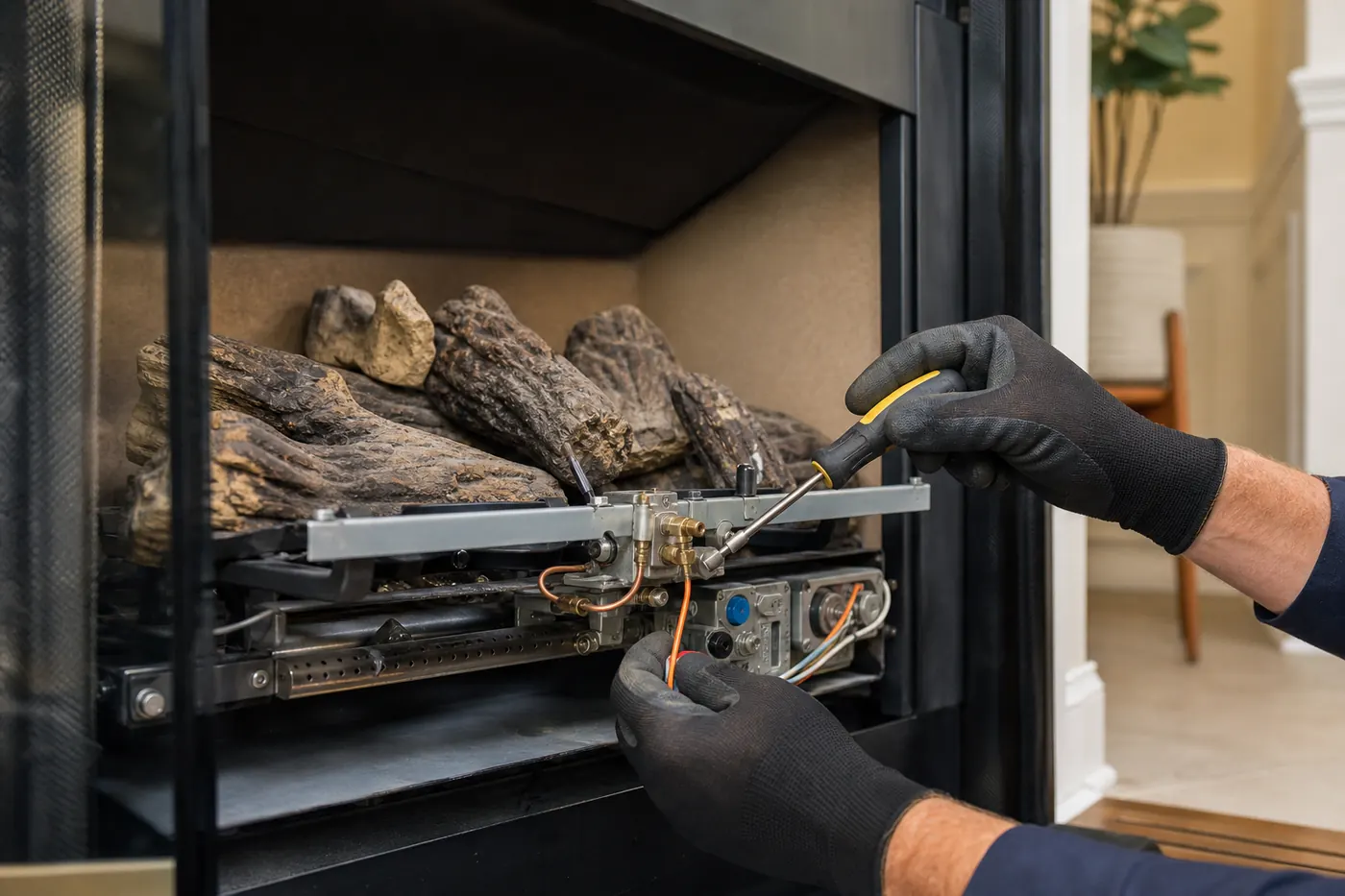
Gas fireplace repair in Boston is $299 to $900 for most fixes, and a full gas kit or burner replacement is $900 to $1,500. The part that failed and the model you own decide where you land. If you smell gas, leave the house and call the gas utility or 911 before anything else.
Safety first: when to stop using the fireplace
Gas appliances are safe when they work and risky when they do not. Stop using the fireplace and call for service if you notice any of these.
- A smell of gas near the unit. Leave and call the gas utility or 911.
- Soot on the glass, walls, or logs, which can mean incomplete burning.
- A carbon monoxide alarm that sounds. Leave and call 911.
- The flame shuts off on its own again and again.
- A yellow, lazy flame where it used to be blue and steady.
- Rattling, popping, or a delayed whoosh when the burner lights.
Do not try to adjust the gas valve, bend parts, or bypass a safety control. A fix that looks harmless can cause a leak or carbon monoxide trouble. Treat anything involving gas as a job for a trained technician.
Price ranges at a glance
| Service | 2026 Boston price |
|---|---|
| Gas fireplace cleaning | $299 |
| Gas fireplace repair | $299 to $900 |
| Full gas kit or burner replacement | $900 to $1,500 |
Repairs start at $299 for a typical fault. If a part is inexpensive and easy to reach, the bill stays near the bottom. A hard-to-find part, a control board, or a replacement burner pushes it higher. A new appliance or hidden building work is a separate quote.
Our fireplace repair cost page shows the same ranges for all fireplace types, and the fireplace repair service page explains how a visit works.
Symptom to likely cause
This table is a rough guide for understanding a quote, not a tool for fixing the fireplace yourself.
| What you notice | What a technician often checks |
|---|---|
| Pilot light will not stay lit | Thermocouple or thermopile, pilot assembly, draft |
| Burner will not ignite | Ignition module, wall switch or remote, gas supply |
| Flame lights then dies | Flame sensor, dirty pilot, venting |
| Sooty glass or logs | Log placement, burner ports, air mixture |
| Odd smell when on | Dust on the burner, seals, venting leaks |
| Remote or switch does nothing | Batteries, receiver, control wiring |
A good technician starts at the cheapest likely cause and works up. If you get a quote that jumps straight to a full kit replacement, ask which tests led there.
Repair or replace the gas kit?
A repair fixes one failed part. Replacing the gas kit swaps the burner, logs, and controls at once. The right choice depends on age, parts, and how many things are failing.
Repair when
- One component has failed and the rest looks sound.
- Parts are still available for your model.
- The fix lands well below the replacement range.
Replace when
- The burner is corroded or cracked.
- Several parts are failing at the same time.
- Parts for the model are no longer sold.
- The kit is old enough that repairs would add up toward the $900 to $1,500 cost of a new one.
Ask for the written estimate to show both options side by side, so you can see what you would be paying for each.
What the main parts do
Knowing the vocabulary makes a quote easier to read. Most gas fireplaces share the same basic parts, even when the brand differs.
Pilot assembly
A small standing flame, or an electronic spark in newer units, that lights the main burner. If the pilot goes out, the gas to the burner stops.
Thermocouple or thermopile
A sensor that sits in the pilot flame. It tells the valve that a flame is present. When it wears out, the pilot will not stay lit. It is one of the more common repairs.
Ignition module and controls
The electronics that start the sequence when you press the switch or remote. Dead batteries in a remote or receiver can look like a failed unit, so check those with the technician before assuming the worst.
Burner and logs
The burner spreads the gas flame. The ceramic logs sit above it in a pattern that matters. Logs knocked out of position can touch the flame and produce soot.
Vent or flue connection
This carries exhaust out of the house. If it leaks or is blocked, you can get odors, moisture, or carbon monoxide trouble. When the appliance vents into a masonry flue, the condition of that flue is part of the diagnosis, and any flue repair is quoted separately from the burner work. A technician should be able to explain which side of the line each problem falls on.
Older Boston homes and converted fireplaces
Many older Boston houses have fireplaces that began as wood-burning and were converted to gas later. Some have gas logs sitting in an open masonry firebox. Others have a factory-built gas insert. Each has different parts and different venting needs.
That matters for two reasons. First, the exact model decides which parts fit, and old labels can be hard to find. A photo of the data plate on the unit helps. Second, if the appliance vents into a masonry flue, the flue itself has to be sound. A cracked or oversized flue can cause poor draft and moisture issues. See our guide on gas versus wood fireplaces if you are weighing the two, and our note on gas fireplace cleaning for what routine care involves.
What affects the final price
- The failed part. A thermocouple is a small item. A control module or burner assembly is larger.
- Model and age. Newer units usually have easier parts. Older models can need hunting.
- Access. Glass fronts, enclosures, and built-in cabinets take time to open safely.
- Venting condition. If a blocked or damaged vent is found, it is quoted separately.
- Gas line or building work. If anything beyond the appliance needs work, it is a separate scope, and some of it belongs to other trades.
When a cause cannot be seen without further opening or testing, the technician says so, and the price is given in writing after that step. You approve the number before more work is done.
Getting ready for the visit
- Write down what happens: when the problem started, and whether it comes and goes.
- Find the model and serial number, usually on a metal plate or the manual.
- Clear the area in front of the fireplace.
- Keep the unit off until the technician arrives if you noticed any of the warning signs above.
- Expect a 3-hour arrival window, with a call ahead.
Between visits, wipe dust from the glass when it is cool, keep curtains, rugs, and boxes well back from the fireplace, and never store anything on or against the unit. A small habit like that prevents many nuisance faults.
You get photos of what the technician finds and a written price before work begins. To schedule, go to our contact page or call (617) 404-9587 and ask for a gas fireplace visit.
Questions homeowners ask
Why will my gas fireplace not stay lit?
The most common causes are a worn thermocouple, a dirty pilot, or a draft problem. A technician tests each in turn. Do not bypass the safety control to keep the flame on.
Is a gas smell near the fireplace always an emergency?
Treat it as one. Leave the house and call the gas utility or 911 from outside. Do not flip switches or light anything inside.
Does the $299 repair price include parts?
A simple fault is priced from $299. Larger parts raise the total, within the $299 to $900 range, and you see the number in writing before work starts.
Can I convert my wood fireplace to gas?
That is a bigger project than a repair and depends on the flue and the firebox. Our conversion cost guide covers the basics, and the final scope comes after an inspection.
How often should a gas fireplace be serviced?
A yearly cleaning and check is a sensible routine, since dust and debris build on burners and controls. Gas fireplace cleaning is $299 in Boston.