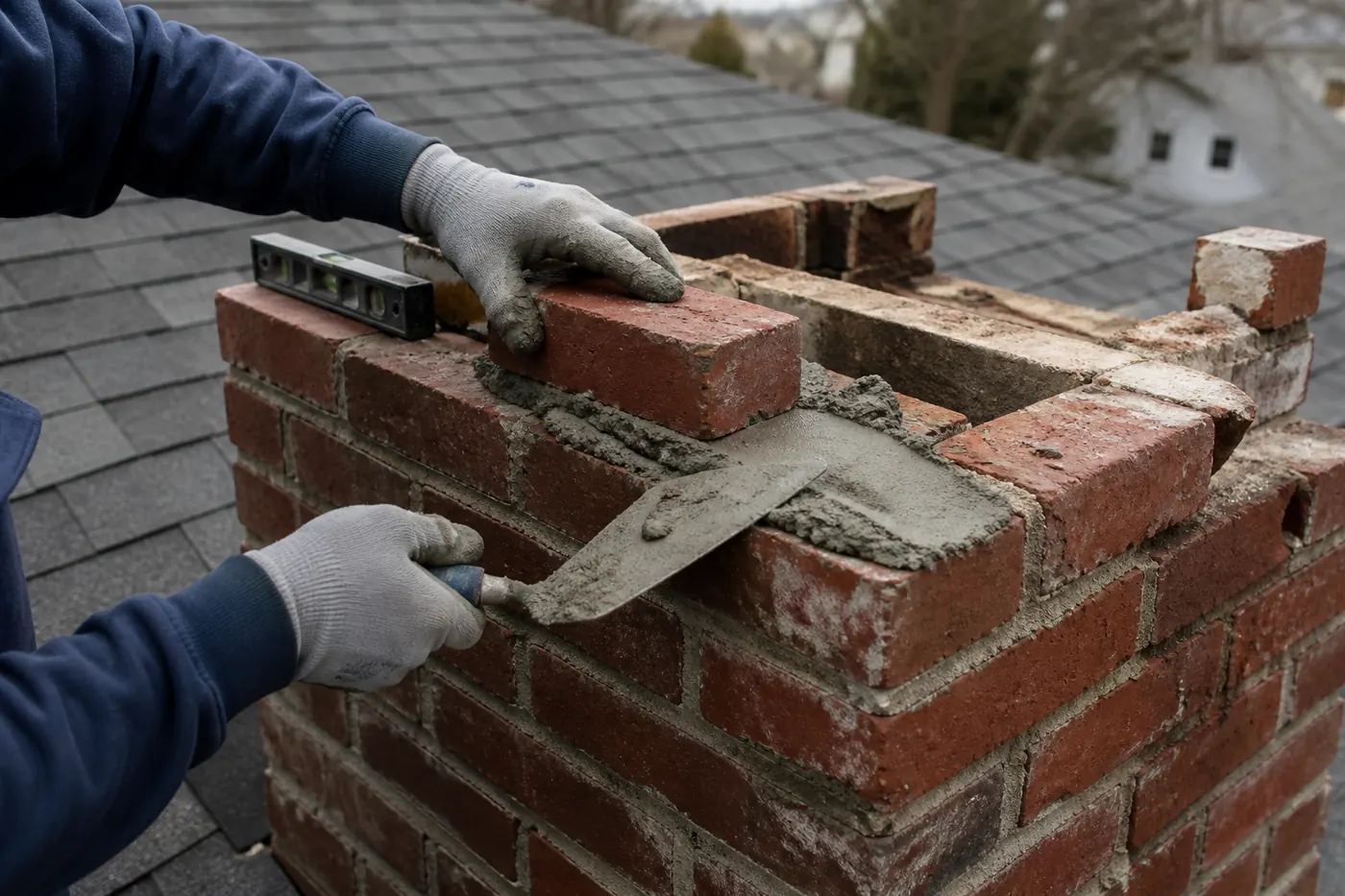
Repoint if the bricks are sound and only the mortar is failing. Rebuild if the bricks themselves are broken, loose, or leaning. In Boston, repointing runs $300 to $700 for partial work and $700 to $2,500 for the full stack. A partial rebuild is $2,000 to $4,500 and a full rebuild $4,000 to $10,000+.
The core difference in one minute
A brick chimney is two materials working together: brick and mortar. Mortar is the softer one. It takes the weather first and is meant to be replaced every so often. Brick lasts much longer.
Repointing replaces the mortar and leaves the bricks alone. Rebuilding takes bricks off and puts them back, or puts new ones in. The question is simply where the damage is. If it is in the mortar only, repoint. If it has reached the bricks, or the structure has moved, repointing alone will not hold.
That is also why the price gap is large. One is surface work at the joints. The other is demolition and reconstruction.
Four checks that point toward repointing or rebuilding
A technician looks at the same four things you can start noticing from the ground.
1. How deep is the mortar loss?
If you can see joints eroded back an inch or so but the brick edges are crisp, repointing fits. Deep voids that run well into the wall are different.
2. What do the brick faces look like?
Flat, intact faces are good. Faces that flake, crumble, or have broken off, a damage called spalling, suggest the brick has absorbed too much water. You can read more in our guide to spalling bricks and freeze-thaw damage.
3. Is anything out of line?
Bulges, a lean, a stepped crack across several courses, or loose bricks that rock when touched all point to movement. That tends to be a rebuild question.
4. Where is the damage located?
Damage that stops below the top few courses is often a partial rebuild. Damage that runs the whole height of the stack may be a full one.
When repointing is the right call
Repointing makes sense when the structure is sound and the mortar has simply aged. Typical signs:
- Sandy mortar that crumbles under a finger.
- Recessed or hollow-sounding joints.
- Small gaps with no loose bricks.
- Brick faces that are mostly intact.
Done properly, the old mortar is cut out to a consistent depth and fresh mortar is packed in and tooled. The work takes advantage of the brick you already have. It also preserves the look of an older house, which matters on a brownstone or a rowhouse where the chimney is part of the character.
See our repointing cost guide for what drives that price and the repointing service page for the work in detail.
When a rebuild is the right call
A rebuild is the better call when mortar work would be wasted on a structure that is failing. Common triggers:
- Bricks that are loose, missing, or fall out of the wall.
- A top section that leans or bulges.
- Many spalled bricks in the same area.
- Cracks that cut through the brick, not just along the joints.
- Repeated failed patches in the same spot.
Rebuilding does not always mean the whole chimney. Often only the part above the roofline, where weather does the most damage, comes down and goes back up. That is a partial rebuild at $2,000 to $4,500. A complete rebuild runs $4,000 to $10,000+. If a chimney is no longer needed at all, removal is another option, priced after inspection, as our chimney rebuild cost page and chimney removal page explain.
Side by side: cost and scope
| Option | Typical Boston price | Fits when |
|---|---|---|
| Partial repointing | $300 to $700 | Mortar failing in limited areas |
| Full repointing | $700 to $2,500 | Mortar failing across the stack, bricks sound |
| Partial rebuild | $2,000 to $4,500 | Damaged bricks or lean in the upper stack |
| Full rebuild | $4,000 to $10,000+ | Widespread structural failure |
The number you pay depends on height, access, the number of flues, and how much needs to come down. The $49 inspection, credited toward approved repair work, gives you a written price based on what the technician actually finds.
What else gets overlooked on the same chimney
Mortar and brick are rarely the only story. Water tends to enter a chimney from the top, and the pieces that keep it out are separate from the brick itself.
- Crown. A cracked crown lets water into the top courses, so the same joints you just repointed can fail again. Crown repair is $300 to $900, and a rebuild is $900 to $2,500.
- Cap. A missing or rusted cap lets rain into the flue. A standard cap is $300 to $700.
- Flashing. Where the chimney meets the roof, loose or failed flashing sends water down the side. Repair is $200 to $400, and a full replacement is $800 to $2,500.
- Waterproofing. A breathable sealer on sound masonry slows water absorption. A standard application is $300 to $500.
These are each quoted on their own lines. That keeps the repointing or rebuild price honest, and it lets you see whether you are paying to fix a symptom or the cause. A contractor who repoints a chimney and walks away from a cracked crown has done half the job, whatever the invoice says.
Matching old brick and old mortar
Old Boston brick is often softer than modern brick, and old mortar was usually softer than modern mixes. Using a hard, dense mortar on soft brick can push stress into the brick faces and cause them to flake. That is why matching matters in both repointing and rebuilding.
Replacement brick should be chosen to match the old in size, color, and strength, not just in how it looks from the street. Ask the contractor how they plan to match both, and whether the plan fits a historic home. Some neighborhoods have review rules about exterior changes. Confirm what applies with the local building department or the historic commission before you start. Our guide on Boston historic district chimney rules gives general background, but your local office has the current answer.
Questions that expose a weak quote
- Where exactly is the damage, and can you show me a photo?
- How much of the stack is coming down, and how much stays?
- What will the new mortar and brick be?
- Will the crown and flashing be checked or replaced at the same time?
- What is not included?
A rebuild without attention to the crown, cap, and flashing can fail again for the same reason the first one did. Water almost always starts at the top. Ask whether those pieces are in or out of the number.
For a general overview of how repairs scale up, see our chimney repair page. If you see a lean, a large crack, or bricks loose enough to fall, keep people away from the area and call. When you want a written answer, book the $49 inspection at our contact page or call (617) 404-9587.
Questions homeowners ask
Can I repoint now and rebuild later?
Yes, but only if the bricks are sound today. Repointing a stack that is already failing wastes money, since the new mortar will crack as the structure moves.
How can I tell if my chimney is leaning?
Look at the stack from a distance, comparing it to a door frame or a window edge. A gap forming between the chimney and the house wall is another clue. Do not climb up to check, and have it inspected.
Does a rebuild come with a new crown and cap?
It can, but it depends on the quote. A rebuilt chimney is a good moment to address the crown and cap, so ask whether they are included or priced as extras.
Why is a full rebuild range so wide?
Height, the number of flues, access, and how much is coming down all change the labor and materials. The written quote after inspection fixes the actual number.
Is it cheaper to rebuild than to keep patching?
If patches keep failing in the same spot, repeated small repairs can add up. A repair-versus-rebuild comparison in writing helps you decide, and our repair versus rebuild guide covers the logic.