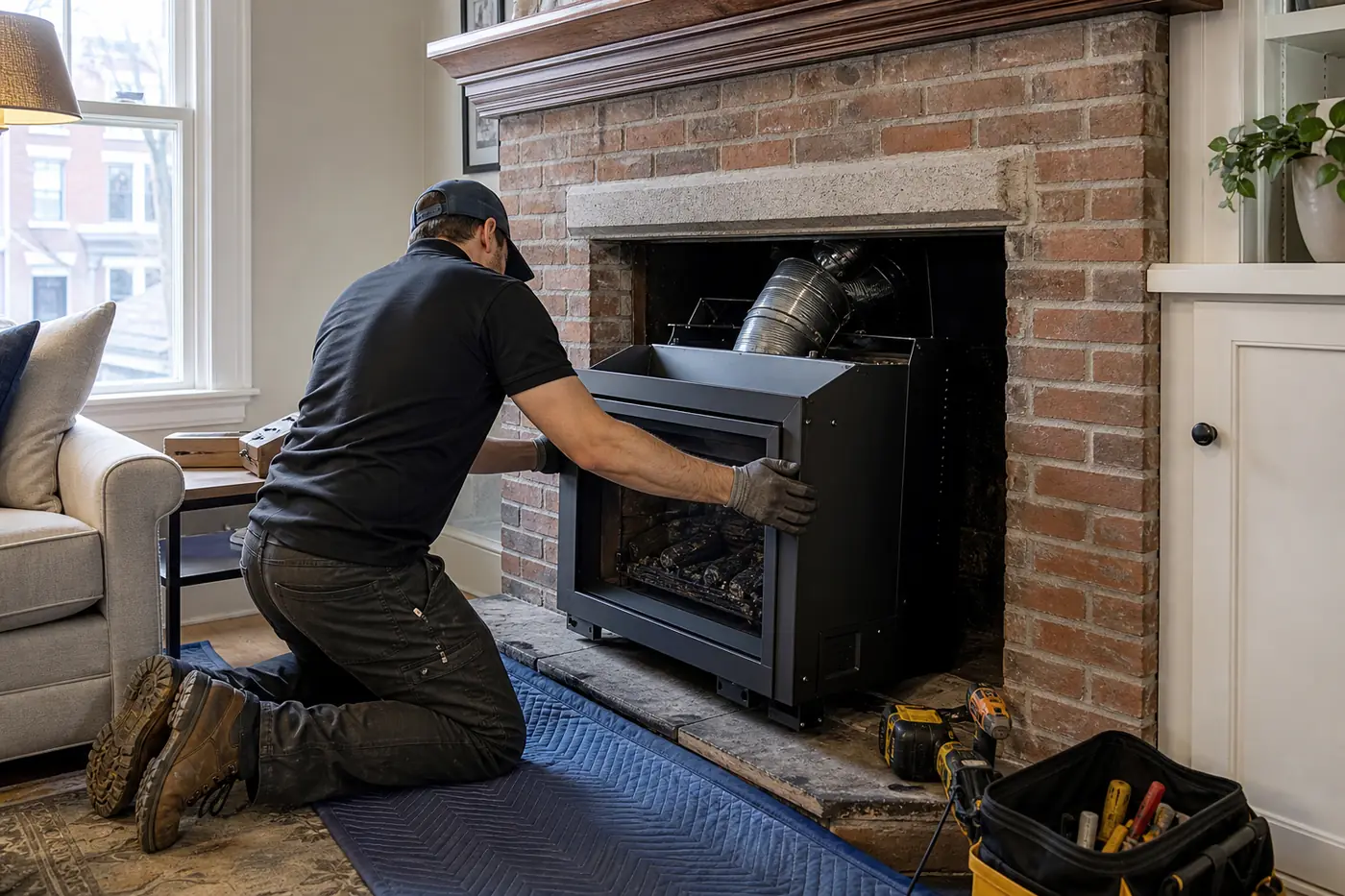
A full gas kit for a conversion runs $900 to $1,500 in Boston, but that covers the kit and its installation scope, not everything around it. Gas lines, venting changes, liners and approvals are separate, and any of them can change the total. The only way to price your fireplace honestly is to inspect it first.
What the $900 to $1,500 range covers
The range applies to a full gas kit, which is the burner, controls and gas-log or burner set that go into an existing fireplace opening. It is a starting scope for a fireplace that is sound and suited to conversion.
It does not automatically include:
- Running or extending a gas line to the fireplace.
- Changes to the chimney or the flue, such as a new liner.
- Masonry repairs to the firebox or smoke chamber.
- Electrical work for a switch, fan or remote.
- Finish work around the opening, like a new hearth, surround or paint.
- Any permit or inspection costs.
Anything beyond the kit range is quoted in writing after the $49 inspection. That way you see the real number before work begins, not a low headline price with extras added later.
Gas logs, burners and inserts: the main options
Not every gas fireplace is the same, and the type you choose affects the price and the chimney work.
Vented gas log sets
These sit in the existing firebox and use the chimney to carry exhaust out. Many are designed for decorative flames and may require the damper to stay open. They keep the look of a traditional fireplace.
Burner kits
A burner kit is a pan-style burner that you dress with logs or glass. It is part of the same $900 to $1,500 kit range for a typical scope.
Gas inserts
An insert is a sealed or direct-vent unit that slides into the opening and gives more heat. It usually needs its own liner and venting. Insert pricing depends on the model and the venting, so it is quoted in writing after the inspection.
Ventless sets
These release exhaust into the room, and rules about them differ by location. Confirm whether one is allowed with your local building department and gas utility before you consider it.
Why the chimney still matters after you switch
Many people think a gas fireplace means the chimney can be ignored. It cannot. A flue that carries gas exhaust has its own needs.
- The liner. Gas exhaust is cooler and more moist than wood smoke, and it can attack an old, unlined flue. A repair is $1,200 to $2,500 and a replacement is $1,500 to $4,500. Venting work for a gas appliance starts from $2,000.
- The cap. A cap keeps out rain and animals. A standard cap is $300 to $700.
- The damper. It may need to be fixed open or removed, depending on the unit. Damper work is $199 to $1,200.
- Old creosote. A former wood-burning flue may hold deposits that need removing first.
A carbon monoxide alarm on every level is also a sensible step with any gas appliance. If it sounds, leave and call 911. See the chimney relining cost guide for more on liners.
Gas fireplace prices to know
| Item | Boston price |
|---|---|
| Full gas kit | $900 to $1,500 |
| Gas fireplace repair | $299 to $900 |
| Gas fireplace cleaning | $299 |
| Liner repair | $1,200 to $2,500 |
| Liner replacement | $1,500 to $4,500 |
| Venting work | From $2,000 |
| General inspection | $49, credited toward approved repair work |
Prices outside this table, such as a gas line, an insert, a permit fee or finish work, are quoted in writing after the $49 inspection. Our fireplace repair page explains how that process works.
Permits, gas utility and local rules
A gas conversion touches more than the chimney. Rules exist because gas, venting and combustion are safety systems, and they can differ between towns in Greater Boston.
Check with these before you commit.
- Your local building department. Ask whether a permit or inspection is needed for the work, and who must pull it.
- Your gas utility. They can tell you about service to the house, and gas supply work belongs with qualified professionals.
- Your condo or homeowners association, if you have one. Some set their own rules for alterations.
- Your insurer or agent. Ask whether a change of fuel affects your policy.
- Historic or landmarked buildings. Ask the relevant local authority whether alterations are restricted.
We do not list specific legal requirements here, because they change and vary by town. Confirm the current rules with the office that handles them, and keep written copies of anything you are told.
Wood or gas: what you gain and what you give up
The choice is personal. Here is how the two compare in everyday use.
| Question | Wood | Gas |
|---|---|---|
| Starting a fire | Kindling, matches, patience | A switch or remote |
| Mess | Ash, bark, smoke residue | Very little |
| Cleaning | Sweep and inspection, $299 | Gas fireplace cleaning, $299 |
| Atmosphere | Real crackle and smell | Steady, more controlled flame |
| Upkeep | Fuel storage and ash removal | Burner, pilot and vent checks |
Gas is cleaner and easier, but it is not maintenance-free. It still needs annual checks. If you are unsure about giving up wood, a gas log kit lets you keep the traditional firebox and look. Our chimney smells bad in summer guide covers what lingering odors from an old wood chimney mean.
Questions to ask before you approve a quote
A conversion quote should be easy to read. Ask these questions and expect clear answers in writing.
- Which exact unit or kit is being installed, and is it approved for use in a fireplace like mine?
- Who handles the gas connection, and is that cost in the price?
- Does the chimney need a liner, and what does that add?
- Will the damper be fixed open or removed?
- What permits or inspections apply, and who is responsible for them?
- What happens to the existing firebox, hearth and finish around the opening?
- What yearly care does the new unit need?
If an answer is vague, ask for it to be written down. A conversion done on a verbal promise is hard to compare with anyone else's price.
Look for what is missing, too. A quote that lists only a kit price and says nothing about the flue, the gas supply or approvals is not a full price. It is only the first line of one.
How the conversion process works
A typical path looks like this.
- Inspection. The technician looks at the firebox, damper, smoke chamber and flue, and checks whether the fireplace suits a gas kit.
- Written proposal. You receive a price in writing for the kit, any chimney work and anything else that applies.
- Permits and gas supply. You confirm what is needed with the building department and your gas utility.
- Installation. Qualified professionals handle the gas connection and appliance.
- Testing. The unit and vent are checked before regular use, and you learn how to operate it.
- Yearly care. A cleaning and inspection keeps the system working.
Never pick a kit from an online measurement alone. A kit that fits the opening is not automatically right for the flue or the room. Book the $49 inspection at /contact/ or call (617) 404-9587, and you will get photos of what is found and a written price before any work.
Questions homeowners ask
Can any wood fireplace be converted to gas?
Not always. The firebox, flue, clearances and gas supply all need to suit the unit. An inspection tells you whether your fireplace is a good candidate.
Will I need a new chimney liner for gas?
Often, especially for an older or unlined flue. A repair is $1,200 to $2,500 and replacement is $1,500 to $4,500. The inspection shows what your flue needs.
Does a gas fireplace still need cleaning?
Yes. Burners, logs, glass and vents collect dust and soot. A gas fireplace cleaning is $299, and repair is $299 to $900 if something is not working.
Do I need a permit for a gas conversion?
Often some form of approval is involved, but rules vary by town. Confirm the current requirement with your local building department and your gas utility before work starts.
Is the $900 to $1,500 the total I will pay?
It is the range for a full gas kit. A gas line, liner, venting, permit and finish work are separate and quoted in writing after the $49 inspection.