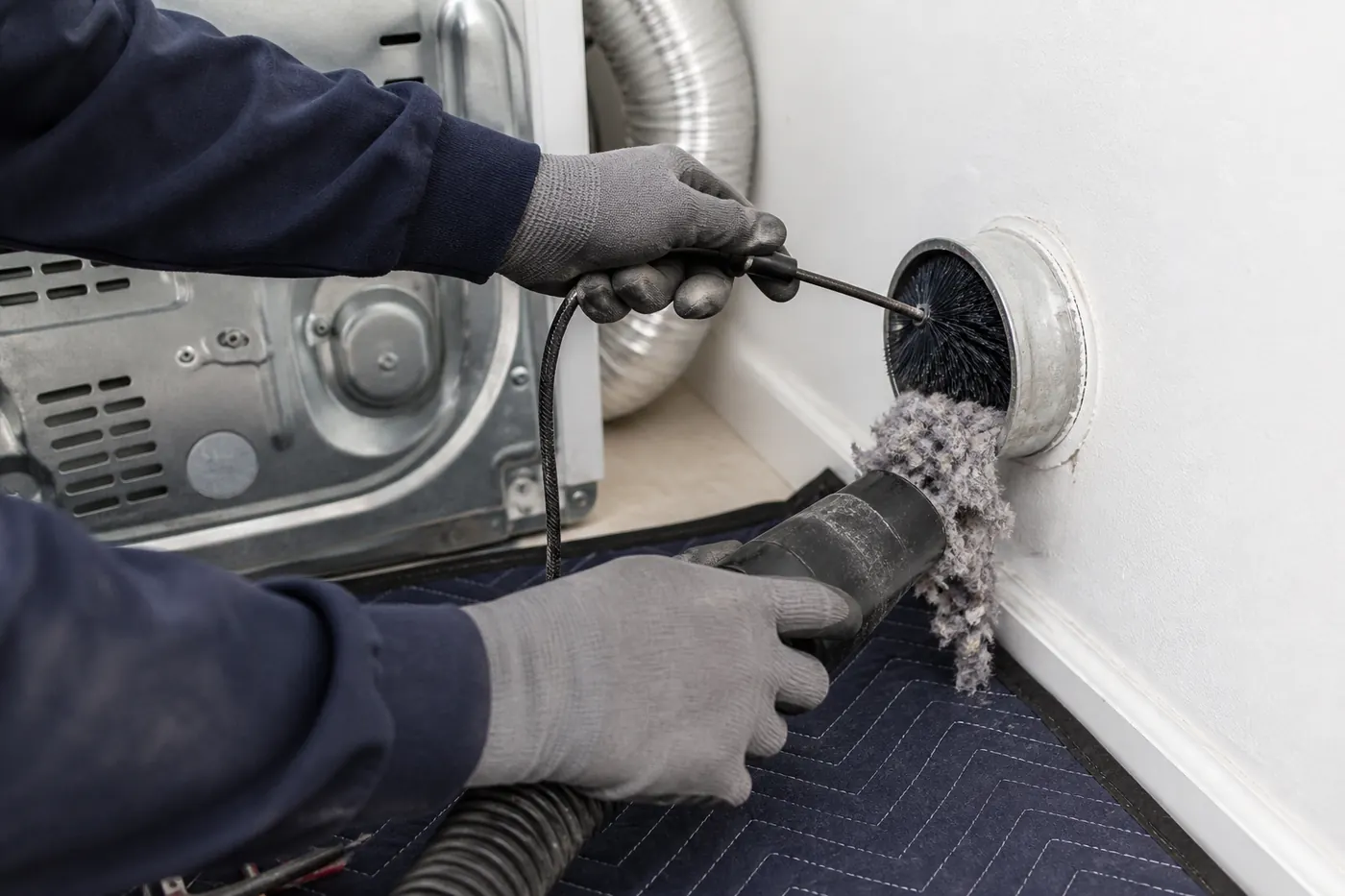
Dryer vent cleaning in Boston is a flat $99 for a standard run, and you need it when clothes take more than one cycle to dry, the laundry area runs hot or the outside flap barely lifts. The service clears lint from the duct between your dryer and the outdoors so hot, damp air can leave the house. This page covers the signs, how the duct is cleaned and what happens at the visit. Long runs or damaged duct are quoted in writing first.
- Dryer vent cleaning in Boston is a flat $99 for a standard duct run.
- Lint in the duct slows drying, traps heat and moisture and can start a fire.
- A clean lint screen does not mean a clean duct; most lint settles beyond the screen.
- Crushed, disconnected or badly routed duct is documented with photos and quoted in writing, not fixed on the spot.
What a dryer vent does and how lint blocks it
A dryer vent is the pipe that carries hot, wet air from the back of your dryer to an opening outside. It does a bigger job than most people notice. Every load pushes warm, humid air and fine fibers down that pipe. The lint screen catches the biggest pieces, but a lot of fiber gets past it.
That fiber settles on the duct walls, at elbows and where seams or screws catch it. Over time it builds into a felt-like lining. The passage narrows, so the air moves slower, loses heat and drops more fiber as it goes. A blocked duct also pushes warm moist air back toward the dryer.
The outside end matters too. It usually has a flap or louver that opens when air is pushed through and closes when the dryer stops. Lint collects there, around birds' nests, leaves and snow, until the flap barely moves.
Cleaning removes that lining and restores a clear path. It does not change the duct itself. If the route is crushed, undersized or longer than it should be, cleaning helps but cannot fully fix it.
Why does the pipe matter so much? Because a dryer is a sealed heat engine. It heats air, wets it with your laundry and relies on the duct to throw that air away. If the exit is half closed, the machine keeps heating the same damp air, and the cycle drags on.
Signs your dryer vent needs cleaning
Dryers are forgiving, so a blocked vent is easy to live with for a long time. Watch for these:
- Clothes are still damp after one full cycle, and you run a second.
- The dryer, the laundry room or the wall behind the machine feels unusually hot.
- The outside flap opens only a little, or does not open at all while the dryer runs.
- Lint is stuck around the outside opening or has blown onto the siding or ground.
- It has been a long time since anyone cleaned the duct, or you do not know when.
- Airflow is weak even though you cleaned the lint screen.
A quick check you can do from inside
With the dryer running, hold your hand near the outside opening if it is at ground level and easy to reach safely. You should feel a strong stream of warm air. If it is faint, the duct is probably restricted. Do not climb a ladder or go onto a roof to check.
Why a clean screen is not enough
The screen is the first filter, not the last. Fine fiber and moisture pass through, and the duct behind the dryer collects what is left.
Pay attention to smell as well. A warm, scorched or musty odor from the dryer, laundry room or the outside opening suggests lint is cooking against a hot surface or that moisture is sitting in the pipe.
Why lint is a fire risk and costs you in other ways
Lint is dry, light fiber, and it burns easily. A dryer produces heat, and a blocked vent traps that heat. When air cannot escape, the temperature inside the dryer and the duct rises, and a layer of lint next to a hot surface is a fire waiting for a spark. The danger grows when lint builds up in a place where airflow is already weak.
There are other costs that show up before a fire does.
- Longer drying times. Each load runs longer, so the machine works harder and uses more energy.
- Wear on the dryer. Heat that cannot leave stresses parts that were built to shed it.
- Moisture in the house. Damp air that cannot get out can end up in the laundry space, which suits mold and peeling paint.
- Gas dryer exhaust. A gas dryer vents combustion gases as well as moist air. A blocked vent can push those gases back into the house.
If you have a gas dryer and a carbon monoxide alarm goes off, leave the house and call 911. A gas smell near the dryer means you leave at once and call the gas utility or 911. Gas line and connection work belongs to the utility or a licensed gas fitter, not to a vent cleaner.
What the technician checks before cleaning
The cleaning plan depends on the route the duct takes. Before any tool goes in, the technician looks at the whole path.
- Where the duct goes. Straight out through a wall, up through a ceiling and roof, or along a basement joist and out. Each route needs different access and tools.
- Where it ends. The outside termination, with its flap or louver, is located and checked for blockage.
- The short piece behind the dryer. This transition piece is often thin foil or plastic. It can be crushed behind the machine, which restricts flow more than a dirty duct does.
- The joints and elbows. Connections held together with tape or loose fittings are noted, since these are places where lint gathers and where a tool might snag.
- Anything that makes the duct hard to reach. A long run, a tight turn, or a finished wall with no access panel.
The dryer is disconnected only where it is safe and where there is room to move the machine. If it cannot be reached without damage, the technician says so rather than forcing it.
Photos are taken of any problem spots on the way, such as a flattened transition piece, a loose joint or heavy packing at an elbow. Those pictures are what you will use to judge any repair later.
How the duct is cleaned
The goal is to loosen lint from the walls and carry it out without damaging the pipe.
Rotary and air-assisted cleaning
A flexible brush on a rod, spun gently, scrubs the duct walls. Another approach uses air pressure to knock lint loose and push it along the run. The technician picks a tool that fits the duct material, since thin foil and flex duct tear more easily than rigid metal.
Working from one end or both
Where the duct is accessible from both the dryer side and the outside, cleaning from both ends clears the middle better and keeps dislodged lint from jamming at a bend. If only one end is reachable, the technician works from that end as far as the tools can go.
Capturing the lint
Loose lint is drawn into a vacuum or caught at the opening so it ends up in a bag, not on your floor or your lawn. This is why the work is tidy when it is done properly.
Checking airflow
When the duct is reconnected, the technician runs the dryer and looks at the outside opening to see that the flap lifts and air moves. A strong, steady flow is the sign that the pipe is clear.
Sections that could not be reached or are in poor condition are noted with photos, not claimed as cleaned.
Dislodged lint is removed, not left in the run. After the last pass the technician makes a final check at both ends so the duct is not sealed back up while loose fiber still sits in it.
Cleaning the outside opening and the flap
The end of the duct is the part that sees weather, and in Greater Boston that means rain, snow, ice and salt air. A flap stuck with lint and old grease can freeze or stay half open. A stuck-open flap invites cold air, rodents and birds in. A stuck-shut flap traps moist air and fiber inside.
The technician clears lint and debris from the flap and its housing, checks that it swings freely, and looks at the screen or cover for damage. Some terminations have a mesh guard that clogs fast with lint. Mesh over a dryer vent opening collects fiber and can cause blockage, so a damaged or clogged guard is flagged.
If the termination is damaged, loose or letting water into the wall, that is a repair, not a cleaning. It gets photographed and quoted in writing. A roof or high wall termination may also be a job for a different kind of access, which the technician explains before quoting.
Where the vent exits through the roof, water stains near the opening can mean the seal around it has failed. That is a roofing question rather than a cleaning one, and the technician will tell you so instead of guessing.
Problems cleaning cannot fix
Some dryer vents stay slow even when perfectly clean. The reason is usually the installation.
- A crushed or kinked duct. A pipe pinched behind the dryer or squeezed through a wall cannot carry full flow.
- Too long or too many turns. Each elbow slows the air, and a very long run makes the dryer work against resistance.
- Disconnected or leaking joints. Air that escapes into a wall or crawlspace carries lint and moisture with it.
- Wrong duct material. Thin plastic or loose foil sags and traps fiber more easily than smooth rigid pipe.
- Undersized duct. A pipe narrower than the dryer's outlet cannot pass the air the dryer pushes out.
When cleaning shows one of these, the technician documents it and explains your options. Replacing or rerouting duct is quoted in writing, since the price depends on how much needs to change and how hard it is to reach. You are under no pressure to approve it that day.
A clean duct on a poorly built run is still an improvement, but you should know what remains so you can decide for yourself.
Ask yourself one simple question when you decide: does the dryer work normally once the duct is clean? If it does, the installation is fine. If drying is still slow, the duct is the likely cause.
Dryer vents in Boston homes and buildings
The layout of older Boston housing makes dryer vents less simple than they look.
In a triple-decker or rowhouse, the laundry may be in the basement, on a landing or in a kitchen, with the duct routed through a long chase or up the side wall. A brownstone may have the dryer in a cellar with the vent running far to reach an outside wall. Longer, bent routes collect lint faster and are harder to clean.
Tight basements and finished walls can limit how far a tool will go. Where there is no access panel, the technician tells you what can be reached and what cannot. Condo and multi-unit buildings sometimes share a vent system, so check with your building manager before booking if the dryer vents into a common shaft.
Cold winters add one more factor. A damp duct in freezing weather can hold ice at the outside flap and cut the airflow. If your dryer runs worse in January than in July, check the flap first.
Houses with a laundry on an upper floor have a related problem: the duct has to climb or travel far, and lint falls back and gathers on any horizontal stretch. A technician will point out those stretches so you know where lint will settle next.
Dryer vent cleaning price and what the visit includes
Dryer vent cleaning is $99. That price applies to a standard duct run that can be reached from the dryer side and the outside. A longer run, a roof termination or damaged duct is quoted in writing before the work starts.
| Service | Price | Notes |
|---|---|---|
| Dryer vent cleaning | $99 | Standard run, cleaned and checked for airflow |
| Chimney inspection | $49, credited toward approved repair work | For a chimney, not a dryer vent |
| Duct repair or rerouting | Quoted in writing | Priced after the technician sees the run |
You get a three-hour arrival window and a call ahead. The technician looks at the duct route, cleans it, tests airflow and shows you photos of what was found. For other chimney and venting prices, see the Boston chimney pricing page.
The $99 is a flat figure, not an hourly rate. If the duct turns out to be shorter or cleaner than expected, the price does not change in either direction unless you approve a different scope in writing.
Before the visit, between cleanings and when to call right away
Make the dryer easy to reach. Clear the space around it and leave a few feet of room so it can be moved. Empty the drum and clean the lint screen. Note any sign you have seen, such as damp clothes or a hot room.
Between cleanings, empty the lint screen after every load, and wipe it if it looks coated with film. Do not run the dryer while you are out or asleep. Keep the area behind and around the dryer free of storage, and look at the outside flap when you can see it from the ground.
Call sooner than planned if a load takes much longer than it used to, the room smells hot or like burning lint, or the flap stops moving. If you ever see smoke or flames from the dryer, get out and call 911.
It also helps to keep notes. Write down the date of each cleaning and how long a normal load takes afterward. A slow creep in drying time is the earliest warning you will get, and it tells you when the next visit is due before the flap or the screen shows a problem.
If you want your dryer vent checked at the same time as a fireplace, the chimney sweep is a separate $299 visit. To book the $99 dryer vent cleaning, use our contact page or call (617) 404-9587.
Questions homeowners ask
How often should a dryer vent be cleaned?
There is no single interval that suits every home. A busy household with a long or bent duct needs it sooner than a single person with a short, straight run. If drying times grow or the flap barely moves, the vent is due.
Can I clean the dryer vent myself with a vacuum?
A vacuum can reach the first stretch behind the dryer, but it will not clean a long run or the outside end. Pulling the dryer out also risks crushing the duct or disturbing a gas connection. If the dryer is gas, leave connection work to the gas utility or a licensed fitter.
Why does my dryer still take two cycles after I cleaned the lint screen?
The screen catches only the larger pieces. Fine fiber settles in the duct, and a crushed transition piece or blocked outside flap restricts airflow no matter how clean the screen is. A vent cleaning is the next thing to check.
Does the $99 price cover a vent that goes through the roof?
The $99 is for a standard run. A rooftop termination, a very long duct or a tight route can add to the work, and any extra is quoted in writing before it starts. Tell us about the layout when you book so the quote fits.
What if the technician finds a damaged or crushed duct?
It is photographed and explained, and you get a written price for the repair or reroute. Nothing is replaced without your approval. You can also ask someone else to quote the repair using the photos.
Is dryer vent cleaning the same as chimney cleaning?
No. A dryer vent clears lint from a duct, while a chimney sweep removes soot and creosote from a flue. They use different tools and have different prices. A chimney cleaning with inspection is $299, and dryer vent cleaning is $99.
Related guidance
Start with the Boston cost guide, then read the guides below.
- Chimney Smells Bad in Summer? Boston Causes and Fixes
- Dryer Vent Cleaning Cost in Boston: $99 (2026)
- Questions to Ask a Chimney Contractor in Boston