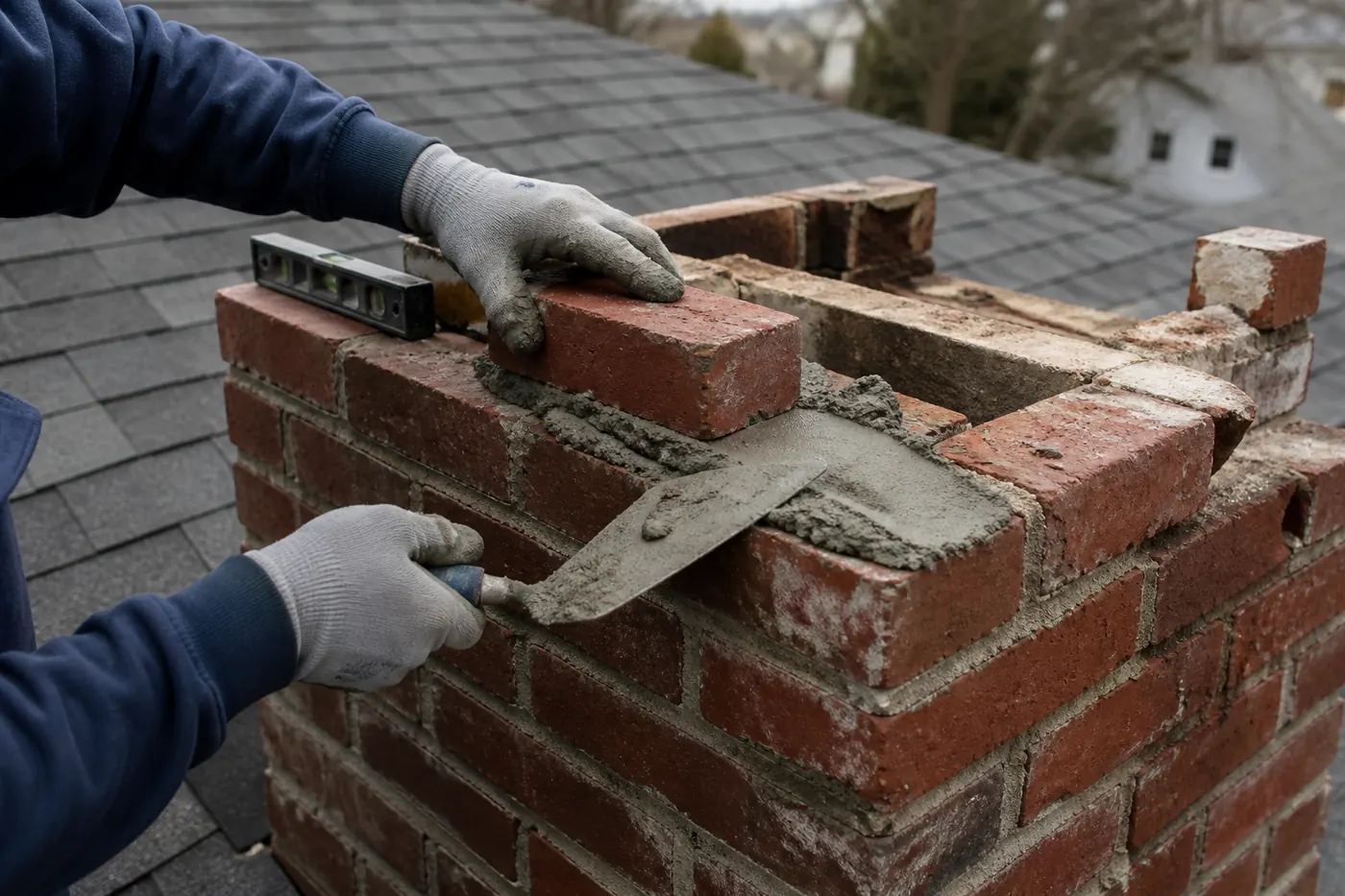
Chimney repair in Boston mostly lands between $300 and $2,500, with major masonry work starting at $2,500 and small flashing fixes starting at $200. The price depends on which part has failed and how much of it. A written price comes before any work, and the $49 inspection is credited toward repairs you approve.
- Masonry repair runs from $300 to $700 for basic work, $700 to $2,500 for standard work, and from $2,500 for major work.
- Crown repair is $300 to $900, and a crown rebuild is $900 to $2,500.
- Flashing repair is $200 to $400, and leak repair is $400 to $3,000.
- The $49 inspection is credited toward repair work you approve.
Chimney repair prices in Boston by type of work
"Chimney repair" covers several different jobs, and each has its own price band. Find the part that is failing and read across.
| Repair | Boston price |
|---|---|
| Basic masonry repair | $300 to $700 |
| Standard masonry repair | $700 to $2,500 |
| Major masonry repair | From $2,500 |
| Crown repair | $300 to $900 |
| Crown rebuild | $900 to $2,500 |
| Flashing repair | $200 to $400 |
| Partial flashing replacement | $400 to $800 |
| Full flashing replacement | $800 to $2,500 |
| Leak repair | $400 to $3,000 |
Anything that does not appear here is quoted in writing after the $49 inspection. The chimney repair service page explains the signs and methods behind each line.
Read the table as a map, not a menu. Most homes need only one or two of these lines. A chimney with worn joints and a failing crown, for example, falls under two lines, and the quote adds them together. That is also why the lowest and highest numbers should not be averaged: no single figure describes every Boston chimney.
What each masonry repair tier covers
Masonry is the biggest source of repair bills, so it is split into three tiers by how much has failed.
Basic, $300 to $700
A limited area, such as a few damaged joints or a small number of bricks. The rest of the stack is sound and the problem is local.
Standard, $700 to $2,500
A larger share of the chimney is affected, for example a whole face with worn joints or several damaged courses. This is the widest band, and the written quote shows where in it your job sits.
Major, from $2,500
Failure spread through much of the stack. At this level the quote often compares repair against a partial rebuild, and you should see both prices side by side. The chimney rebuild cost page covers that next step.
The tier names are shorthand for the amount of work, so the label on your quote matters less than the description beneath it. Ask the quote to say how much of the chimney is covered, in words you can check against the photos.
Where crown, flashing and leak prices sit
Not every repair is brick. Three other parts account for many calls in Boston, where freeze-thaw cycles and nor'easters test every opening.
- Crown. The concrete or mortar slab on top. Repair is $300 to $900. If the slab has failed past patching, a rebuild is $900 to $2,500. See the chimney crown repair cost page for the breakdown.
- Flashing. The metal seal where the chimney meets the roof. A repair is $200 to $400, a partial replacement $400 to $800, and a full replacement $800 to $2,500.
- Leaks. A leak is priced from $400 to $3,000 because the source can be one small opening or several.
A cap or chase cover has its own prices. Those are quoted from the inspection findings, not folded into a general repair number.
Why leaks have the widest span
The $400 to $3,000 range for a leak reflects uncertainty about the source. One failed seal at the roofline sits near the bottom. A leak that comes from several openings at once, or that has already damaged material around it, sits higher. The written findings narrow the range to a figure.
What moves a repair price up or down
Two chimneys with the same symptom can sit at opposite ends of a band. These factors decide where yours falls.
- Height and access. A tall stack, a steep roof or a hard-to-reach side takes more setup before repair work can begin.
- How much has failed. A few bad joints and a whole face of loose brick are different jobs, even if both begin with the same stain.
- The number of problems. Crown, flashing and mortar issues often travel together. Each one is quoted, and combining them can change the total.
- Earlier patches. Old fixes that have come loose may need to come out before new work goes in.
- Weather and season. Winter conditions affect when some work can be done.
Because the factors vary, the written quote, not a general figure, is the price you rely on.
What does not move the price
The length of the visit does not set the price, and neither does how alarming the damage looks from the ground. The quote follows the scope: which parts, how much of each, and how hard they are to reach. Ask that the written price list exactly those three things.
Why the stain on your ceiling does not set the price
A damp patch near the chimney tells you water is getting in. It does not tell you where, and the repair price follows the source, not the stain.
The same ceiling mark can come from a worn crown, a rusted flashing, open mortar joints or a missing cap. Those four fixes cost very different amounts, from $200 at the low end of a flashing repair to $2,500 or more for major masonry. A company that quotes before finding the source is guessing, and a wrong guess means paying for work that does not stop the leak.
This is the reason the inspection comes first. It names the cause, shows it in photos, and prices that cause. If your concern is a leak specifically, the chimney leak repair page describes how leaks are traced.
Our stated approach is to find the real cause first and quote second. That is how a $200 flashing repair avoids being sold as a $2,500 masonry job, and the other way around.
What a written repair quote should list
A repair quote that is worth signing breaks the job into parts.
- Each repair named separately, with its own price.
- The area affected, such as which face of the chimney.
- Photos from the inspection that show the problem.
- What is not included.
- How the $49 credit is applied to the total.
- The date and arrival window.
A single total with no breakdown is hard to compare and hard to trim. When each repair has its own line, you can approve the urgent ones and schedule the others later.
Why separate lines help you
Boston homeowners often face a budget limit and a weather clock at the same time. Separate lines let you do the item that keeps water out now, and plan the cosmetic or lower-risk items for another season, without losing the price you were quoted for them.
How to compare two repair quotes
Lining up two quotes only works if they describe the same work. A short method helps.
- Match the repairs line by line. If one quote has an item the other lacks, ask why.
- Check the size of each repair, such as which and how many faces of the chimney.
- Look at the cause each quote names. Two quotes that name different causes are describing different jobs.
- See whether the cheaper quote leaves out a tier. For instance, a mortar fix with no mention of the crown above it.
- Ask whether the price is final or an estimate.
If the two quotes disagree sharply, a free second opinion is available when you bring a written report from a reputable local chimney company.
A note on very low quotes
A figure far below the listed bands is worth a question. Either the scope is smaller than your problem, or items are missing that will show up later as extras. Ask the company to show where the lower price comes from, and put the answer in writing.
What is quoted separately and how the $49 credit applies
A repair quote does not automatically include everything near the chimney. Cleaning, creosote removal, a new liner, a cap or a damper are priced as their own services. Repointing and rebuilding have dedicated cost pages, including the repointing and tuckpointing cost page, because their prices work differently from small repairs.
The $49 inspection that started the process comes off the repair price when you approve the work. If you split the work into stages, ask which stage carries the credit and have the answer written into the quote.
If you plan to claim any repair with your insurer, check with your insurer about what documentation they need. Written findings and dated photos are the usual starting point.
When waiting turns a repair into a bigger bill
Water is the cost multiplier. A small gap lets in moisture, moisture freezes in a Boston winter, and ice widens the gap. A basic repair that begins at $300 can drift into the standard band, and a standard job into major masonry from $2,500.
Loose material is a safety issue too. If bricks or pieces of crown are falling, keep people away from the area below and book soon. If you smell gas or a carbon monoxide alarm sounds, leave and call 911.
Book your $49 inspection at our contact page or call (617) 404-9587.
Questions homeowners ask
Why is there such a wide range for chimney repair?
Because the phrase covers different parts and different amounts of damage. A $200 flashing fix and a $2,500 major masonry job are both repairs, but they involve different parts and very different amounts of work. The inspection tells you where yours falls.
Can I get a repair quote over the phone?
You can get the published ranges by phone at (617) 404-9587. A firm price needs an inspection first, since the cause of a problem often differs from the symptom you can see. The written price comes before any work.
Do I pay the $49 inspection and the repair price?
The $49 is credited toward repair work you approve, so it comes off that bill. If you choose not to repair, you keep the written report and photos.
Is a small repair worth doing, or should I just wait?
Small repairs are usually the least expensive point to act. Moisture and freezing temperatures enlarge damage over winter, which can move a job into a higher price band. A written quote lets you decide with the numbers in front of you.
When does repair stop making sense and a rebuild begin?
When failure is deep or widespread enough that new work would not hold. The quote should then show repair and partial rebuild next to each other. Partial rebuilds are $2,000 to $4,500, and full rebuilds are $4,000 to $10,000 or more.
What if I think the quote I received is too high?
Compare it line by line with another written quote. If you have a written report from a reputable local chimney company, we will provide a second opinion at no charge. The comparison is easier when both quotes itemize each repair.