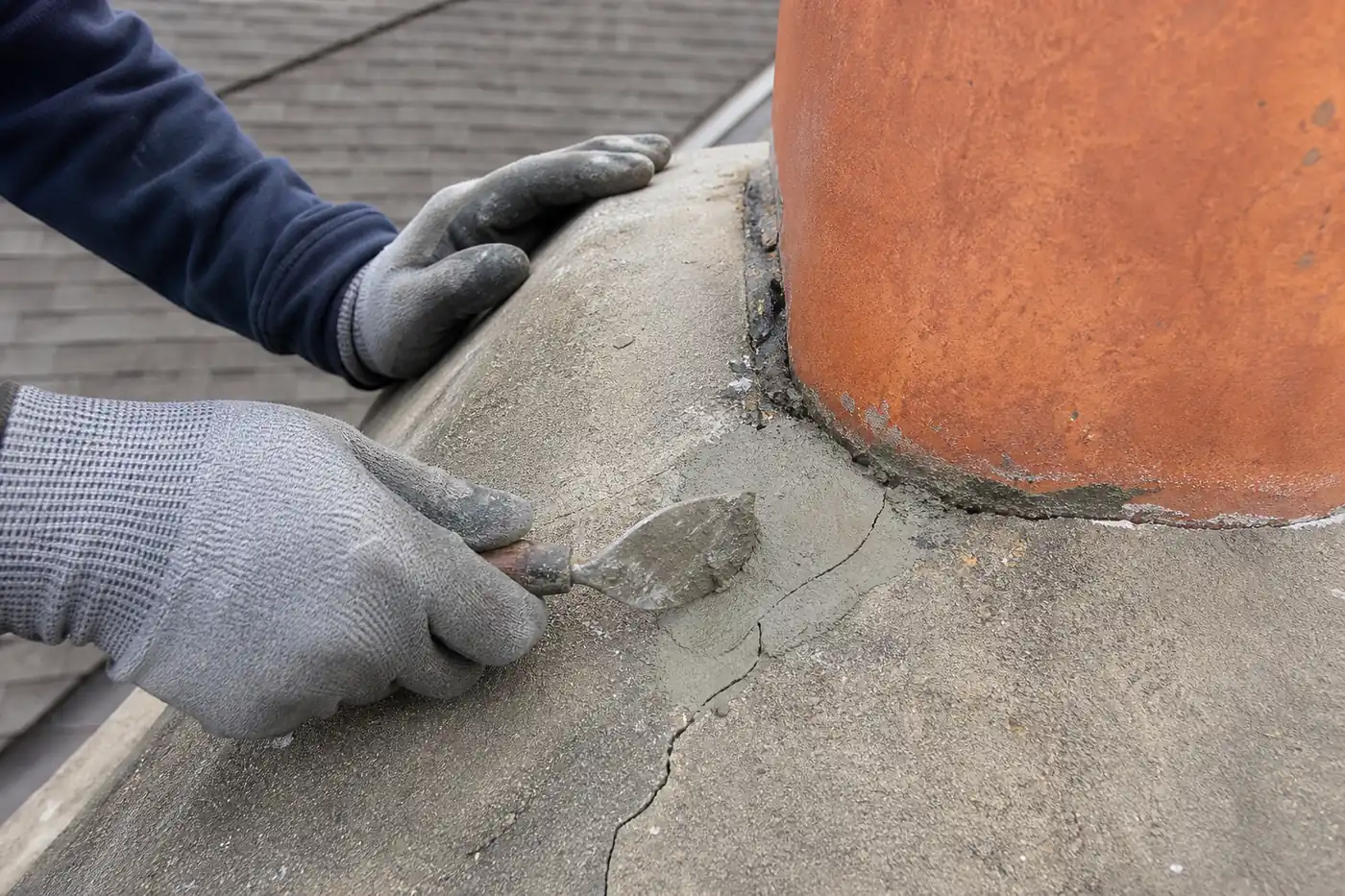
Chimney crown repair in Boston runs $300 to $2,500: $300 to $900 to seal or patch a crown that is still sound, and $900 to $2,500 to rebuild one that has failed. The crown is the slab of mortar or concrete on top of your chimney, and when it cracks, rain gets into the brick below. A $49 inspection, credited toward approved work, tells you which of the two jobs you have before you pay for either.
- The crown is the sloped slab on top of the chimney that sheds rain away from the flue and the brick.
- Repair, meaning sealing cracks or patching sound areas, runs $300 to $900.
- Rebuild, meaning removing a failed crown and casting a new one, runs $900 to $2,500.
- The $49 inspection is credited toward approved work, and you get the price in writing before anything starts.
What a chimney crown does and how it fails
The crown is the sloped cap of mortar or concrete that covers the top of the brick stack and surrounds the flue tile. Its only job is to throw water off the chimney. Rain that lands on it should run to the edge and drip clear of the brick, not sit on the surface or soak in.
A crown fails in a few ordinary ways. Shrinkage and movement put hairline cracks in it. A crown poured flat, or one that has settled, lets water pool. A crown with no overhang lets water run straight down the face of the brick. Where the crown meets the flue tile there is supposed to be a flexible joint of sealant, and that joint dries out and splits.
In Greater Boston the damage speeds up because of freeze-thaw cycles. Water that gets into a crack in November freezes and expands overnight, thaws the next afternoon, and freezes again. Each cycle widens the crack a little. Coastal salt air and nor'easter rain driven sideways put more water on the same weak spots. In time the top courses of brick take on water, the brick faces flake off, and the job stops being a crown job and becomes a masonry job.
That is why the crown is worth looking at early. A crack you can seal today can turn into a rebuild of the top of the stack. If your chimney has no cover over the flue opening, read about chimney cap installation as well, since a cap keeps rain out of the flue while the crown protects the masonry around it.
Signs your chimney crown needs attention
Most homeowners cannot see the crown from the ground, so some of the clues show up lower down. You may spot a few from the yard with binoculars or from an upstairs window. Do not go on the roof to look.
- Visible cracks across the crown. Fine hairlines are common and often sealable. Wide cracks, or cracks that run to the edge and split it, mean water is reaching the brick.
- Flat areas that hold water. After rain, a puddle or a dark patch that dries slowly shows the surface is not shedding. Standing water finds every crack.
- Sealant pulled away from a flue tile. A gap or a dark line around the tile lets water run down the outside of the flue.
- An edge that stops flush with the brick. A crown without an overhang sends water down the chimney face, so you see damp streaks or staining just below it.
- Wet or flaking top courses. Brick near the top that looks darker than the rest, or sheds faces and grit, has been taking in water.
- A peeling coating. An old paint or coating that is lifting traps moisture and hides what is under it.
Any one of these is a reason to book an inspection. None of them is a diagnosis on its own, which is why the technician looks at the whole top of the chimney, as described next.
What the technician checks on a crown
The inspection is a close look at the top of the chimney, with photos, before anyone prices a repair. These are the checks.
- Thickness, slope and edge. How thick the crown is, whether it falls away from the flue on every side, and whether the edge overhangs the brick far enough to drip clear.
- Cracks and loose material. Each crack is probed to see whether it is a surface line or whether the material around it is hollow, crumbling or lifting.
- Every flue tile. Each flue that comes through the crown gets its own look. The joint at the tile is checked for gaps, and the tile for cracks that would send water down the flue.
- The brick below. The top courses are checked for wet brick, loose faces and open mortar joints, because the crown and the brick under it tend to fail together.
- Support for the work. The upper masonry has to be sound enough to carry a repaired or new crown. If it is not, that finding changes the job and the price.
You get photos of what was found. They show the problem and the proposed fix, so you are approving something you have seen.
Repairable cracks or a failed crown: how the call is made
The main decision is whether the crown can be kept. Two crowns with the same crack on the surface can need very different work.
Signs the crown can be kept
The cracks are narrow and stable, the material around them is hard, the slope still sheds water, and the crown still overhangs the brick. These crowns are cleaned and sealed, or patched in the weak spots. This is the $300 to $900 repair tier.
Signs the crown has failed
The crown is cracked through, pieces move when probed, large areas sound hollow or crumble, it was poured flat, or it has no overhang. A coating over a crown like that hides the problem for a season. These crowns come off and are rebuilt, which is the $900 to $2,500 tier.
Why a coating alone is not a fix
A surface product cannot restore slope, cannot add an overhang and cannot bond to material that is already coming apart. It also covers the cracks, so water damage can carry on underneath without anyone seeing it. A coating has a place on a stable crown as one step of a sealing job. It has no place as a cover for a crown that has failed.
If one company tells you to rebuild and another says a coating will do, ask each to show you the photos of the cracks and the hollow areas. If you already hold a written report from a reputable local chimney company, we give a second opinion on it free.
How a cracked crown is repaired
When the crown can be kept, there are three methods. Which one fits depends on how far the damage reaches.
Cleaning and sealing stable cracks
Loose debris, moss and old failed material are cleared out of the crack. The crack is then filled and sealed with a material that suits masonry and tolerates a little movement. This suits narrow cracks in a hard crown that already slopes correctly.
Partial repair of sound areas
If the damage is limited to one corner or one side, that section is cut back to solid material and patched, and the patch is shaped to match the slope of the rest. The remaining crown is left in place and sealed.
Resurfacing
A thin new layer can go over a crown that is sound underneath but worn on top. It works only when the base is firm, the slope is already right and the edge already overhangs. If any of those fail, resurfacing would put new material over an old problem, and the job moves to a rebuild.
In all three, the aim is the same: a surface that sheds water to the edge, with no open crack for the next freeze to widen.
How a failed chimney crown is rebuilt
A rebuild removes the old crown and casts a new one. It costs more because it is more work, and because it fixes the shape of the crown as well as its surface.
- The old crown is broken out and the debris is cleared from the top of the stack. The technician checks the brick under it as it comes into view.
- Loose or damaged top courses are noted. Brick and mortar work beyond the crown is quoted separately, and chimney repointing is the usual companion job.
- A form is set so the new crown will slope away from each flue and overhang the brick on every side.
- The crown is cast around the flue tile, with a gap left at each tile for flexible sealant instead of being locked in solid.
- The crown is finished and left to cure before the sealant at the tiles goes in.
The reason for the gap is movement. A flue tile heats and cools with every fire, and it does not expand at the same rate as the crown. Locked in solid, the crown cracks again right at the tile. A flexible joint lets both parts move without tearing the crown.
Rebuilding is also the one point where a missing overhang can be fixed properly, because an overhang has to be formed into the crown. It cannot be painted or coated on afterward.
Flue tile seals and the brick under the crown
The crown is rarely the only thing that needs attention at the top of a chimney. These neighbouring items are checked at the same visit and, where needed, quoted alongside it.
Flue tile seals
The ring of sealant around each flue tile is usually the first part of a crown to go. It is renewed after a repaired or new crown has cured, with a product that is compatible with the crown material. If the tile itself is cracked, that is a liner question and is priced on its own after the inspection, see chimney relining.
Wet brick below the crown
Top courses that stay wet or flake after the crown is sound are a separate repair, and the price is set in writing after the $49 inspection. If the brick keeps drinking water once the crown is fixed, a water-repellent treatment is the next conversation. It is not part of the crown price. You can read how it works on the chimney waterproofing page.
Old coatings
A peeling coating is scraped back to find out what is under it. Sometimes it is a sound crown that someone painted. Sometimes it is a failed crown that someone painted over. The two get very different quotes, which is why the coating comes off before a price is written.
What the visit and the work day look like
The inspection visit
You are given a 3-hour arrival window, and the office calls ahead before the technician comes. The inspection is $49 and covers the crown and the stack below it. Photos are taken of what is found. You then get the price for the work in writing before anything starts, and the $49 is credited toward the work if you approve it.
The repair day
Sealing or patching a sound crown is a shorter job than a rebuild, because a rebuild means breaking out the old slab, forming and casting the new one, and letting it cure before the final sealing. We do not promise a number of hours or days. The weather and the condition found on top of the stack decide that, and wet or freezing conditions can push masonry work back so that the material can set properly.
Afterward
You see photos of the finished crown, so you can check the slope, the edge and the sealed tile joints for yourself without climbing anything.
Is it the crown, or another part at the top of the chimney?
Water stains near a chimney are not always a crown problem, and it helps to know where the crown sits among its neighbours before you spend money.
- Crown: the slab across the very top of the masonry. A problem here shows as cracks, ponding and wet top courses.
- Cap: the metal cover over the flue opening. A problem here shows as rain or animals getting into the flue itself.
- Flashing: the metal where the chimney meets the roof. A problem here usually shows as a stain on the ceiling or attic next to the chimney, well below the crown.
- Chase cover: the metal lid on a framed, siding-clad chimney. A prefab chase has no masonry crown, so a chase cover does that job.
A technician separates these by tracing the water from the top down. Water can enter in more than one place at once, so it is normal for an inspection to find a crown that needs sealing and a second weak spot lower on the stack. Each item is listed and priced on its own line in the written quote, so you can see which part of the job is the crown.
If your chimney is a framed enclosure with metal on top and no brick above the roofline, the crown does not apply to you, and the job to read about is the chase cover.
Chimney crown repair price at a glance
Crown work runs $300 to $2,500 in total. Which end you land on depends on which kind of job you have.
| Crown job | Price |
|---|---|
| Crown repair: clean, seal or patch a sound crown | $300 to $900 |
| Crown rebuild: remove and recast a failed crown | $900 to $2,500 |
| General inspection, credited toward approved work | $49 |
Height, how reachable the chimney is, the number of flues and how much of the crown has failed move a job within its tier. The full breakdown, and how to compare two quotes, is on the chimney crown repair cost page.
How to prepare, and when a cracked crown is urgent
Before the visit
- Note where you see stains, drips or damp patches, and whether they appear after wind-driven rain.
- Move cars, grills and patio furniture away from the base of the chimney, since tools and debris can fall.
- Keep children and pets indoors and away from the work area.
- If the chimney is reached across a shared roof or a neighbouring yard, mention that when you book.
When it should not wait
Book soon if pieces of crown or brick are dropping, if a ceiling stain is growing after storms, or if the top of the chimney is wet and the forecast has a hard freeze, since trapped water splits masonry fast. If pieces are falling toward a walkway, keep people away from that side of the house.
A chimney fire, a gas smell or a carbon monoxide alarm is an emergency: leave the house and call 911.
To find out whether your crown needs a seal or a rebuild, book the $49 inspection at our contact page or call (617) 404-9587.
Questions homeowners ask
Can a cracked chimney crown just be sealed?
Often yes, if the cracks are narrow and the crown is hard, well sloped and still overhangs the brick. Those jobs fall in the $300 to $900 repair tier. If the crown is cracked through or crumbling, sealing only hides the damage and a rebuild is the honest answer.
What is the difference between a crown and a chimney cap?
The crown is the sloped slab of mortar or concrete that covers the masonry at the top of the stack. The cap is a metal cover that sits over the flue opening and keeps out rain and animals. A chimney can need either one, or both.
Why does the crown crack in the first place?
Shrinkage as the material cures, movement of the stack, and repeated freezing and thawing all play a part. Boston winters are hard on a crown because water sits in a hairline crack, freezes, and pushes it wider. A flat crown or one with no overhang gets worse faster.
Do I need a new crown if I only see a crack at the flue tile?
Not necessarily. A split joint of sealant around the tile is a small, common repair, and the sealant is renewed after any crown work has cured. The technician checks whether the crown itself is sound before deciding.
Is a coating or paint-on product enough to fix my crown?
On a stable crown it can be one step of a sealing job. It cannot restore slope, add an overhang or hold together a crown that is already coming apart. Ask to see photos of the crack and the hollow areas before agreeing to a coating alone.
Do I pay the $49 inspection fee on top of the repair?
No. The $49 general inspection is credited toward approved repair work. You get the written price for the crown job after the inspection, and nothing starts until you approve it.
Related guidance
Start with the Boston cost guide, then read the guides below.
- Cracked Chimney Crown Signs and Fixes in Boston
- Chimney Cap vs Chase Cover: Boston Homeowner Guide
- Chimney Cap Installation Cost in Boston (2026)
- Chimney Crown Repair Cost in Boston: 2026 Price Guide
- Chimney Repair vs Rebuild in Boston: How to Decide