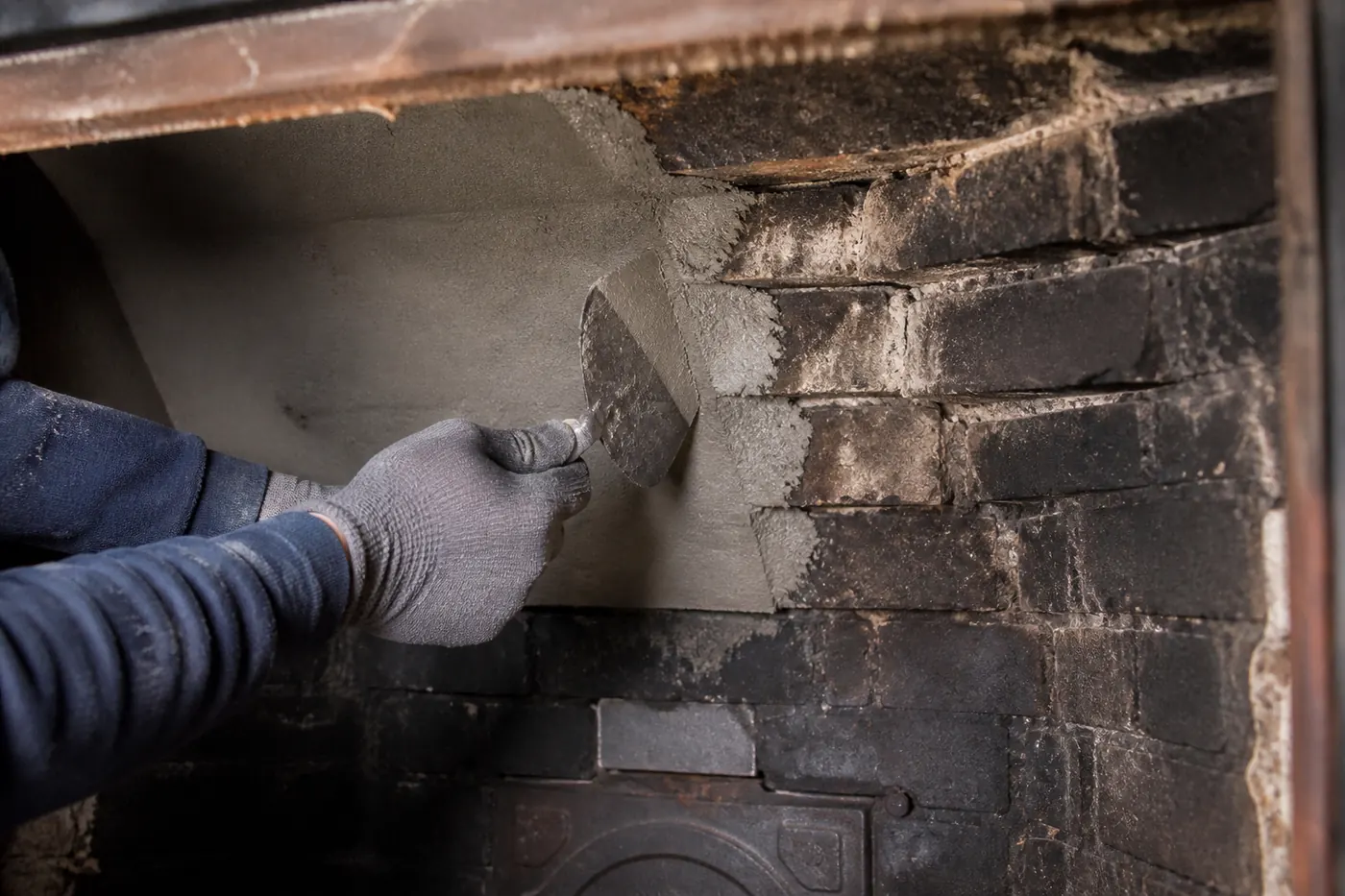
Heat and humidity wake up whatever is stuck in the flue: old soot, damp masonry or an animal that got in. Warm air also stops pulling smell up and out, so odors drift into the house. A sweep and inspection is $299 fixed in Boston, and it is the usual way to find out which cause you have.
Why the smell shows up in warm weather
In winter your chimney works like a straw. Warm indoor air rises up the flue, so smells are carried outdoors. In summer that effect weakens, and on some days it reverses.
Outside air can be hotter than the air in the flue, and the cool, heavy air inside the chimney sinks into the room. Air conditioning makes it stronger by lowering the pressure in the house, and exhaust fans pull even more air in through the open firebox.
Humidity matters too. Soot and creosote hold odor in their pores, and wet air releases it. That is why a chimney that seemed fine in January can smell like a campfire in a July heat wave.
Smell identifier: what each odor usually means
The kind of odor is your best clue.
| What you smell | Likely cause | Next step |
|---|---|---|
| Smoky, tar-like, like a stale campfire | Soot or creosote in the flue | Sweep and inspection |
| Musty, like a damp basement | Water in the masonry or flue | Find the leak, then repair |
| Rotten, sour or sharp | A dead bird, raccoon or squirrel, or nesting debris | Animal removal and cleaning |
| Chemical or sulfur-like | Gas appliance or gas line, or a bathroom or boiler vent | See the safety box below |
If more than one smell is present, deal with the strongest first. A technician can usually tell by a quick look in the firebox and up the flue.
If the smell is like gas
A rotten-egg or gas smell is a different matter. Leave the house, do not touch light switches or lighters, and call your gas utility or 911 from outside.
Do the same if a carbon monoxide alarm sounds. Carbon monoxide has no smell, so a working alarm is the only warning you get. Our guide to carbon monoxide chimney warning signs explains what to look for and what to do.
Do not wait for a visit if you smell gas. Safety comes first, and the chimney can be looked at after the house is safe.
How to narrow it down at home
You can learn a lot in ten minutes without touching the chimney.
- Notice when it is worst. Humid afternoons suggest soot or creosote. Smell after rain suggests water. A sudden smell with scratching or flapping sounds suggests an animal.
- Check whether the damper is open or closed. Closing a working damper often reduces odor, which also tells you the flue is the source.
- Turn off the air conditioner and any kitchen or bathroom fans for a short while and see whether the smell changes.
- Look into the firebox with a flashlight for debris, feathers, nest material, black buildup or standing water.
- Write down the date, the weather and which room smells strongest.
Never climb onto the roof to look at the top of the chimney. Photos taken from the ground are plenty to share with a technician.
Fixes that remove the cause, not just the smell
Candles, sprays and bowls of baking soda cover a smell for an hour. The cause is still there. Real fixes depend on what is found.
Soot and creosote
A chimney sweep removes deposits and inspects the flue for $299. Heavier buildup is creosote removal at $299 to $450 for stage 1, $450 to $700 for stage 2 and from $700 for stage 3.
Animals and debris
Removal is $299 to $900. A new cap, $300 to $700 for a standard one, keeps the next visitor out. Our guide on birds and animals in the chimney covers the details.
Moisture
Damp smells need the water source repaired. A cap, a crown repair ($300 to $900) or a flashing repair ($200 to $400 for a small one) may be all it takes, and a leak that needs more tracing runs $400 to $3,000. Standard waterproofing is separate, at $300 to $500.
Smells that come from somewhere else in the house
The fireplace gets blamed for plenty of odors that start elsewhere. A quick check of these saves a service call.
- The dryer vent. Lint, damp air and trapped moisture can smell musty or burnt in summer. Dryer vent cleaning is $99, and the dryer vent cleaning page explains what is involved.
- A boiler or water heater flue. In many older Boston homes these share a chimney with the fireplace. A chemical smell there needs a heating professional or the gas utility, not a fireplace sweep.
- A gas fireplace. New or recently used gas appliances can give off a faint odor at first. A strong or lasting smell is not normal. A gas fireplace cleaning is $299, and repairs run $299 to $900.
- The basement. Damp air in a basement can travel up an old unlined flue and show up in the living room.
If a flue is shared with a heating appliance, mention it when you call. It changes what the technician needs to check, and it is a safety point as well as a comfort one.
A sealed-off fireplace is another surprise. Even a blocked opening can let smell through if the flue behind it is wet or holds old soot.
Stopping the smell from coming back
Once the source is fixed, a few habits keep the room fresher in summer.
- Close the damper tightly when the fireplace is not in use. A glass door or a tight-fitting top-sealing damper can reduce air movement further.
- Keep the cap in good shape, with a screen that keeps birds and squirrels out.
- Book the yearly inspection in spring, so any repairs happen in dry weather and before the humid months.
- Burn only dry, seasoned wood next winter. Wet wood leaves the sticky residue that gives off the strongest smell.
- Run a dehumidifier in a damp basement near the chimney base.
If the damper is stuck, rusted or does not close, that is worth repairing too. Damper work is priced from $199 to $1,200, depending on the damage.
When to call and what to expect
Call when a smell lasts more than a day or two, when it comes with scratching, droppings or water, or when it fills a room. Do not run the fireplace to burn it off.
On the visit the technician will check the firebox, damper, smoke chamber and flue. You should receive photos of what is found, a written price before any work and an arrival window of three hours with a call ahead.
If the cause is a sealed-off, rarely used flue that still smells musty, that detail helps too, so mention it.
Not every visit ends in a repair. Sometimes the answer is a sweep and a tighter damper, and the technician will say so. If something larger turns up, you get a clear written price first and can decide at your own pace.
Book the $299 sweep with inspection at /contact/ or call (617) 404-9587.
Questions homeowners ask
Why does my fireplace smell only when the air conditioner runs?
The AC lowers the air pressure inside the house, which pulls air down the chimney and into the room, along with whatever odor sits in the flue. A tight damper and a clean flue reduce it a lot.
Is a smoky smell in summer a fire risk?
The smell itself is not an emergency, but it shows deposits are present. If you see flames, hear roaring or smell hot smoke from the chimney, get everyone out and call 911.
Can I use the fireplace after the odor goes away?
Wait for the inspection result if you are unsure what caused it. A blocked flue or a cracked liner can make a fire unsafe even when the smell is gone.
How can I tell if an animal died in the chimney?
A strong, rotten or sour smell that grows in the heat, often with flies near the fireplace or noises that stopped, is a strong sign. Do not try to reach it. A technician has the tools to remove it safely.
Will the smell go away on its own in cooler weather?
It often fades, but the cause remains, and it returns the next humid week. Deposits, moisture and animal debris do not leave by themselves.