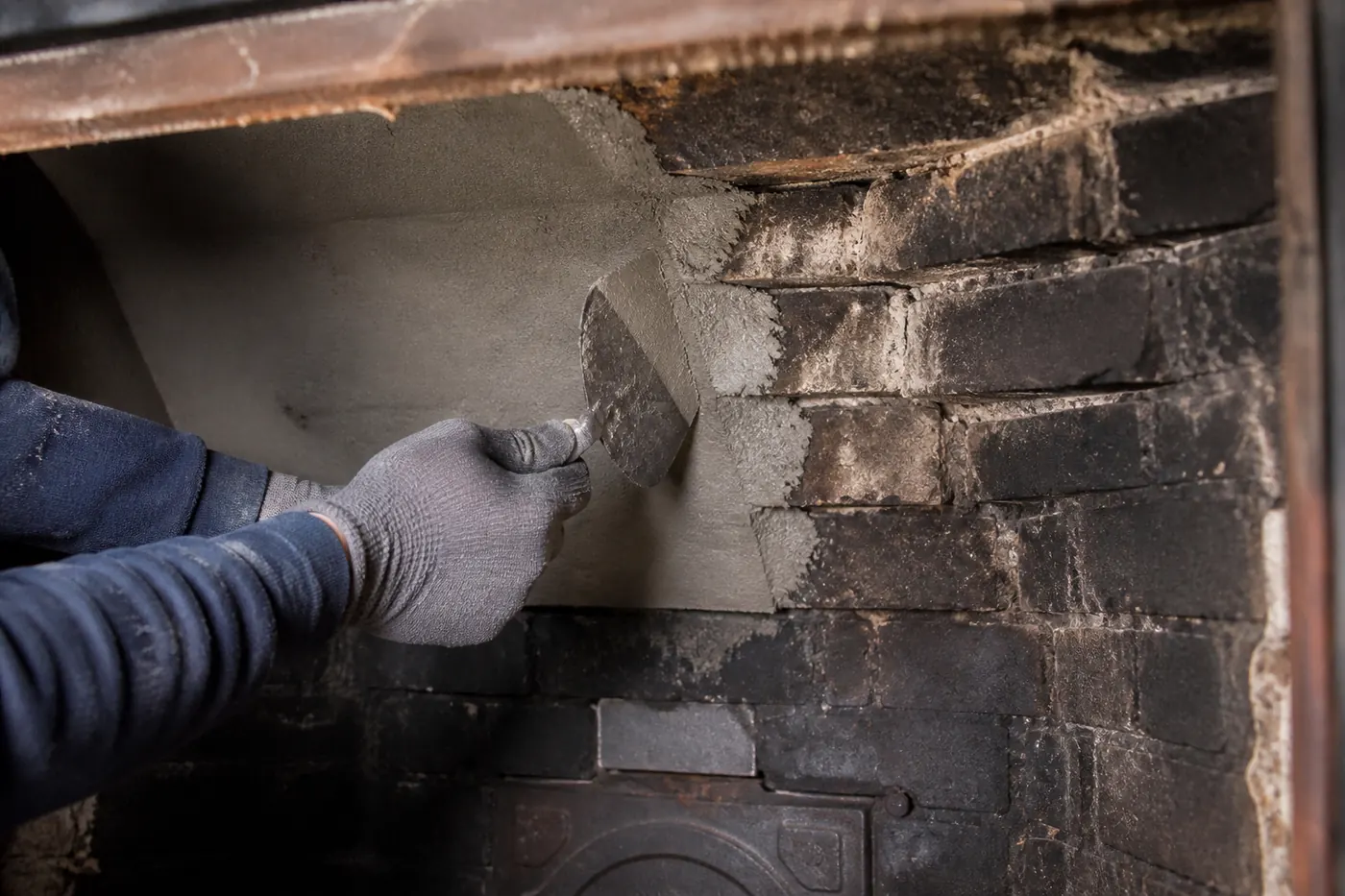
Smoke enters the room when the chimney is not pulling the fire's exhaust up and out. Common causes are a closed or stuck damper, a cold flue, a blockage, heavy deposits, a damaged flue, or a house that is short of air. Stop using the fireplace until the cause is found. A $49 inspection, credited toward approved repair work, looks at the whole path.
First, make it safe
Smoke in the room is a stop-use symptom. It means exhaust, including carbon monoxide, may be entering the house, and you cannot see or smell the dangerous part.
- Let the fire die or put it out the safe way, using the tools and methods your equipment calls for.
- Open a window and ventilate the room.
- Do not relight until the cause is found.
- Make sure a working carbon monoxide alarm is nearby.
If flames or heavy smoke are coming from anywhere other than the top of the chimney, leave the house and call 911. If a carbon monoxide alarm sounds, leave and call 911 as well. Do not go back in to investigate.
Six reasons a flue stops drawing
| Cause | What you notice | Typical fix |
|---|---|---|
| Damper not fully open | Smoke right at the start of a fire | Open it fully, or repair a damaged damper |
| Cold flue | Smoke at lighting that clears once the fire is hot | Warm the flue before lighting the main fire |
| House under negative pressure | Smoke when fans run, or on windy days | Close fans, crack a window, review house airflow |
| Blockage | Smoke whatever you do, sometimes with debris falling | Remove nest or debris, check the liner |
| Heavy deposits | Smoky smell, fires that burn poorly | Cleaning, with heavier removal if needed |
| Damaged or poorly sized flue | Constant poor performance | Repair or reline |
The sections below take the main ones in turn. Notice that several of them have nothing to do with how dirty the chimney is, which is why simply hiring a cleaning does not always end the problem. Matching the fix to the real cause is what keeps you from paying for work that does not help.
Quick checks from inside the room
These do not require tools and do not put you at risk.
- Is the damper fully open? Look at the handle or lever and the plate above the firebox. Do not force a damper that is stuck or damaged. A damper that will not move needs repair, not muscle.
- Did the smoke only happen at the start? A cold chimney holds a heavy plug of cold air that resists the first warm exhaust. This often resolves once the flue warms up.
- Are fans or a dryer running? Kitchen hoods, bathroom fans and dryers pull air out of the house.
- Is it a very windy or snowy day? Strong gusts, snow and ice can affect draft or block a cap.
Write down what you changed and whether it helped, since that tells the technician what has already been ruled out. If the problem returns after you correct these, the cause is probably inside the chimney, and an inspection is the next step.
Tight houses and competing exhaust
A fireplace needs a steady stream of replacement air. In a leaky old house, that air comes through cracks. In a recently renovated, air-sealed house, there may not be enough, so the fire pulls what it needs down the chimney instead, and smoke follows it into the room.
Greater Boston has many older homes that have been tightened with new windows, insulation and air sealing, so this is a common change. The same fireplace that worked for decades can start to smoke after a renovation.
- Turn off exhaust fans and the dryer while the fire burns.
- Open a window slightly near the fireplace.
- Ask whoever did the air sealing whether fireplace air was considered.
If the problem is about house air, a chimney repair will not solve it, which is why cause comes before price. Our guide on fireplaces that do not draw goes through this in more detail.
Blockages, deposits and damage inside the flue
When the room checks do not solve it, the cause is usually in the chimney itself.
Blockages
Birds and squirrels build nests in uncapped flues. Leaves, branches and broken liner pieces can drop in too. A blocked flue gives smoke nowhere to go.
Deposits
Soot and creosote narrow the flue and roughen its surface, which slows draft. Heavy creosote is also a fire risk.
Damage and design
A cracked or collapsed liner, a rough or poorly shaped smoke chamber, or a flue that is too big or too small for the fireplace can all spoil draft. A chimney that is too short, or sits near a taller roof or trees, can also have wind pushing down into it.
Water can play a part as well. A crown or cap that lets rain in can wet the flue, and a damp flue drafts poorly and smells in humid weather. That is one more reason the whole chimney is looked at, from the firebox to the top.
These conditions cannot be seen from the room, so a technician checks the flue with a camera or direct view and photographs what they find.
What the repairs cost in Boston
The price depends entirely on the cause. These are Boston prices for the work most often involved.
- Inspection: $49, credited toward approved repair work.
- Cleaning with inspection: $299.
- Creosote removal: stage 1 $299 to $450, stage 2 $450 to $700, stage 3 from $700.
- Animal and nest removal: $299 to $900.
- Damper repair or replacement: $199 to $1,200.
- Smoke chamber repair: $500 to $1,500.
- Liner repair: $1,200 to $2,500.
- Standard chimney cap: $300 to $700.
Anything not listed is quoted in writing after the inspection. The inspection cost page explains what the $49 covers, and smoke chamber repair describes one of the less obvious fixes.
Keeping smoke where it belongs
A few habits cut the risk of smoke coming back into the house.
- Open the damper fully before lighting, and leave it open until the ashes are cold.
- Burn dry, seasoned wood.
- Light a small kindling fire first to warm the flue on cold days.
- Keep a cap on the chimney to keep nests and debris out.
- Have the chimney inspected every year, and cleaned when the findings call for it.
If the problem only shows up in one kind of weather, say so. A chimney that smokes only in a north wind, or only after a heavy snow, points to a different cause than one that smokes every time. A technician can use that pattern to narrow the search and check the cap, the chimney height and the surroundings.
Keep notes when it happens: the date, the time, the weather, which room, what was running and how the fire was built. That timeline helps separate a one-off from a recurring cause.
If you want the whole path examined, the chimney inspection is the starting point. Book at our contact page or call (617) 404-9587.
Questions homeowners ask
Why does my fireplace only smoke when I first light it?
A cold flue holds a column of heavy cold air that has to be warmed before smoke rises. Warming the flue with a small kindling fire, and opening the damper fully, often fixes it. If it keeps happening, have the chimney checked.
Is a little smoke in the room really dangerous?
Treat it as a warning. Smoke can mean exhaust gases are also entering the room, and carbon monoxide cannot be seen or smelled. Stop using the fireplace and keep a working alarm nearby.
Could a new roof or new windows cause my fireplace to smoke?
New windows and air sealing can reduce the air available for the fire. Roof work can change how wind moves around the chimney, or disturb the cap or flashing. Mention recent work when you call.
Will a chimney sweep fix smoke problems?
Only if deposits or a blockage are the cause. Cleaning is $299 with inspection. If the cause is the damper, house pressure or a damaged flue, cleaning alone will not solve it.
Can a chimney cap stop downdrafts?
Some caps are designed to help with wind, but a cap cannot fix a flue that is too short, blocked or leaking. Diagnosis comes first, and a standard cap is $300 to $700.