White, powdery or crusty patches on chimney brick are usually efflorescence: mineral salts that water carries out of the masonry and leaves behind as it dries. The salt is harmless, but it tells you moisture is moving through the chimney. In Boston, the fix often starts with finding the water, and waterproofing runs $300 to $500 standard, $500 to $800 with a crown seal, and from $800 for a full system.
How white stains form on brick
Brick, mortar and the stone beneath them contain natural salts. Rain or snowmelt soaks into the masonry and dissolves some of those salts. As the wet brick dries, the water travels to the surface and evaporates, and the salts stay behind as a white film. That film is efflorescence.
Three things have to be present for it to happen: salts in the masonry, water, and a path for the water to move. If you remove any one, it stops. Salts are hard to remove from brick, so the useful one is water. That is why the stain matters more as a clue than as a cosmetic flaw.
You see it more in cold, damp months, when the masonry stays wet longer, and on the sides of a chimney that get the most rain. In Greater Boston, with winter freeze-thaw cycles, wind-driven rain and sea air, it is a common sight on older brick chimneys, especially near the top.
Is it efflorescence or something else?
Several things can look white or pale on a chimney. A close look and a simple test help tell them apart.
- Efflorescence: Dry, chalky, powdery or crystal-like. It tends to sit on the surface in patches or streaks, and often appears on a clean brick without any paint. A damp cloth will often wipe some of it off or dissolve it.
- Lime run or hard deposits: Harder, more like a crust or drip, and not easy to rub away. It can mean water is passing through mortar or concrete.
- Peeling paint: Flakes or curls with color underneath. It means someone painted the brick, and the paint is failing, often because moisture is trapped behind it.
- Algae, mold or lichen: Often gray, green or black rather than clean white, with a fuzzy, slimy or patchy texture.
- Soot or smoke streaks: Dark, not white.
Take photos from the ground, in daylight, before touching anything. If you cannot tell, a technician can identify it at an inspection.
Where the water is coming from
Because the stain follows the water, the pattern on the brick points toward the cause. Think of the stain as a map.
Near the top of the chimney
Stains just under the crown often mean the crown has cracks or the cap is missing or too small. Water seeps in from above.
Along mortar lines
Mortar that has gone sandy or cracked lets water into the wall. Streaks that follow the joints point to repointing needs.
Near the roof line
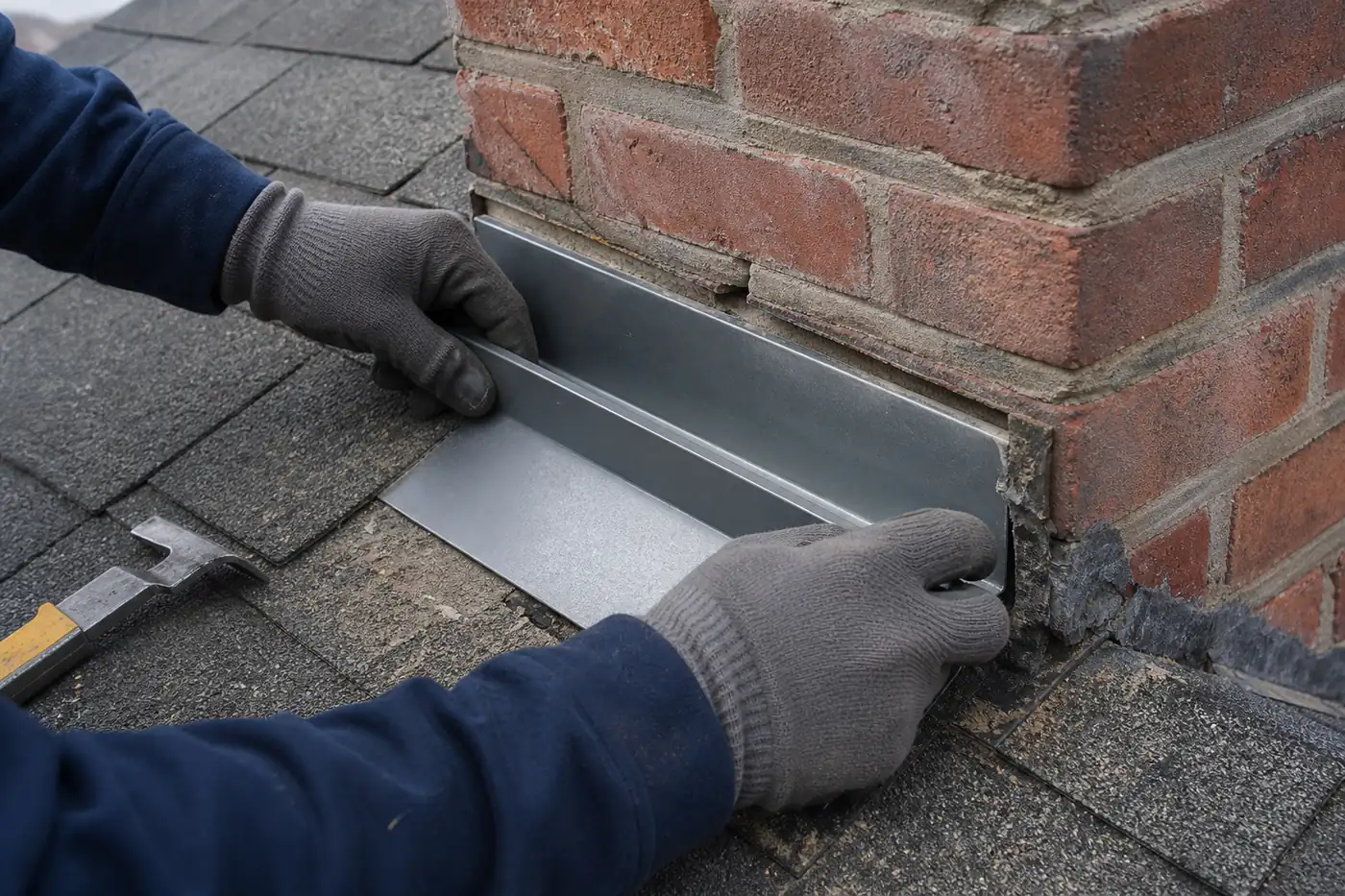
Bad flashing lets rain run behind the chimney, and white marks low on the stack suggest that source.
Over the whole face
If the entire chimney is evenly stained, the brick itself may be soaking up too much water, which waterproofing can help with.
On the inside
White deposits in the attic or on the interior side can mean a leak that is hidden from outside. Our chimney repair page covers how these sources are found and fixed.
What to do first, and what to hold off on
Resist the urge to scrub right away. Cleaning without fixing the water source just brings the stain back.
- Photograph it. Take wide and close shots with the date. Note recent weather.
- Watch it. If it appears after storms and fades in dry spells, that confirms moisture is the cause.
- Lightly brush loose powder with a dry, soft-to-medium brush from a safe position on the ground or a porch, only if you can reach it safely. Do not go on the roof.
- Hold off on harsh cleaners. Strong acids and pressure washers can etch brick, wash out mortar and make the brick absorb more water.
- Get the source found. Then clean, with a method that suits the type of brick.
If the chimney has been painted or sealed with a film coating, tell the technician. That changes what cleaning and treatment are safe.
How repair and cost line up with the cause
The price follows the problem, so here are Boston planning ranges by cause. The final number is in writing after inspection.
- Brick absorbs water: Breathable water repellent. Standard is $300 to $500, with a crown seal $500 to $800, and a full system from $800. See chimney waterproofing.
- Cracked crown: Repair $300 to $900, rebuild $900 to $2,500.
- Worn mortar: Repointing, partial $300 to $700 and full $700 to $2,500.
- Damaged brick: Masonry repair, basic $300 to $700, standard $700 to $2,500, major from $2,500. Read about masonry repair.
- Flashing leak: Repair $200 to $400, partial $400 to $800, full $800 to $2,500.
- Missing or broken cap: Standard cap $300 to $700.
Often two items are needed together, such as repointing and then waterproofing. Our chimney repair cost guide shows how combined work is priced.
Cosmetic issue or warning sign?
A light, one-time bloom on a new or recently repaired chimney is common. Fresh mortar and new brick often show some while they dry out for the first time, and it may fade on its own.
It becomes a warning sign when it keeps returning, covers a growing area, or shows up with other symptoms:
- Flaking or peeling brick faces
- Soft, sandy or missing mortar
- Stains inside, near the fireplace or on an attic wall
- A damp or musty smell
- Rust on metal parts
Repeated wetting and freezing is what turns a harmless film into damaged brick. Salts that crystallize inside the brick, rather than on the surface, can push the face off. That is the point where a stain turns into a repair bill.
Keeping the water out, early, is a lot less expensive than replacing brick later.
A useful habit is to photograph the same wall from the same spot every few months. Side-by-side photos show whether the white area is growing, shrinking or moving, and that history helps a technician decide if the problem is old and settled or active and getting worse.
Getting a clear answer
A good visit looks for the actual water path, not only the stain. Expect the technician to check the crown, the cap, the mortar, the flashing and the brick face, take photos, and explain which one is feeding the moisture. You should leave with a written price and a plan that says what comes first.
It also helps to bring your own notes: when the stain first appeared, whether it grows after rain, and whether the chimney was ever painted, sealed or repaired.
If your chimney has white patches, book a $49 general inspection, credited toward approved repair work, at /contact/ or call (617) 404-9587.
Questions homeowners ask
Will the white stain go away if I just leave it?
Sometimes a light bloom fades on its own, especially on new masonry. If water keeps getting in, it will come back. A recurring stain usually means a leak or high absorption that needs attention.
Can I wash efflorescence off with vinegar or a pressure washer?
We advise against both. Acids and high pressure can damage old brick and mortar. A dry brush on loose powder is safer, and a technician can pick a cleaning method suited to your brick.
Do white stains mean my chimney is about to fall?
No. The stain by itself is not a sign of collapse. It does tell you that water is moving through the masonry, and over time that can weaken it, so it is worth having it checked.
Why does the stain appear mostly in winter?
Masonry stays wet longer in cold, damp weather and dries slowly, which lets salts rise to the surface. Freeze-thaw cycles add to the stress on wet brick.
Should I seal the brick myself to stop the stains?
Be careful. A film-forming sealer can trap water inside and cause flaking. A breathable repellent applied after the water source is fixed is the better approach, and it works best when a technician selects it.