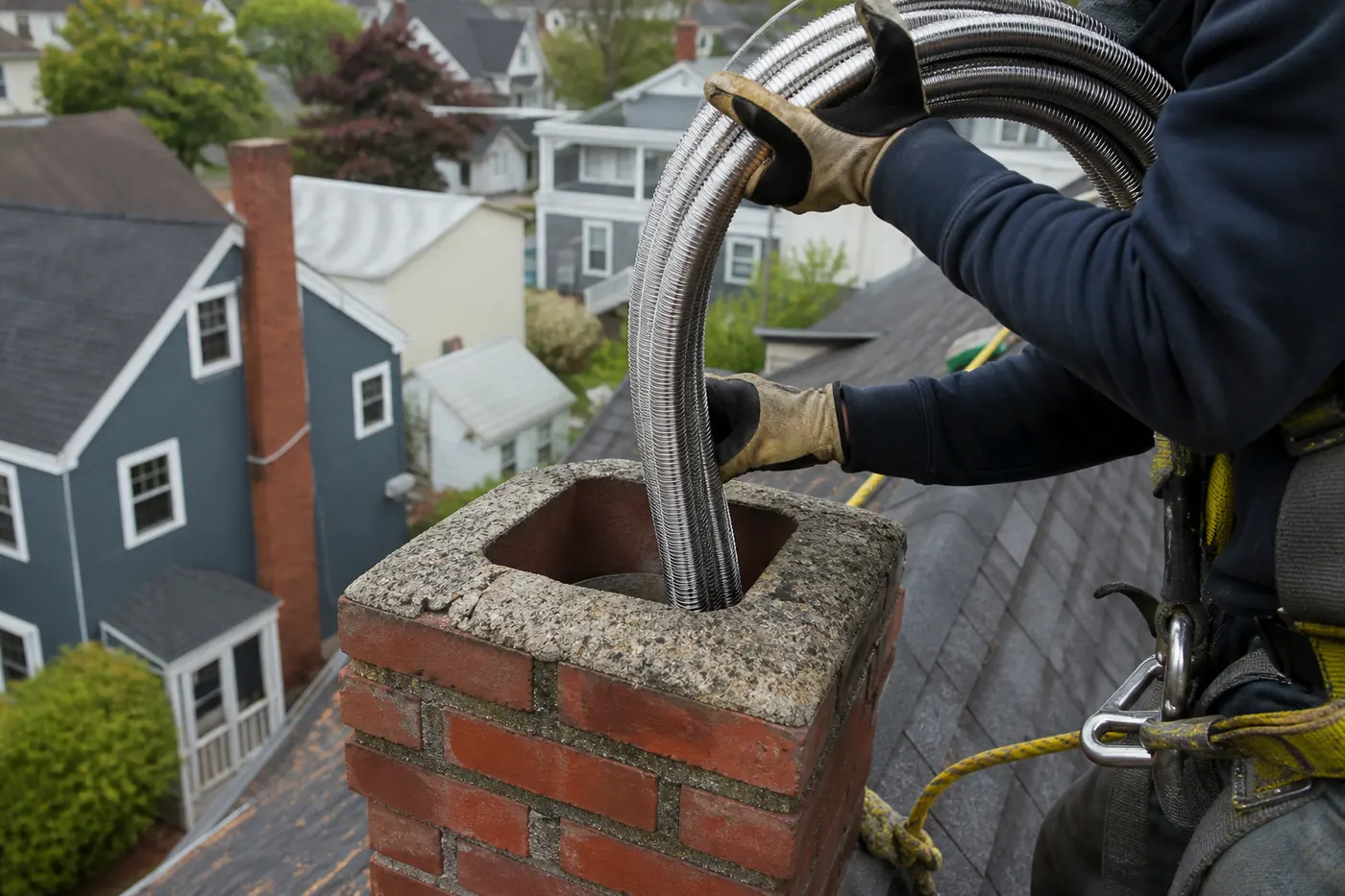
Most Boston relining jobs land between $1,200 and $4,500 in 2026. A liner repair is $1,200 to $2,500, a full replacement is $1,500 to $4,500, and a liner built for a new venting setup starts around $2,000. Your exact number depends on the flue size and height, and we confirm it in writing after a $49 inspection.
The price table
| Job | 2026 Boston range |
|---|---|
| Liner repair | $1,200 to $2,500 |
| Liner replacement | $1,500 to $4,500 |
| New venting liner (appliance change) | From $2,000 |
| Chimney inspection | $49, credited toward approved work |
These are planning ranges, not quotes. A short, straight flue on a one-story ranch sits near the low end. A tall, narrow flue running through a three-story brick house sits near the top. After the inspection, the number you are given is the number in writing.
If you want to understand the jobs behind these labels first, our page on chimney relining walks through the work in order.
What a chimney liner actually does
A liner is a smooth tube that runs the full height of the flue inside the masonry. Think of it as a sleeve. It does three jobs.
- It carries smoke and exhaust gases up and out without letting them seep into the brick or the house.
- It protects the masonry from acidic condensation, which is common with modern, efficient gas heating equipment.
- It sizes the flue to the appliance, so the draft pulls correctly.
Old brick chimneys in Greater Boston often have clay tile liners from the day the house was built. Over decades those tiles crack, shift, or lose mortar between sections. Some older stacks have no liner at all. That is when relining stops being optional for a working fireplace or heating appliance.
Signs your flue may need a new liner
You cannot judge a liner from the living room. But some symptoms are common reasons a technician runs a camera down the flue.
- Pieces of clay tile in the ashes or on the smoke shelf.
- Smoke or a sour smell coming back into the room.
- Flaking or rusty metal on a liner that is already stainless.
- A recent switch to a high-efficiency boiler, furnace, or insert.
- A chimney fire in the past. A fire can crack clay tiles even if the house looked fine afterward.
If you have had a fire, do not light the fireplace again until the flue has been inspected. During a chimney fire, leave the house and call 911. Our liner types guide shows what clay, stainless steel, and cast-in-place liners look like and when each is used.
What moves the price up or down
Four things drive most of the difference between $1,200 and $4,500.
Length and diameter
More feet of liner costs more. A larger round or oval flue for a big fireplace needs more material than a six-inch appliance flue.
Bends and offsets
A straight flue is simple. If the chimney jogs sideways inside the wall, a flexible liner has to be fed past those turns, and that takes more time.
Insulation
Some appliances need the liner wrapped or surrounded with insulation. That adds material and labor.
Access
A narrow roof pitch, a tall stack, or a fireplace that is hard to reach from below all add hours. Multi-flue stacks, common on older houses and triple-deckers, can complicate the job because liners for neighboring flues have to fit together.
Matching the liner to your appliance
The liner is not chosen from a catalog by price. It is matched to what is connected to the bottom of it.
- Wood fireplace or stove: needs a liner rated for high heat and solid fuel.
- Gas fireplace or furnace: typically needs a smaller liner, and sometimes a different material, because gas exhaust is cooler and wetter.
- Oil boiler: has its own requirements and needs a liner suited to oil exhaust.
This is why a liner installed for one appliance is not automatically right if you later swap the equipment. If you plan to add an insert or change from oil to gas, tell the technician before the quote. Changing the appliance later can mean paying twice.
Relining, rebuilding, or leaving the flue alone
A damaged flue does not always mean a new liner. The choice depends on what the camera shows and what you plan to burn.
Leave it and monitor
Hairline cracks in an otherwise intact clay liner on a fireplace you use lightly may be watched year to year. The technician photographs them so you can compare next visit.
Repair a section
If only a few tiles have shifted or a joint has opened, a targeted liner repair at $1,200 to $2,500 can be enough. This is common when the rest of the flue is straight and sound.
Replace the whole liner
When damage runs the full height, or when the appliance has changed, a full replacement at $1,500 to $4,500 is the normal answer. It gives the appliance a flue that fits it.
Rebuild instead
If the masonry around the flue is also failing, lining alone will not help. A relined flue inside a crumbling stack is still a problem, and that is when a chimney rebuild enters the conversation.
Whichever way it goes, the written quote should say which option was chosen and why the others were set aside.
What happens on the day
The typical flow looks like this. Exact steps vary with your chimney.
- The technician arrives inside the 3-hour window we gave you after calling ahead.
- Floors and furniture near the fireplace are covered.
- If you have a camera inspection scheduled, the old flue is scanned and photos are taken of any cracked tile or gaps.
- The old liner or debris is cleared if it blocks the new one.
- The new liner is lowered or pulled through, then connected at the bottom and finished at the top.
- A cap or termination piece is attached, and the connection to your appliance is checked.
We do not promise how long a job takes. A simple flue can move faster, and a stubborn old tile liner that has to be removed first takes longer. If something unexpected turns up, the technician explains it and you approve any added work in writing before it begins.
Questions to ask before you approve a liner quote
Use these to compare quotes honestly.
- What material is the liner, and why is it right for my appliance?
- How many feet are you installing, and what size?
- Does the price include insulation, a top plate, and a cap?
- Are the connection pieces at the appliance included?
- What happens if you find an obstruction or a collapsed tile?
- Will I get photos of the old flue before work starts?
A per-foot number with nothing else is not enough. The total should be built from measurements. Related work, such as chimney repair costs for a damaged crown or a leaking joint, should be priced separately so the liner quote stays clear.
When you are ready for numbers, book the $49 inspection at our contact page or call (617) 404-9587.
Questions homeowners ask
Why do liner quotes vary so much between companies?
Companies may measure the flue differently, propose different materials, or leave out insulation, a cap, or the appliance connection. Ask each one to list what is included so you compare the same job.
Can a cracked clay tile liner be repaired instead of replaced?
Sometimes. Liner repair runs $1,200 to $2,500. Whether it works depends on how many tiles are damaged and where, which a camera inspection shows. Widespread damage usually points toward replacement.
Do I need a new liner if I switch to a gas furnace?
Often a smaller liner suited to gas exhaust is needed, because the old flue can be too large and the exhaust can condense inside it. The technician checks this after the inspection and lists it in the written quote.
Does relining stop a chimney from leaking?
No. A liner carries exhaust and is not a water barrier for the outside of the chimney. Leaks usually come from the crown, cap, flashing, or mortar joints, which are separate repairs.
Is a liner the same as a chimney cap?
No. The liner runs inside the flue, while the cap sits on top and keeps rain and animals out. Many relining jobs include a new termination or cap, so ask whether it is in the quote.