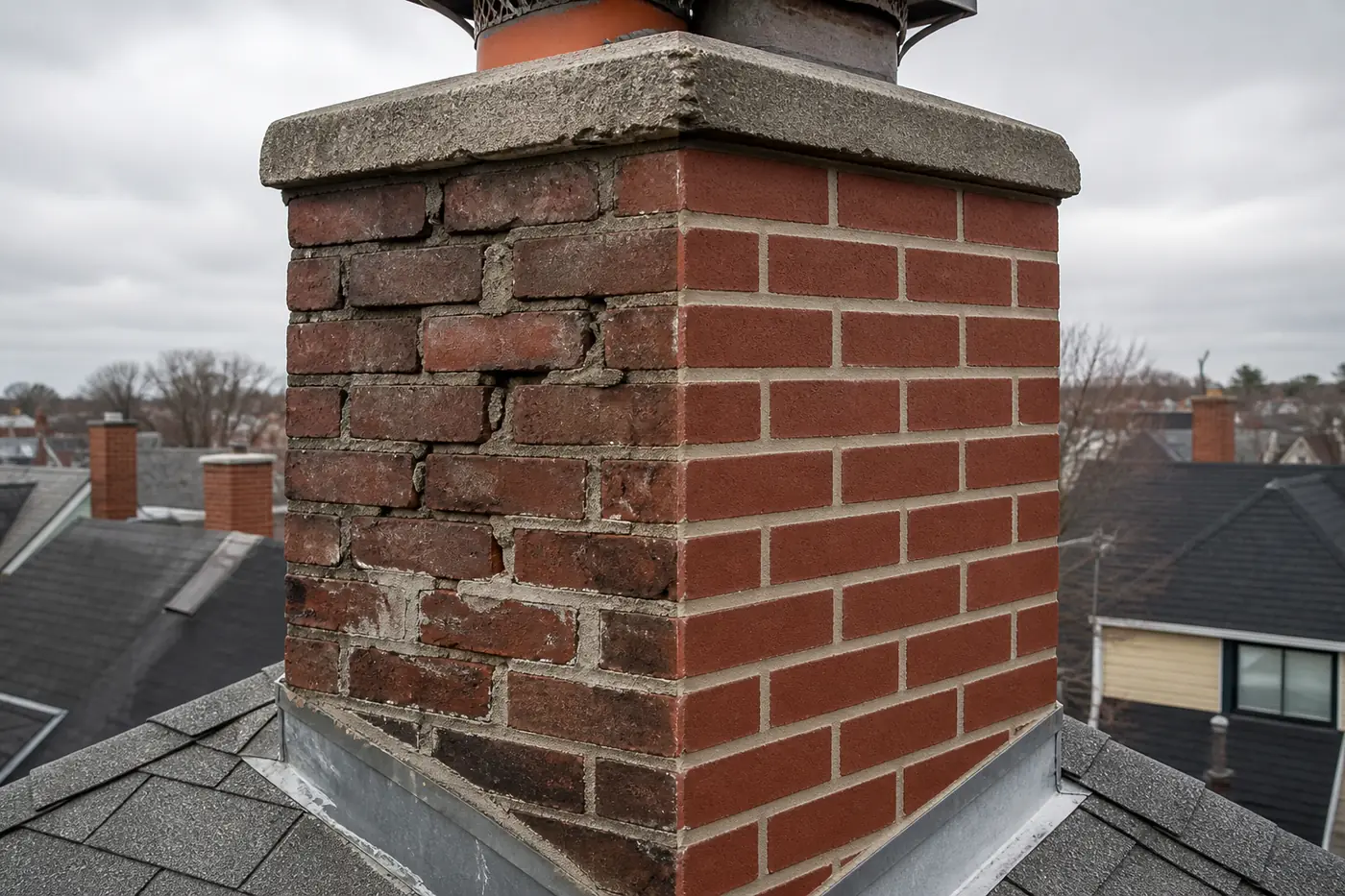
Most focused chimney repairs in Greater Boston cost $300 to $2,500, and major rebuilding starts above that. "Chimney repair" is not one job, so the price depends on which part failed: the crown, flashing, mortar, brick, cap or liner. A $49 inspection, credited toward approved repair work, identifies the part and gives you a written price.
Repair prices by component
This table shows Boston prices for the repairs homeowners ask about most. A single chimney often needs just one line from it.
| Repair | Boston price |
|---|---|
| Basic masonry repair | $300 to $700 |
| Standard masonry repair | $700 to $2,500 |
| Major masonry repair | From $2,500 |
| Crown repair | $300 to $900 |
| Crown rebuild | $900 to $2,500 |
| Repointing, partial | $300 to $700 |
| Repointing, full | $700 to $2,500 |
| Flashing repair | $200 to $400 |
| Standard chimney cap | $300 to $700 |
| Liner repair | $1,200 to $2,500 |
| Partial rebuild | $2,000 to $4,500 |
For anything not shown, the price is quoted in writing after the inspection. Our chimney repair cost page keeps the full list.
Notice how the ranges overlap. A crown repair and a basic masonry repair both start at $300, but they solve different problems. Many homes need two small items rather than one large one, for example a crown repair together with partial repointing. Each item is priced and listed separately in the written proposal, so you can see what you are approving and decline anything that is not urgent.
Why one phrase covers so many different jobs
A ceiling stain, a crumbling top and a smoky fireplace can all be called chimney repair, but the work behind each is entirely different. The stain might be flashing or a cracked crown. The crumbling top might be old mortar or deteriorated brick. The smoke might be a liner or a blockage.
That is why a quote that says only "repair chimney" cannot be compared with another. A proposal worth acting on names:
- The exact component that failed.
- The quantity and location, such as how many feet of joints or which side of the chimney.
- What will be removed and what will stay.
- The material that will replace it.
- Surface preparation, cleanup and cure time.
- What is excluded and what would change the price.
With photos attached, you can see the same condition the technician saw. The page on our chimney repair service explains how that evaluation works.
Repair or rebuild: where the line falls
A targeted repair makes sense when the surrounding brick is stable and the damaged area can be prepared properly. Think of one failed crown, a section of open joints, or a rusted cap.
Rebuilding enters the conversation when the problem is no longer local. Warning signs include:
- Bricks that are loose, shifted or leaning.
- Broad flaking across many faces, not just a few.
- Cracks that run through several courses.
- Masonry below the visible damage that has lost strength.
A partial rebuild is $2,000 to $4,500 and a full rebuild is $4,000 to $10,000 or more. See the chimney rebuild cost page for what drives those numbers, and repair versus rebuild for a plain-language comparison.
Beware of a quote that jumps straight to rebuilding without photos of loose or displaced brick. Equally, beware of a patch quote on a chimney that is clearly leaning. The evidence should decide.
A middle path exists too. Sometimes the safest, most economical answer is to repair the top of the chimney now and monitor the lower section, with a dated photo record so the next inspection can compare. Ask whether that option fits your chimney, and what the technician would watch for.
What pushes your price up or down
How much sound material can stay
The more good brick and mortar that can remain, the smaller the job. A chimney that is solid below the damaged top costs less than one with problems running down into the stack.
Height, roof pitch and access
A tall chimney on a steep roof takes more time, more staging and more safety equipment. Dense Boston lots can add a layer: if work needs access over a neighbor's yard or a narrow side passage, that affects labor.
Matching materials
New brick, mortar color and joint style should blend with what is there. Matching takes sourcing, mixing and care, and older chimneys cost more to match than newer ones.
Preparation, disposal and tie-ins
Old material must be removed and hauled away, and new work has to tie into what stays. Those steps are real labor, and a thin quote may skip them.
How Greater Boston conditions shape repairs
Greater Boston has cold winters, repeated freeze-thaw cycles, wind-driven rain and coastal salt air, and many homes have older brick chimneys. Water gets into masonry, freezes, expands and breaks the surface from the inside. Most repairs here are about keeping water out or repairing what water already did.
That is why a small, early repair often saves money. A cracked crown repaired for a few hundred dollars protects the brick underneath. Left alone, the same crown lets water into the stack, and the repair grows into masonry work, flashing damage and sometimes interior leaks. If water is already coming in, the first job is finding the entry point, which is why the inspection comes before any repair label.
Diagnosis matters more than the label on the repair. Several different failures can produce one identical stain in your living room.
Getting a quote you can trust
Compare proposals on scope, not on the total alone.
- Get the scope in writing with photos before you agree.
- Ask the company to explain why each item is needed and what happens if you wait.
- Check that the cause of the problem is addressed, not just the symptom.
- Ask what is not included, such as roof work or interior drywall.
- If you are unsure, get a second opinion. A second opinion is free when you bring a written report from a reputable local chimney company.
Be wary of any contractor who asks for the full payment up front or cannot show you what they found. Confirm that the contractor holds whatever registration Massachusetts requires for home improvement work, and check with the state's official website or your local building department if you are unsure what that is.
When to schedule and what happens next
Earlier is almost always cheaper, because water keeps working on masonry while you decide. Schedule before winter if you see crumbling mortar, white staining, chips of brick in the yard or rust at the top. Do not wait for an interior leak, because that means water has already traveled a long way.
If you ever see flames, heavy smoke or a glow from the chimney outside the fireplace, leave and call 911. That is an emergency, not a repair.
For everything else, the visit is straightforward. You choose a day, you get a three-hour arrival window and a call ahead, and the technician photographs what they find. The written price comes before any work starts. Book the $49 inspection at our contact page or call (617) 404-9587.
Questions homeowners ask
What is the cheapest chimney repair, and what does it fix?
Flashing repair at $200 to $400 and basic masonry repair at $300 to $700 are among the lowest. They suit small, contained problems. If the damage is widespread, a small repair will not hold.
Does the $49 inspection fee get added on top of the repair?
No. The $49 is credited toward approved repair work, so if you go ahead with the repair, it comes off the price.
How do I know whether my chimney needs a repair or a rebuild?
Look at the stability of the brick. Loose, displaced or broadly crumbling brick points to a rebuild, while a stable chimney with a few failed areas points to repair. Photos from the inspection make that visible.
Can I do small chimney repairs myself?
Climbing on a roof and working at height is risky, and patches over wet or deteriorated masonry often fail. Leave work above the roofline to a professional and limit your own work to ground-level observation.
Why do two companies quote very different prices for the same chimney?
They may be pricing different scopes, one with full masonry cuts and matching and one with a surface patch. Compare what is included in writing before comparing totals.