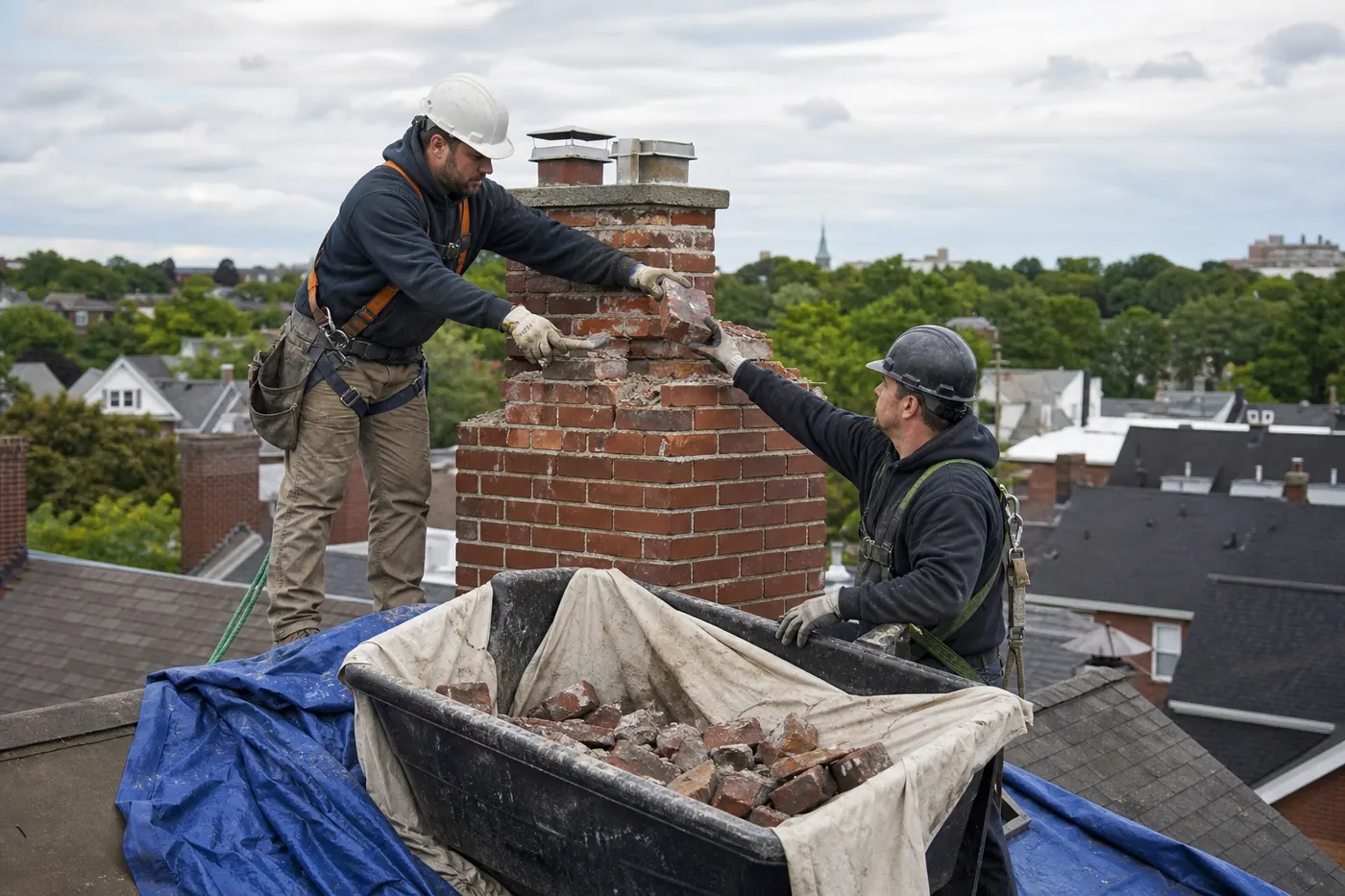
There is no single price for chimney removal, because no two removals are the same. Taking out a stack above the roof is a very different job from removing one that runs through every floor. We price it by inspection: a technician looks at your chimney, and a written price follows the $49 visit.
Why a fixed price would be a guess
A chimney is not a freestanding object. It is tied into your roof, your floors, your heating system and sometimes your neighbor's. A number quoted from a photo ignores everything that really sets the cost.
Two houses on the same street can have very different jobs. One has a lone brick stack that stops in the attic. The other has a chimney that rises through a kitchen, a bedroom and a hallway, shares a flue with the unit upstairs, and carries the boiler exhaust. The first is mostly roof work. The second is demolition inside a lived-in home, plus structural questions and a lot of cleanup.
That is why our chimney removal cost page explains the factors and does not post a number. We will not hand you a figure we cannot stand behind. What we can promise is that you get a written price, with photos of what the technician found, after the inspection and before any work is approved.
Three kinds of removal, three different projects
Above the roofline only
The visible part of the stack comes down to a point just under the roof surface. The roof is then closed over so it is weather-tight. The inside of the house is mostly untouched, but the leftover chimney below still exists and may still be in use.
Down to the attic or top floor
More of the stack is taken out, usually to the highest ceiling. This opens up the attic space, but it also means the remaining chimney below needs proper support and a clean finish.
Floor to roof
The whole chimney is removed, level by level. Floors, ceilings and walls where it passed through must be rebuilt or patched. This is the largest project, and it is where most of the cost and the surprises are found.
Which of these fits your goals is the first decision. If you only want to stop a roof leak around a chimney you never use, the answer may be smaller than you expect. If you want the extra floor space back, the answer is the larger project, and it deserves a careful look at what holds up the floors and walls beside it.
Weather also plays a part. An open roof in a nor'easter or a freeze-thaw week is a risk, so removal work needs a plan for temporary protection and a realistic look at the season.
What drives the final number
Here are the main pieces the written price has to account for:
- How much comes out. Height and width of the stack, and how many floors it crosses.
- Structural role. Some older masonry chimneys help carry loads or brace framing around them. Taking them out can mean new beams or posts.
- Active flues. A furnace, boiler or water heater may still vent through the chimney. Removing it means that appliance needs a new, approved way to vent.
- Access. Narrow lots, attached buildings and tight stairways slow down moving debris.
- Roof closure. The hole where the chimney stood needs framing, sheathing, flashing and roofing to match your existing roof.
- Interior finishing. Plaster, drywall, flooring and paint where the chimney used to be.
- Debris and protection. Brick and mortar are heavy, and the rooms around the work need protection from dust.
- Approvals. See the next section.
Because each item can swing the total, a removal quote that ignores them should make you cautious.
Check what is still connected before anyone swings a hammer
The most important question is simple: does anything still use this chimney? Boston-area homes often have a shared or reused flue. Old coal chimneys were later fitted with a gas boiler, and a fireplace flue may sit right beside a heating flue in the same stack.
During the inspection, the technician traces what each flue serves and whether any of them are still active. If a boiler or water heater vents into the stack, it has to be dealt with by the right qualified trade before the chimney comes down. Removing a chimney that still carries exhaust can send carbon monoxide into the house.
In a triple-decker, rowhouse or brownstone, the stack may also be shared with a neighbor or serve other units. Ownership boundaries, party walls and condo association rules can all matter. Settle those questions before you commit, not after the roof is open.
Permits, approvals and rules: confirm before you start
Removing a chimney can touch several kinds of rules, and they differ by city and by building. Typical categories include building permits for structural and roof work, rules for work in historic or landmark areas, condo or homeowner association requirements, and what your insurer expects when you change the structure of the home.
We are not able to tell you which of these applies to your property. Please confirm the current requirements with your local building department, and with your association or insurer if they are involved. If you live in an older neighborhood, our post on historic district chimney questions is a useful starting point for what to ask.
It is wise to settle approvals before the work is scheduled. A written scope from the inspection helps, because the building department and your insurer will want to know exactly what is coming out and how the roof will be closed.
Should it come out at all? Alternatives worth pricing
Removal is permanent, so compare it with the options that keep the chimney in place.
- Repair or rebuild the top. If the problem is crumbling brick above the roof, a partial rebuild runs $2,000 to $4,500. Our chimney rebuild page explains when this makes sense.
- Cap and seal the flue. A chimney you never use can sometimes be capped and left alone, which keeps rain out and costs far less than demolition. Chimney caps are $300 to $700 for standard models.
- Keep it for resale. Many buyers in older Boston houses like a working fireplace. Taking it out may change what some buyers see as value.
- Use the space. If your goal is room, ask whether removing only the portion above the attic gets you there.
A good technician will tell you if one of these is a better fit, even if it means a smaller job.
What a clear written price should include, and how to prepare
Before you approve anything, the proposal should spell out:
- Exactly where the demolition stops, floor by floor
- What happens to any flue that still serves an appliance
- How the roof will be closed and flashed
- Whether interior patching and paint are part of the price
- Who handles debris and permits, and who is responsible for approvals
- What happens if hidden conditions appear, such as extra rot or an unmapped flue
To get the most from the inspection, clear access to the attic and to the base of the chimney, and know where each heating appliance in the house vents. Photos of the stack from every floor save time. Tell us about any plans for a renovation, because they change the best order of work.
Ready to start? Book your $49 inspection at /contact/ or call (617) 404-9587, and you will receive photos and a written price before you decide.
Questions homeowners ask
Is the $49 inspection credited if I decide to go ahead with removal?
The $49 general inspection is credited toward approved repair work. Ask your technician how the credit applies to your specific project when you receive the written price, so there are no surprises.
Will removing my chimney make my house worth less?
It depends on the home and the buyer. Some people want the space, while others value a working fireplace in an older house. Consider talking with a real estate agent before you decide, and weigh the cost against the alternatives.
Can I remove just the part of the chimney that sticks out of my roof?
Often yes, but the remaining chimney below must be capped or closed off properly, and the roof must be sealed. If a heating appliance still vents through it, that has to be solved first.
Who decides if I need a permit to take down a chimney?
Your local building department makes that call, and rules vary by city and neighborhood. Call them before work is scheduled, and also check with any condo association or insurer involved.
How long does a chimney removal take?
It depends on how much is coming out and what is attached to it, so we do not give a timeline before the inspection. The written proposal will describe the scope, and any schedule should be confirmed with you in writing.