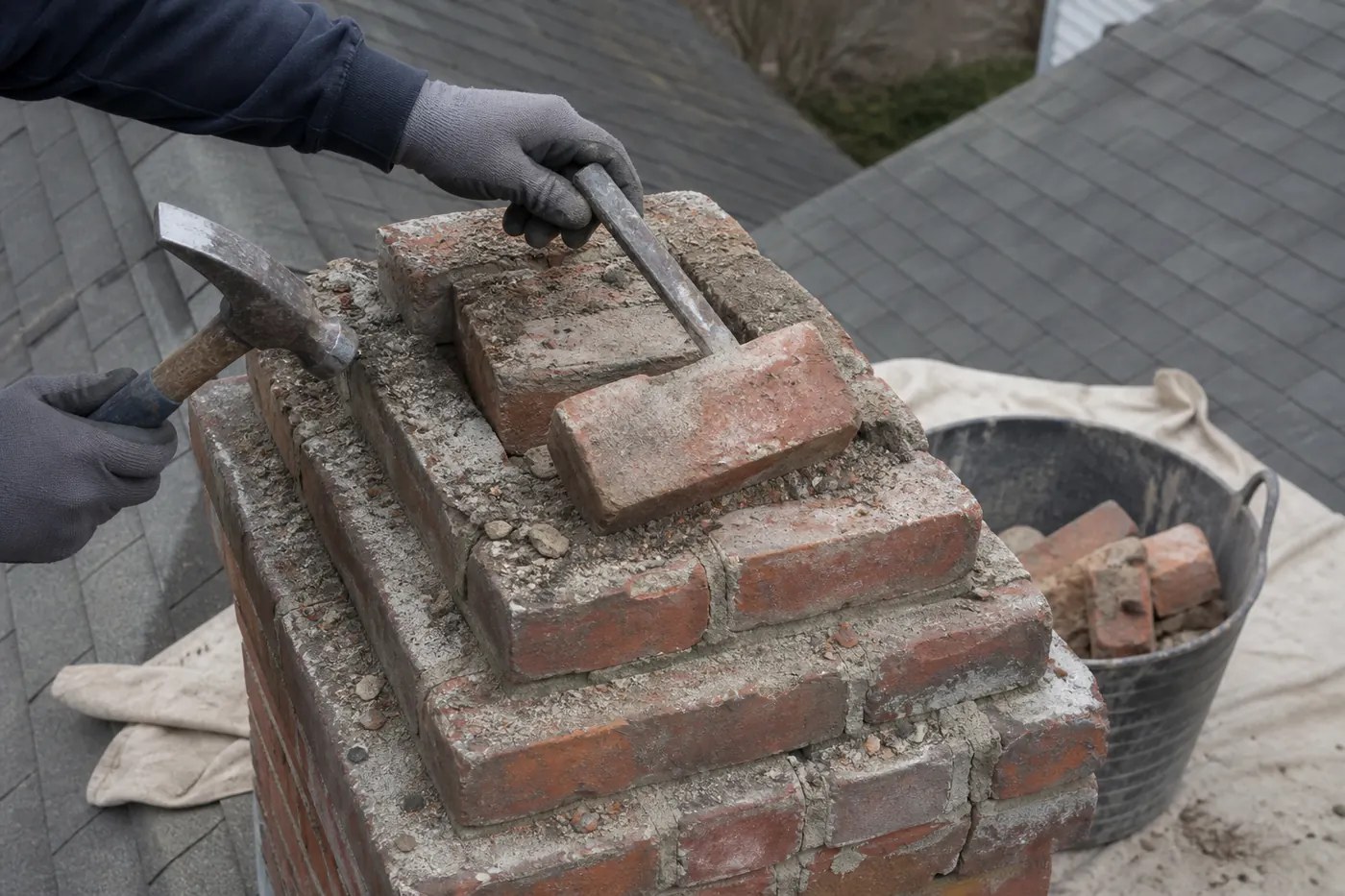
Chimney removal in Boston has no fixed price: you get a written quote after a $49 inspection, because the same words cover a stack taken down above the roof and a chimney removed through several floors. The quote depends on how much comes out and how much has to be rebuilt afterward. This page explains what drives it. For the work itself, see the chimney removal service guide.
- Chimney removal is priced in writing after inspection, with no standard number.
- How far down the chimney comes out is the biggest cost driver.
- Roof closure and interior finishing are part of the price, so ask for them to be listed.
- The $49 inspection is credited toward approved removal work.
Why chimney removal is priced only after inspection
A fixed price would be a guess. Removal can mean cutting a chimney off at the roofline, taking it down to the attic, or opening up the living space to take out the part inside the house. Each of those is a different amount of work, with a different amount of repair afterward.
The inspection answers the questions that set the price: what the chimney is attached to, whether anything still vents into it, how it sits against the framing and what the roof will need once it is gone. You then get a written price for the exact scope you choose.
Greater Boston adds its own wrinkles. Many homes are older brick buildings, triple-deckers and rowhouses where a chimney is tied into party walls, shared rooflines or several floors of framing. Those details only show up when someone looks, which is why the quote follows the inspection and not the other way around.
The $49 inspection is therefore the first real cost of removal, and it is credited toward the job if you approve it.
How removal scope changes the quote
No dollar figure is published for removal, so this table compares what each scope adds to the quote instead.
| Scope | What adds to the quote | What to confirm in writing |
|---|---|---|
| Stack above the roof only | Closing the roof opening and matching the surface around it | Who patches the roof and with what |
| Down to the attic level | Working inside the attic, framing and roof infill | Where the removal stops and what is left standing |
| Through the living space | Dust control, wall and floor repair, finishing | Whether finishing is included or separate |
| Unused stack that is falling apart | Careful demolition in smaller pieces | How debris is handled and hauled |
Pick the scope first, because the price follows from it. Many owners start by asking for removal of the whole chimney when removing only the part above the roof would solve the problem they actually have, such as a leak or a crumbling stack. The inspection helps you see which option fits.
If you do want the part inside the house gone, expect the quote to be larger and to include more finishing, since walls and floors are affected.
What drives a chimney removal quote
- Where the removal stops. Each extra level of chimney removed adds labor, debris and repair.
- Size of the chimney. A narrow single-flue stack and a wide masonry mass with several flues are not the same load.
- Connections. A heating appliance, fireplace or utility still tied into the chimney has to be dealt with before anything comes down.
- Framing. Floor and roof framing around the chimney may need to be rebuilt where the masonry used to be.
- Access. Narrow lots, shared walls and tall rowhouses make it harder to bring down and carry out heavy material.
- Condition. Loose or crumbling brick has to be taken down more slowly than sound masonry.
- Roof pitch and height. A steep or tall roofline makes the work above it slower and the roof closure more involved.
None of these is a fixed surcharge. They are the questions the inspector answers so that the written price reflects your chimney and not an average one.
What the roof and interior finish add to the price
Taking the chimney out leaves holes, and the price should include closing them. On the roof, that means decking and weatherproof covering that matches the rest of the roof. Inside, it can mean patching a ceiling or wall where the chimney breast stood.
These finishing steps are where quotes tend to differ most. One may stop at a patched roof while another includes interior plaster, paint and flooring. Ask which finishes are included and which are left to you or another trade.
Matching old brick, slate or shingles on a Boston rowhouse or triple-decker can also affect the quote, since the closure should look like it belongs. Say so at the inspection if appearance matters to you, and the quote can describe the materials that will be used.
Weather matters too. A roof opening should not be left uncovered, and the quote should explain how it will be kept dry between stages of the work.
What a written removal quote should say
Because the scope varies so much, the written quote is your main protection. It should contain:
- The exact point where the chimney will be taken down to.
- Every appliance or connection that was found and how each is handled.
- How the roof opening will be closed and what it will look like.
- What happens inside the house, room by room if floors or walls are involved.
- Who removes the debris and protects the rooms during work.
- Photos of the chimney as the technician found it.
- One total price, set before work begins.
If the quote leaves one of these out, ask for it in writing. A line that is missing today can turn into an extra charge later.
How to compare two chimney removal quotes
Quotes for removal can look far apart when they describe different jobs. Before comparing totals, compare the removal point, the roof closure and the interior finishing line by line. A quote that ends at the roofline cannot be set against one that includes the attic and a patched ceiling.
It also helps to ask each company why it is recommending removal rather than repair. Keeping a chimney that still works may cost less than removing it, so compare against the chimney rebuild cost guide, where a partial rebuild runs $2,000 to $4,500 and a full rebuild runs $4,000 to $10,000+. For smaller defects, see the chimney repointing cost guide first.
Finally, ask each company what they expect to be different once the work is open. Hidden framing, an old flue connection or a chase that is wider than it looked can all change a scope. The better quotes tell you how any change would be priced and agreed before extra work goes ahead.
Costs that sit outside a removal quote
Some items belong to other trades or other offices and are not part of the removal price.
- Disconnecting or moving a boiler, furnace or water heater, which belongs to the gas utility or a licensed gas fitter.
- Permits. Ask your local building department whether your project needs one.
- Building a new vent path for an appliance that is staying.
- Redecorating beyond the patched surfaces.
- Any separate structural assessment that your local building department asks for before a large opening is made.
It is worth asking early whether any of these apply to your house, since they can affect both the timing and the total you end up spending.
Anything on this list that you want us to price is quoted in writing after the inspection. Keeping these items separate from the removal price is not a trick. It simply keeps the quote honest about who does what, and it lets you hire the right trade for each part.
How the $49 inspection credit applies to removal
You pay $49 for the inspection and receive written findings with photos. If you approve removal, that $49 is taken off the job total. If you decide to keep the chimney, you still have a documented picture of its condition to use in any other decision. Our chimney inspection service page describes what the visit covers.
There is no pressure to approve on the day. Take the findings home, read the scope and ask questions. The price in writing stays tied to the scope on the page, so if you change the scope, the price is revised in writing too.
When waiting makes removal more expensive
An unused chimney that keeps taking in rain does not stay still. Loose brick can fall, water can reach roof framing and ceilings, and a small removal can grow into a bigger one with repairs on top. If bricks are already falling or a section looks like it is leaning, keep people away from the area and book promptly. Delay rarely makes a deteriorating stack cheaper, and the repairs around it tend to grow while you wait.
A leaking roof opening around an unused stack is the most common reason removal gets more expensive. Water that gets in can stain ceilings and soften framing, and the quote then has to include those repairs as well as the removal itself.
If you suspect a chimney fire, leave the house and call 911. For everything else, book the $49 inspection at our contact page or call (617) 404-9587.
Questions homeowners ask
Can you give me a removal price over the phone?
No. Removal has no standard figure because the scope varies so much. After the $49 inspection you receive a written price for the exact work you choose.
Does removing a chimney always cost more than repairing it?
Not necessarily. Sometimes repeated repairs add up to more than removal, and sometimes a repair is cheaper. The written findings let you weigh both against the repair costs published on our cost pages.
Is the roof patched as part of the removal?
It should be, and the quote should say so. Ask how the opening will be closed and what the roof will look like afterward, so there is no gap between what you expect and what is priced.
What if my chimney is still connected to a boiler?
The connection has to be sorted out before the chimney comes down. Gas work is handled by the gas utility or a licensed gas fitter, and the quote should state how the appliance will vent afterward.
Why would two companies quote such different totals?
Usually because the quotes cover different things. One may stop at the roof while another includes the attic, the ceiling and the paint. Compare the removal point and the finishing items first.
Do I need a permit?
That depends on the project and the municipality. Check with your local building department before work starts, and tell us if one is required so it can be noted in the quote.