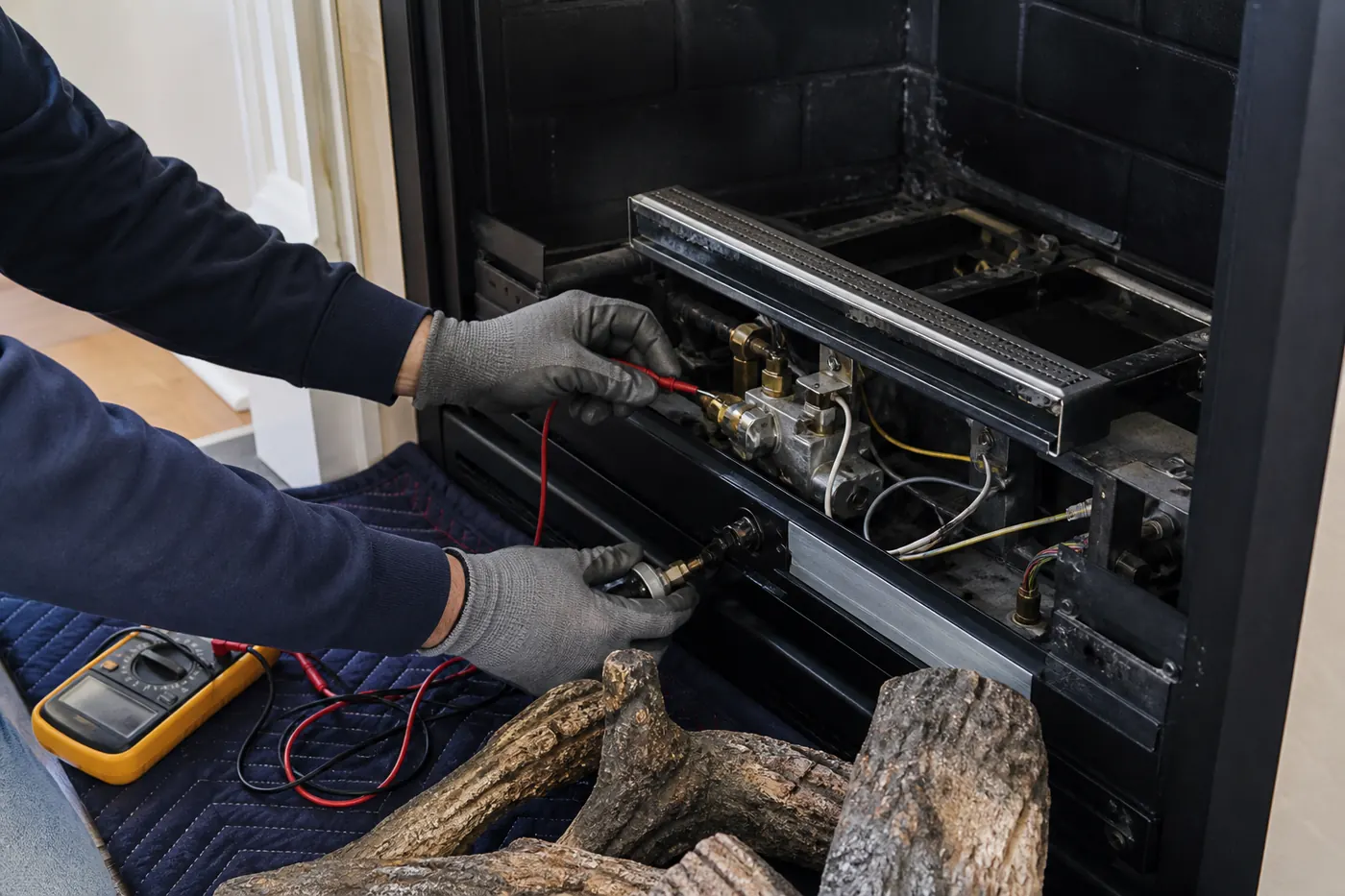
An insert usually puts out more usable heat and burns fuel more cleanly than an open fireplace, but it needs a sound chimney and a matching flue liner first. An open fireplace gives you the look and sound of a real fire, with most of the heat going up the flue. The right pick depends on whether you want a heating tool or an occasional fire.
What each one actually is
An open fireplace is a masonry or factory-built firebox with a damper above it and a flue leading to the roof. Air from the room feeds the fire and carries most of the heat up the chimney. You see the flames directly, and the fire is open to the room.
An insert is a sealed or mostly sealed stove built to slide into that firebox. It has a door, usually glass, and a controlled air supply. It can burn wood, pellets or gas. The firebox becomes a housing, and a connection pipe or liner carries the exhaust up the chimney.
Both use the same chimney, but they use it very differently, which is why the chimney must be checked before you commit.
Heat and efficiency trade-offs
An open fire loses a great deal of heat up the chimney, and the draft it creates can pull warm room air out with it. Many people find an open fireplace pleasant to sit near but not much of a heater.
An insert controls how much air the fire gets and radiates heat from its steel or cast-iron body, often with a blower. More of the fuel's heat ends up in the room, and the fire burns more steadily and with less smoke when run correctly.
Neither one replaces a central heating system in a typical home. Think of an insert as a supplement for a main living area, and an open fire as occasional ambience. Our post on gas vs wood fireplaces looks at the fuel side of the choice.
Greater Boston winters make the difference more noticeable. On a bitter night, an open fire can leave you warm in front and cold behind, while the room air it uses is replaced by cold air leaking in through gaps elsewhere in the house. A glass-fronted insert draws less room air, so that effect is smaller. If your home is tightly sealed, ask the installer whether the appliance needs its own outside air supply.
Whichever you choose, keep a working carbon monoxide alarm on each level. If it sounds, leave the house and call 911.
The check that comes before any purchase
Before you shop for an insert, have the existing fireplace inspected. An insert hides the firebox, and a problem that is easy to fix now can be costly to get at later. A technician should check:
- Firebox. Cracked firebrick, open joints or a failed floor. Repairs run $350 to $900.
- Damper. Whether it works and whether it will be replaced with a block-off plate. Damper work is $199 to $1,200.
- Smoke chamber. Rough or damaged walls above the damper. Repair is $500 to $1,500.
- Flue. The size, the condition of the tile and whether it can be lined to fit the insert.
- Opening and hearth. Whether the insert's dimensions and the required clearances to the surround fit your fireplace.
Our fireplace repair page explains the common fixes, and the fireplace repair cost page lists ranges.
Why most inserts need a liner
A large old flue is made for a large open fire. An insert has a much smaller exhaust. Connected to an oversized flue, the exhaust cools quickly, the draft weakens, and creosote builds up fast. Most installations therefore run a stainless steel liner from the insert's collar all the way to the top of the chimney.
The liner also seals off a cracked or aging flue tile. The cost depends on the height and the type of insert, but as a planning range, replacement is $1,500 to $4,500 and venting work starts from $2,000. The exact insert price is not set until the technician has seen your firebox, so it is quoted in writing after the $49 inspection. Read more on chimney relining.
Fuel choice shapes the install
- Wood inserts need a continuous liner, a way to clean the flue and space for the wood.
- Pellet inserts burn compressed pellets and usually need electricity for the feed and fan.
- Gas inserts need a gas line or propane supply and their own venting.
Each one has its own venting rules and its own service needs, so choose the fuel with the installation in mind. If you plan to switch fuel later, ask how the liner and connections would be affected.
If you ever smell gas near a fireplace, leave the house and call the gas utility or 911.
Upkeep differs, too
An open fireplace needs a yearly look at the flue, damper and firebox and a cleaning when soot or creosote builds up. An insert needs the same flue care, and the stove itself must be cleaned and its door gasket and glass checked. If the insert is run with the air turned low, creosote forms faster, so many owners find they need more frequent sweeping than they expected.
A cleaning with inspection is $299 fixed. Gas fireplace cleaning is also $299, and gas repairs run $299 to $900. Neither type should go a full season without a check.
Ash handling also changes. An open fireplace can hold a deep bed of ash safely. An insert usually has a small ash pan and runs best with a thin bed. Always scoop ashes into a metal container with a lid and set it outside on a non-combustible surface, away from the house, because coals can stay hot for days.
One more practical difference is cleaning access. A sweep can reach an open flue from the firebox directly. With an insert, the technician often has to disconnect or pull the unit to get at the damper area, so ask what the cleaning visit will involve before you buy.
When the open fireplace is the better fit
An open fireplace can be the right choice when:
- You burn a few times a year for atmosphere and not for heat.
- The masonry and flue are in good shape and you do not want to spend on a liner.
- The room or house style calls for an open hearth.
- The opening is an odd size that does not suit standard inserts.
It is not a failure to keep an open fireplace. If you do, a good cap, a sound crown and a working damper become the key items. See chimney repair for how those are handled.
A simple way to decide
- Decide what you want: warmth, ambience or both.
- Have the fireplace and flue inspected, so you know what condition they are in.
- Ask for written prices for any repairs and the liner, kept separate from the insert price.
- Choose the fuel that matches how you live.
- Confirm that the person installing it will check clearances and finish the venting properly.
Start with the $49 inspection, credited toward approved repair work, at /contact/ or call (617) 404-9587.
Questions homeowners ask
Can any insert go into any fireplace?
No. The insert has to fit the opening, the hearth and the clearances around the fireplace, and it needs a flue that can be lined to match. Measurements and an inspection should come before you buy.
Will an insert stop the smoke from coming into my room?
A sealed insert with a well-sized liner often draws better than an open fireplace, but it depends on the cause of the smoking. If the issue is a blocked flue or a missing cap, fix that first.
Do I still need the chimney swept if I have an insert?
Yes. The liner collects soot and creosote just as an open flue does, and inserts burned at low settings can build creosote quickly. A yearly check is still the standard.
Does an insert work during a power outage?
A wood insert with a natural-draft setup does not need power for the fire itself, though a blower will not run. Pellet inserts generally need electricity, and gas inserts vary by model.
Can I convert later from wood to gas in the same insert space?
Often a different unit and venting are needed, so it is a change to plan for, not a switch. Ask the installer how the existing liner would be affected before you decide.