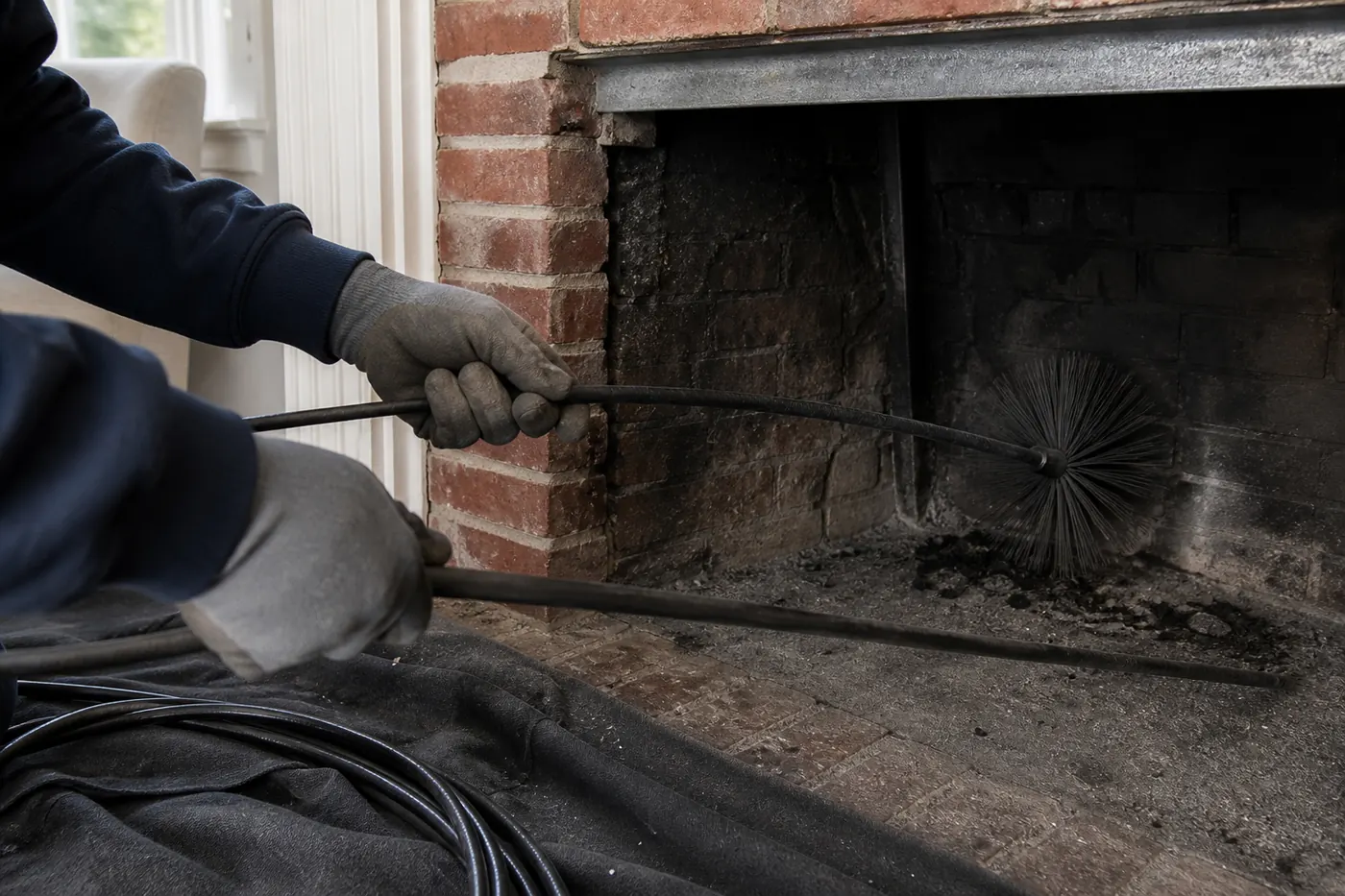
A technician protects your floor, checks the fireplace and flue, brushes out soot and creosote, vacuums the debris, and shows you photos of what was found. In Boston the standard single-flue cleaning with inspection is $299. Here is what to expect, in the order it usually happens.
Before the technician arrives
A little preparation on your side saves time and keeps the visit safe.
- Let the fireplace go cold. Do not burn anything on the day of the visit, so the firebox, damper, and flue are cool enough to work on.
- Clear the hearth. Move rugs, furniture, and decor a few feet back.
- Clear a path. The technician needs to carry tools from the door to the fireplace, and sometimes to the roof.
- Tell us about odd symptoms. Smoke in the room, a strange smell, or a stuck damper all help the technician look in the right place.
You get a call ahead, and the arrival window is 3 hours. Plan to be home, since the technician will want to show you the results.
Arrival and protecting your home
Soot is fine, black, and messy. The first job is not brushing. It is protecting your house from the brushing.
The technician lays drop cloths or covers over the floor and the area around the fireplace. A vacuum with filtration is set up so debris is pulled out of the system instead of floating into the room. The opening of the firebox is typically sealed or covered during brushing so the dust has somewhere to go besides your living room.
If you have gas logs, a glass fireplace door, or an insert, tell the technician early. Different setups need different steps, and some parts have to be removed and replaced carefully.
The first look: inspecting before any brushing
The inspection comes first, because heavy soot can hide damage. Your $299 visit includes a Level 1 inspection, which covers the parts of the chimney that can be seen and reached without tearing anything apart. Our page on chimney sweep service describes how this fits into the visit.
- Firebox: cracked firebrick, gaps in joints, or loose pieces.
- Damper: does it open fully and close firmly?
- Smoke shelf and chamber: a spot above the damper that collects debris.
- Flue lining: visible cracks, missing sections, or heavy glaze.
- Chimney top: the cap, crown, and visible masonry, as far as they can be seen safely.
If the technician sees something that cannot be judged without more work, such as a hidden crack that needs a deeper look, that goes into the report as a next step, not as a guess.
Brushing: tools for the flue you actually have
Chimneys are not all the same, so the tools are not all the same either.
Clay tile flues
These are common in older brick houses. They are usually brushed with a stiff brush on flexible rods. A hard wire brush can scratch clay, so the tool choice matters.
Stainless steel and listed liners
Metal liners and factory-built systems are brushed with a softer poly brush, because a wire brush can damage them.
Wood stove and insert flues
These are smaller and carry more soot. They are brushed with a size-matched brush and often need more attention at the connector pipe.
The technician works the brush up and down, and the loose soot falls to the firebox and is vacuumed out. You may hear the rods and brushing from inside the house. That is normal. Cleaning removes creosote and soot that has settled on the walls of the flue, which matters because creosote is flammable.
What creosote stage means for the visit
Creosote comes in different forms. Light, dusty soot comes out with a regular brushing. Tarry or glazed creosote is harder and may need extra work.
| Stage | What it looks like | Price |
|---|---|---|
| Stage 1 | Light, flaky soot | $299 to $450 |
| Stage 2 | Shiny, hardened flakes | $450 to $700 |
| Stage 3 | Thick, glazed, tar-like | From $700 |
Anything beyond a standard sweep is quoted in writing before the extra work starts. For a closer look at how these build up, read our guide on creosote stages and dangers, and see the creosote removal page for the removal work.
Cleanup, photos, and the report
When brushing is done, the technician vacuums the firebox and smoke shelf, wipes down the hearth area, and removes the covers. Debris leaves the house in the vacuum or in bags.
Then comes the part many homeowners value most: the walkthrough. You are shown photos of what the technician found, with a plain explanation of each one. Expect to hear one of three things.
- Nothing needed beyond cleaning. You are told when to plan the next cleaning.
- Something to watch. A small crack or worn mortar is noted, and you decide whether to act.
- Something to fix. The technician explains the issue and gives a written price before any work. For repair prices, see chimney sweep cost and our chimney repair page.
We do not promise outcomes or how long the visit lasts. A single flue with light buildup moves differently from a neglected one with several flues.
What a sweep does not do
A cleaning is not a repair, and it helps to know the edges of the service so nothing surprises you.
- It does not fix cracks. Brushing removes deposits. It cannot close a gap in a liner or rebuild a crumbling joint.
- It does not waterproof. A clean flue can still leak if the crown, cap, or flashing has failed.
- It does not replace a full camera or Level 2 look. If a problem is suspected, the technician may recommend a deeper inspection and quote that in writing.
- It does not clear every blockage. A nest, a collapsed tile, or an object stuck high in the flue may need its own scope.
This is not a way to upsell you. It is the reason the report exists. If the technician finds something outside the sweep, you get photos and a written price, and you choose what happens next.
Signs you should not wait for the next scheduled sweep
Call sooner if you notice smoke coming into the room, a strong tar smell, flakes of black material in the firebox, a damper that sticks, or water stains near the chimney. Any of these deserves a look before the next fire.
Your safety checklist after a sweep
- Keep the damper open when you light the first fire so smoke goes up the flue.
- Burn dry, seasoned wood only. Wet wood creates more creosote.
- Keep a working smoke alarm and a carbon monoxide alarm near the fireplace and bedrooms.
- If a chimney fire ever starts, get everyone out and call 911.
- If a carbon monoxide alarm sounds, leave the house and call 911.
- Never go on the roof to look at the chimney yourself.
A yearly inspection is what NFPA 211 recommends, and heavy users may need cleaning sooner. Do you want to know how often your own household should schedule it? See our guide on how often a chimney should be swept in Boston.
Ready to book? Reserve the $299 cleaning with inspection at our contact page or call (617) 404-9587.
Questions homeowners ask
How long does a chimney sweep take?
It varies with the number of flues, how much buildup there is, and how hard the access is. We cannot promise a time. The technician gives you an idea once the first look is done.
Will a chimney sweep make a mess in my house?
Floors are covered and a filtered vacuum catches debris, so the mess is kept small. Tell the technician about white carpet, rugs, or fragile items so extra care is taken.
Do I have to be home during the cleaning?
Plan to be home to let the technician in and to go over the photos and findings at the end. That conversation is how you learn what is happening with your chimney.
What if the technician finds a problem?
You see the photos and get a written price before any repair work. Nothing beyond the sweep is done without your approval.
Can I use the fireplace right after a sweep?
Usually yes, once any covers are removed and the firebox is clean. If the technician found something that makes it unsafe, you will be told not to use it until it is fixed.