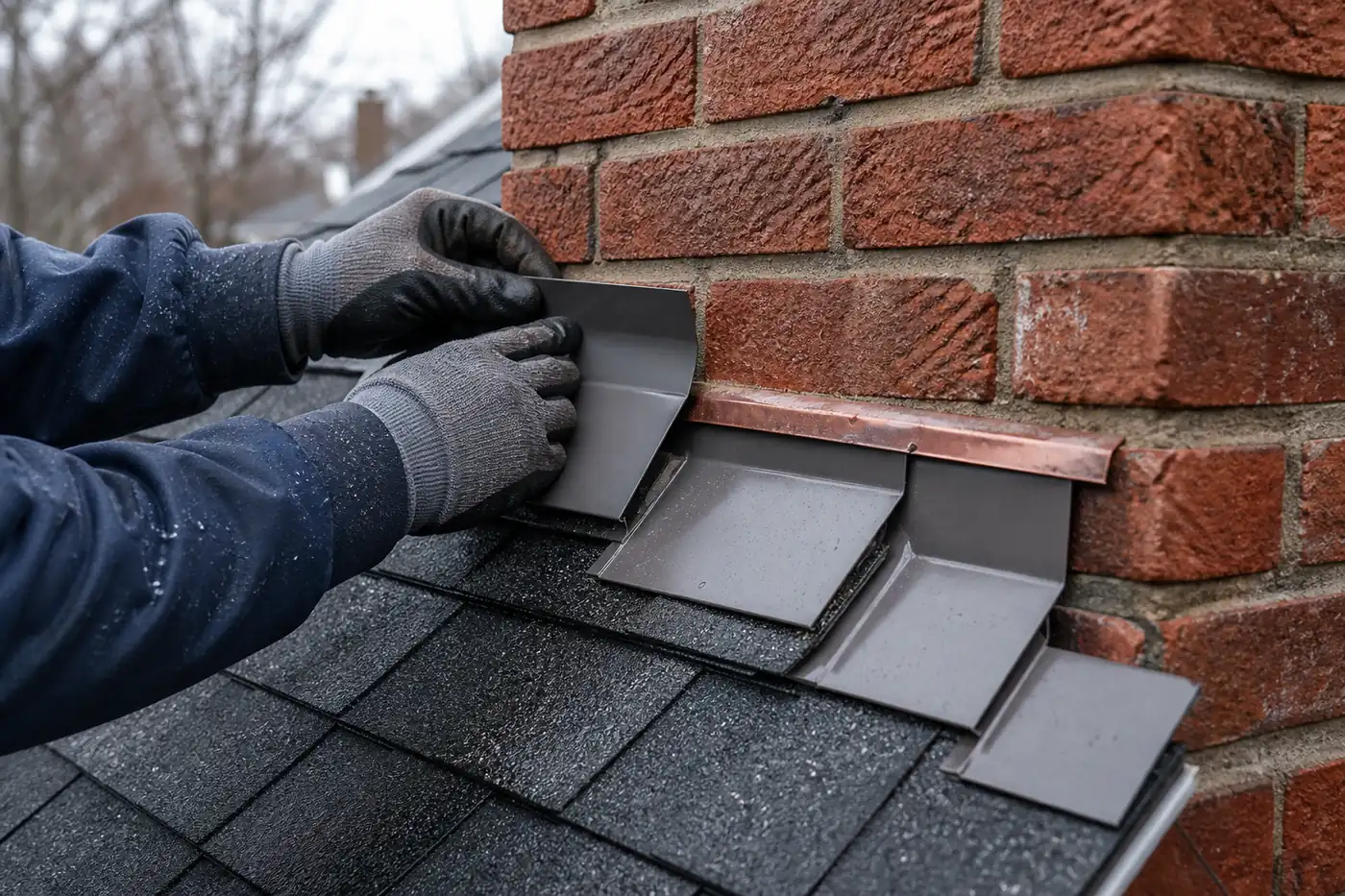
Chimney flashing repair in Boston costs $200 to $400 for a focused repair, $400 to $800 for partial replacement, and $800 to $2,500 for full replacement. The spread is wide because the same ceiling stain can come from a small gap or from metal that needs to be rebuilt around the whole chimney. A $49 inspection, credited toward approved repair work, settles which one you have.
Flashing prices at a glance
| Scope | Boston price | Typical situation |
|---|---|---|
| Flashing repair | $200 to $400 | One small stable opening, loose edge or failed sealant line |
| Partial replacement | $400 to $800 | One or two sides are corroded, short or pulled away |
| Full replacement | $800 to $2,500 | Metal is failing all around, or was layered wrong from the start |
| Leak repair, all sources | $400 to $3,000 | Water is entering and the source involves more than flashing |
The inspection is $49 and is credited toward approved repair work. You get photos of the problem area and a written price before anything is done. Our flashing cost breakdown shows how those ranges are built, and the chimney flashing repair page describes the work itself.
What flashing does and how it fails
Flashing is the metal that bridges the gap between your chimney and your roof. A roof sheds water downhill, and the chimney sticks up through it, so every side of the chimney needs a watertight transition. On a typical job that involves several pieces working together:
- Base or apron flashing at the downhill face.
- Step flashing along the sides, woven into the roof courses.
- Counter-flashing set into the masonry above, which laps over the pieces below.
- A back pan or small cricket on the uphill side, so water splits around the chimney instead of pooling.
Flashing fails in a few predictable ways. Sealant dries out and splits. Metal rusts through at edges and fasteners. Pieces lift when the roof moves. The counter-flashing pulls out of a mortar joint that has crumbled. Sometimes the original installer simply layered the metal in the wrong order, and the leak was always going to happen.
Boston weather speeds all of this up. Metal expands and contracts through freeze-thaw cycles, nor'easters push rain sideways into joints, and winter ice can lift edges that looked tight in October.
Four things that move the quote
Price follows measurable work, not the name of the service. Each of these four factors should show up in the written proposal as a photo, a location and a quantity.
1. What actually failed
Fresh sealant at one small stable gap is a modest job. Metal that is corroded, too short, loose or layered the wrong way needs to be replaced, and that costs more. The proposal should name which problem you have.
2. Chimney width and the uphill side
A wider chimney needs more metal and more labor. A missing back pan or cricket on a wide chimney adds work because water has nowhere to go but into the joint. Roof pitch matters too, since steep roofs take more time and more safety setup.
3. Roof material
Asphalt shingles are the easiest to lift and reset. Slate, tile and membrane roofs demand more care and can raise the cost because disturbed pieces must be handled without breaking them.
4. Access and masonry cuts
Good counter-flashing is set into a groove cut in the brick and then sealed. That masonry work, plus the need to coordinate with a roofer when roof material has to come up, can push a quote higher. Ask who owns each tie-in so nothing is left half done.
Why sealant alone is not always the answer
A bead of sealant is a legitimate fix when the metal is sound and the gap is small. It is not a fix for rusted, loose or poorly layered metal, and it tends to fail again within a season or two when the underlying cause stays. Do not accept a repair that is just caulk over a bad layout without being told that is what you are buying.
A useful rule of thumb: if rust has eaten through the metal, or the metal has lifted away from the roof, it is past the point where sealant helps. The same goes for pieces that stop short of the masonry or sit under the shingles in the wrong order. Those need replacement metal, not another bead.
That is the most common reason people pay twice. If a first repair did not hold, the next proposal should say what was missed and why a different approach is warranted. For a full picture of leak work, see chimney leak repair.
Check that flashing is really the leak source
Water is rarely honest about where it entered. It can run along framing before it shows up as a stain a few feet away, so the damp spot on your ceiling does not identify the opening. Wind-driven rain can enter at an uphill or side joint, while snowmelt and ice can create a different pattern than a summer storm.
Before approving full flashing replacement, the inspection should rule in or out these other sources:
- A cracked crown, where rain enters the top of the masonry.
- A missing or damaged cap or chase cover.
- Open mortar joints on the sides of the chimney.
- Roof problems near the chimney that have nothing to do with it.
If a different part is the cause, you can end up paying for the right repair instead of flashing you did not need. Our guide on chimney leaks when it rains walks through the clues.
Questions to put to any flashing quote
A quote you can compare has details. Ask each company the same questions.
- Is this a sealant repair, partial replacement or full replacement, and why?
- Which roof materials will be lifted or replaced?
- Will counter-flashing be set into the masonry, and how will those cuts be sealed?
- Who handles the roofing tie-in if shingles must come up?
- Are the cap, crown and mortar joints part of this price or excluded?
- What will I receive in writing, with photos, before the work begins?
If one proposal is far lower than the others, check whether it covers the same scope. A very low figure often leaves out the masonry cuts or the roof tie-in.
When to schedule, and what to do this week
Do not wait for the ceiling stain to spread, because every rainstorm adds to the hidden damage. A small opening lets water into insulation and framing for months before you see it, and that hidden damage costs more than the metal. Schedule when you notice a stain after rain, rust streaks near the roofline, or visible gaps where metal meets brick.
While you wait for the visit, place a bucket under any active drip and photograph the stain with a date. Do not go on the roof yourself. Binoculars from the ground are enough to describe what you see when you call.
To get the flashing assessed, book the $49 inspection at our contact page or call (617) 404-9587.
Questions homeowners ask
Is chimney flashing repair a roofer's job or a chimney company's job?
It can be either, and large jobs often involve both. The metal and masonry tie-in belong with a chimney contractor, while shingles or slate that must be lifted may need a roofer. Ask who is responsible for each piece before work starts.
How long does fresh flashing sealant last?
It depends on the product, sun exposure and how well the surface was prepared. It is a short-term answer for a small gap, and it will not hold if the metal underneath is rusted or loose. We do not promise a lifespan for any repair.
Why is my ceiling stained when the flashing looks fine from the ground?
Water can enter at the crown, cap, mortar joints or a nearby roof area and travel along framing before it appears. From the ground you cannot see the back or uphill side. An inspection with photos checks all of those spots.
Does flashing replacement include the crown or cap?
Not unless the written proposal says so. Crown and cap work is priced separately, and crown repair runs $300 to $900 while a standard cap is $300 to $700. Ask that every inclusion and exclusion be listed.
Will insurance pay for flashing repair?
That depends on your policy and on whether the cause is sudden damage or wear. Ask your insurer or agent before you file, and keep the inspection photos and written report to show what was found.