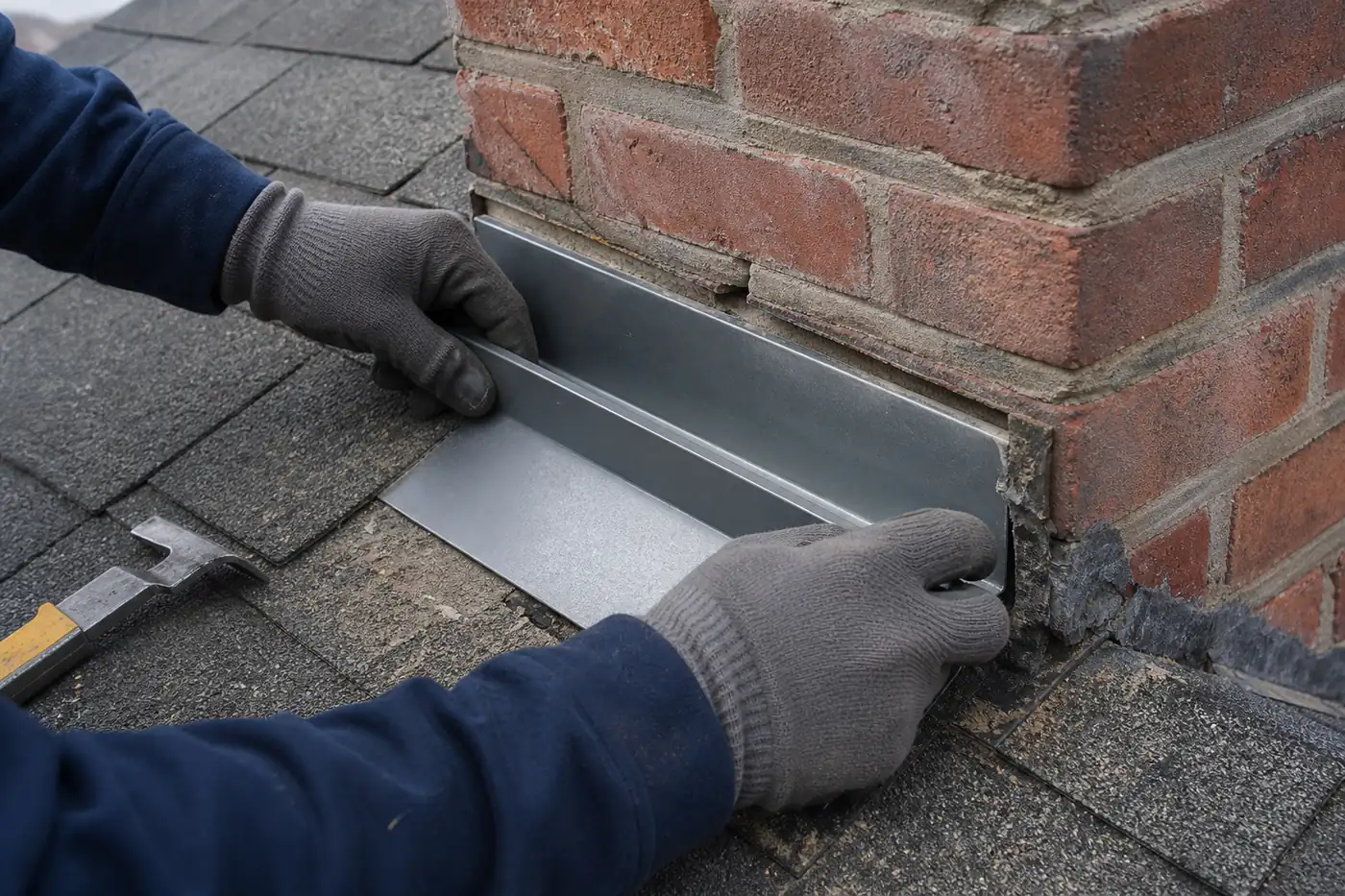
Rain is getting into the chimney somewhere above the roofline, and the most likely entry points are the cap, the crown, the flashing or the masonry itself. In Boston, fixing a chimney leak runs from $400 to $3,000 depending on what the inspection finds, which is why you want the source confirmed before you approve work.
Where rainwater gets into a chimney
Water behaves in surprising ways. It can enter at one spot, run along a flue or a roof beam and drip out somewhere else entirely. The stain you notice is often a long way from the opening.
| Entry point | Clue | Typical Boston cost |
|---|---|---|
| Open or missing cap | Water falls straight down the flue, with leaves or birds | $300 to $700 |
| Cracked crown | Dampness inside the stack, white staining on brick | $300 to $900 |
| Failed flashing | Stain on the ceiling or wall next to the chimney | $200 to $2,500 |
| Soaked, open masonry | Damp bricks, crumbling joints | $300 to $2,500 |
| Mixed or hidden causes | More than one clue at once | Quoted after inspection |
These ranges come from the price lists for caps, crowns, flashing and masonry. The overall leak repair range of $400 to $3,000 covers the spread between a simple fix and a layered one.
Read the clue: what the drip pattern tells you
Where and when the water shows up narrows down the cause.
Water falls into the firebox
This often means the flue is open to the sky. A missing cap, a cracked crown or a damaged top-of-flue edge is the usual explanation. Water running down the liner can also collect in the smoke chamber and drip out later.
A stain on the wall or ceiling beside the chimney
That points toward flashing, the metal that seals the joint where the stack meets the roof. Once it lifts, rain runs down behind it.
Damp patches, peeling paint or white powder on interior chimney walls
The masonry is probably saturated. Water is passing through brick and mortar instead of around them.
Leaks only in certain storms
If it happens only with a driving nor'easter and not a gentle shower, wind is pushing rain sideways into a gap that stays dry otherwise.
What to do right now
You can limit the damage safely from inside the house.
- Put a bucket or towels where water falls, and move rugs and furniture away.
- Do not light a fire in a wet fireplace.
- Photograph the stain with a date, then mark its edge with a pencil line so you can see if it grows.
- Write down the weather: heavy rain, wind direction, snow melt or a thaw.
- If the ceiling is bulging or water is near wiring, keep away from that spot and call an electrician as well.
Never go on the roof to look or to put a tarp on the chimney. Wet roofs are dangerous, and a technician has the right equipment and safety gear.
Keep the photos and notes. A drip that happens on the first heavy rain after a dry spell tells a different story than one that begins after a thaw, and that detail speeds up the diagnosis.
What the inspection should look at
A good leak inspection does not stop at the first thing it finds. It follows the water from top to bottom.
- The cap, checking for rust, missing screens or a loose fit.
- The crown, looking for cracks or a surface that lets water sit instead of shed.
- The wall faces and mortar joints, especially the top few courses.
- The flashing and counterflashing at the roof line.
- Nearby roof surfaces, gutters and drainage that might aim water at the chimney.
- The interior, including the firebox, smoke chamber and any stained walls.
It should end with photos of what the technician found and a clear statement of which spot is actually causing the leak. If an area is hidden or cannot be reached, the report should say so rather than guess.
The chimney leak repair page describes how that process works.
Repair first, waterproofing second
Spraying a repellent over a leaking chimney is one of the most common mistakes. A water repellent helps sound masonry shed water. It cannot bridge a crack, replace a missing cap or seal flashing that has pulled away.
The sensible order is simple.
- Repair the physical opening, such as a crown crack, failed joint or loose flashing.
- Let the masonry dry and cure as the product directions require.
- Only then consider a breathable water repellent. Standard waterproofing is $300 to $500, with a crown seal $500 to $800.
If the leak stems from decayed brick or mortar, the repair follows the same pattern described in our article on freeze-thaw damage. For a broader view of price ranges, see the chimney repair cost guide.
Leaks that are not really the chimney
Not every wet spot near a fireplace comes from the chimney itself. Several other things look similar, and ruling them out saves money.
- Roof leaks nearby. A bad shingle or a damaged vent pipe can drip along a rafter and appear at the chimney wall.
- Gutters and downspouts. Overflow can soak the roof edge or a masonry base.
- Ice dams. In a Boston winter, melting snow can refreeze at the eaves and push water under the roof near the stack.
- Condensation. Warm, moist air meeting a cold flue can leave moisture that has nothing to do with rain.
- Plumbing or window leaks. A pipe or a window on the same wall can produce a similar stain.
The easiest test is timing. A stain that grows only during or right after rain points outside. One that grows on cold dry mornings suggests condensation or a plumbing source.
A technician will check the chimney and tell you plainly if the problem looks like roofing or another trade, so you are not paying chimney prices for a roof issue.
Why delay costs more
A small leak can turn into something much larger over a single wet season. Water that sits in masonry rots mortar and, in winter, freezes and cracks it. Water that runs behind flashing soaks the roof deck and framing. Water inside a flue can rust the damper and the firebox parts.
It can also lead to mold and a musty odor in the room, which are harder to get rid of than the original drip.
None of that means every leak is a $3,000 job. Many are fixed with a cap, a crown repair or a flashing repair. The point is that a small price now is usually the cheap end of the range, and a long wait is how the job becomes a bigger one.
Standard chimney repair work is quoted in writing before it starts, so you decide with the full picture.
Book the inspection
The $49 general inspection finds the source, and the $49 is credited toward approved repair work. You will get photos of what is found, a written price before any work, and a 3-hour arrival window with a call ahead.
Book at /contact/ or call (617) 404-9587.
Questions homeowners ask
Is it normal for a chimney to drip a little in heavy rain?
A few drops from a chimney without a cap can happen, but a regular drip is not something to ignore. Water in the flue means water is also reaching the masonry and the damper, so the cause is worth finding.
Could the leak be condensation instead of rain?
Yes. Moisture can form inside a cold flue, especially after a gas appliance runs. A leak that appears only during or right after rain points to an outside source, while moisture that appears on dry, cold days points to condensation or draft trouble.
Can I use roof cement or caulk to stop it?
Those materials are short-term patches at best. They crack as the chimney and roof expand and shrink with the temperature, and they can hide the real source for a season. A proper flashing or crown repair lasts longer.
Will my homeowners insurance pay for a leaking chimney?
That depends on your policy and on the cause, so check with your insurer or agent before work begins. Keep dated photos and the written report from the inspection, since both are usually asked for.
How soon after a leak should I call?
As soon as you can. You can dry the room and limit damage yourself, but the cause stays active until the opening is closed. The next rain will find it again.