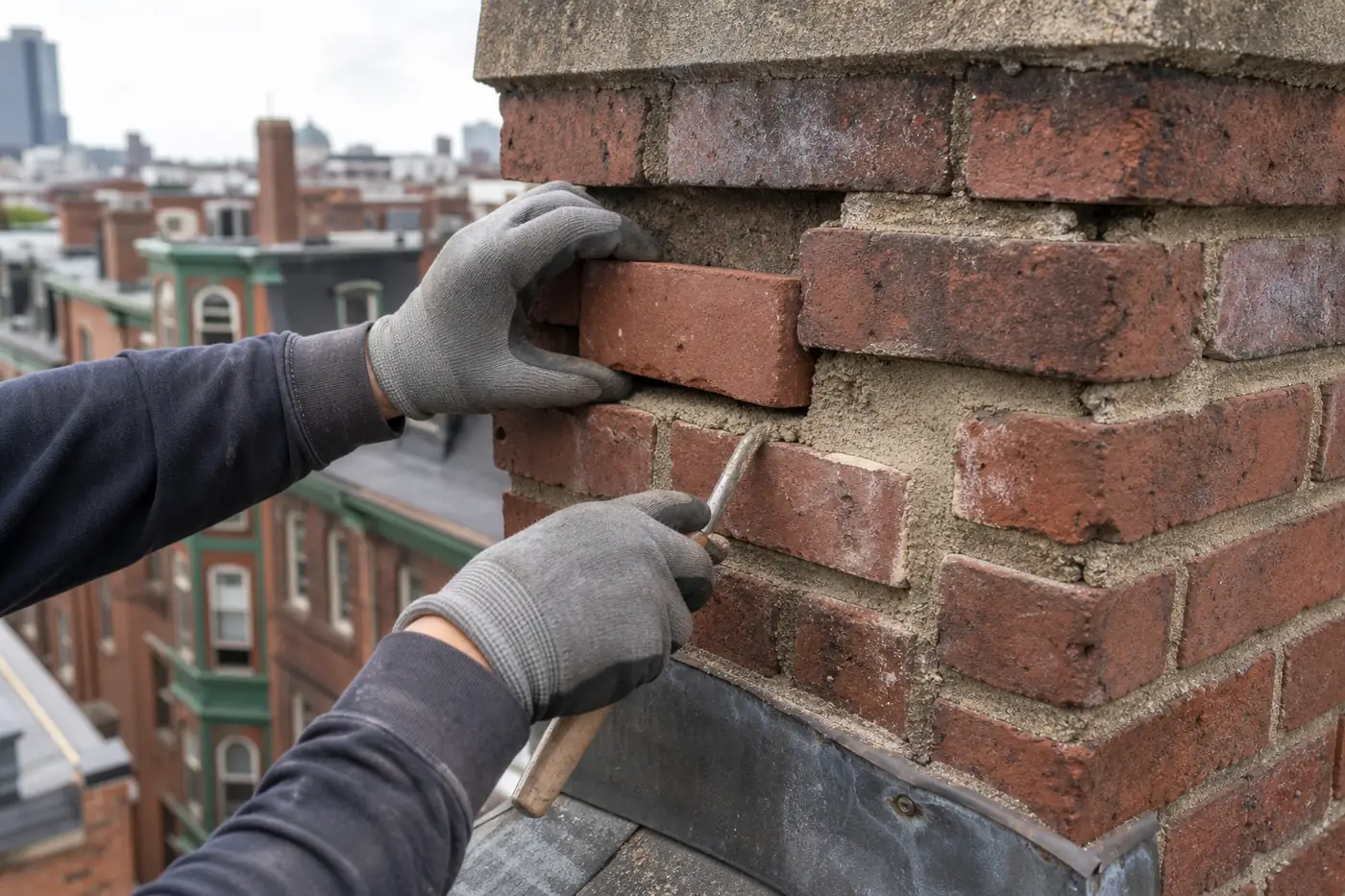
Boston chimney masonry repair is $300 to $700 for basic work, $700 to $2,500 for standard jobs and from $2,500 for major repairs. Which tier you land in depends on how many bricks and joints have failed, and how far the damage runs into the wall. A $49 inspection, credited toward approved repair work, pins that down in writing.
Three tiers of masonry work
| Tier | What it usually covers | Typical Boston price |
|---|---|---|
| Basic | A few loose bricks, a small patch of failed joints | $300 to $700 |
| Standard | Larger joint network, several replacement bricks | $700 to $2,500 |
| Major | Wide deterioration, bulging or leaning sections | From $2,500 |
Major work can slide into a partial or full rebuild, which has its own prices on our chimney rebuild cost page. The ranges above are planning figures. The price that matters is the written one you get before any work begins.
A fair way to read the table: if the problem is confined to one face of the stack and a handful of bricks, expect basic pricing. If joints are failing on several sides, or bricks are coming apart across a wide area, expect the standard tier. If the structure has moved, expect an inspection to talk about major work.
What masonry damage looks like from the ground
You do not need to climb up to spot trouble. Binoculars from the yard or a look from a window will show most of it:
- Mortar joints that look sandy, recessed or missing.
- Brick faces that have flaked off, leaving a rough pitted surface.
- White crust on the brick, which is mineral salt left behind by moving water.
- A stack that leans, bulges or shows stair-step cracks.
- Loose bricks or pieces of mortar on the roof, in the gutters or in the yard.
Any of these deserves a closer look. Do not go on the roof to check. A technician can photograph the stack safely and send you pictures so you can see the same thing.
Why Boston chimneys wear out the way they do
Brick is porous. It takes on water, and in Greater Boston that water freezes and thaws many times in a season. Each cycle expands the moisture inside the brick and joints, which slowly breaks them apart. Coastal salt air, wind-driven rain and chimneys that sit high above the roofline make it worse.
Older homes add another wrinkle. Brownstones, rowhouses and triple-deckers often have soft old brick and lime-rich mortar. When someone patches that with a hard, modern mortar, the brick takes the stress and spalls. So the repair is not only a matter of filling holes. The material has to suit what is already there.
Chimneys on multifamily buildings carry extra load. A triple-decker stack may serve several flues and rise well above the roof, so a failing section affects more than one household. Tell the technician which units connect to the chimney so the written scope covers the whole stack.
Our post on freeze-thaw damage goes deeper into this cycle.
Repointing, brick replacement and rebuilding compared
Repointing
The failed mortar is ground out and new mortar is packed in. Partial repointing costs $300 to $700 and full repointing $700 to $2,500. It is the most common fix. See our chimney repointing page.
Replacing bricks
Cracked or flaking bricks are cut out and new ones set in. This is often combined with repointing in a standard job.
Rebuilding
When the wall is leaning, bulging or broken through, taking it down and relaying it is safer than patching. A partial rebuild runs $2,000 to $4,500 and a full one $4,000 to $10,000 or more. Rebuilding is the most expensive route, so a good estimator proves it is needed with photos.
What moves a quote up or down
- How many bricks and how much joint length. More failed area means more labor and materials.
- Surface or through-wall damage. A flaked face is different from a wall that has crumbled all the way through.
- Old brick and mortar. Matching soft historic material takes more care than modern brick.
- Height and access. Tall stacks, steep roofs and narrow lots can call for staging, roof protection and extra setup time.
Hidden conditions also play a part. Sometimes a stack looks fine until the first layer is opened. Your written quote should say what happens if more damage turns up, and who must approve any change in price first. If you want more help understanding the broader range, the chimney repair cost page compares work types.
What to ask before you accept a masonry price
A price is only useful if you know what it buys. Ask these questions, and expect plain answers in writing:
- How many bricks will be replaced and how many feet of joint will be repointed?
- What mortar will be used, and why is it suited to my brick?
- How will the work area, roof and landscaping be protected?
- What happens to the old brick and debris?
- What does the quote assume, and what would change the price?
You can also get a second opinion. It is free with a written report from a reputable local chimney company, and it is a fair way to compare. Our masonry repair page explains how we document the scope.
When masonry damage becomes a safety problem
Most masonry wear is slow and can be scheduled. A few signs move it up the list, because masonry that is cracked all the way through can let heat, smoke and gases reach places they should not:
- Smoke or a burning smell in the attic, a bedroom wall or the next room.
- Bricks that have shifted so the stack looks crooked against the sky.
- Large pieces of brick or mortar on the roof or ground after a storm.
- A carbon monoxide alarm sounding, which means you leave the house and call 911.
If you smell smoke from the wall of a room while the fireplace is lit, stop using it and have it inspected before the next fire. If there is a fire in the chimney or the house, leave and call 911. Our post on carbon monoxide chimney warning signs explains what to watch for.
Cracked masonry can also expose a damaged flue behind it. That is why a masonry problem and a flue problem are often looked at together, and why a technician checks the inside as well as the outside.
When to schedule and what to do now
Do not wait for a full winter. Water that gets into open joints will freeze and widen them, so a $300 to $700 fix can turn into a larger job. Mortar also cures best on dry, mild days, so spring through fall is when most masonry work gets done.
Until the repair, keep an eye on the stack from the ground, avoid using a fireplace that shows smoke leaking through cracks, and keep a record of any new staining or fallen pieces. If you see brick or mortar fall, stay clear of that side of the house.
If you plan to sell or buy, masonry condition often comes up in negotiation. A $99 buyer or seller inspection records it in writing, and our post on chimney red flags when buying a home shows what a buyer should look for.
Book your $49 inspection at /contact/ or call (617) 404-9587, and you will get photos and a written price before any masonry work begins.
Questions homeowners ask
Is it cheaper to repoint or to replace the chimney?
Repointing is usually far cheaper, at $300 to $2,500 depending on the area. A rebuild starts at $2,000 for a partial job. Repointing only works if the bricks themselves are still sound, which the inspection checks.
Why does my chimney have white stains on the brick?
That white crust is usually mineral salt left behind when water moves through the brick and dries. It is a sign that moisture is getting in, so it is worth having the crown, joints and flashing checked.
Can I patch crumbling mortar myself?
Surface patching is rarely enough and the stack is high above the ground, which is a fall risk. The wrong mortar can also damage old brick. Have a technician photograph it first and quote the proper repair.
Will insurance pay for masonry repair?
It depends on your policy and the cause of the damage. Wear and age are often treated differently from sudden events. Ask your insurer or agent before you assume it is covered.
How do I know a masonry quote is fair?
Compare scopes, not only totals. Look for counted bricks, measured joint lengths, named materials and a clear statement of what could change the price. A second opinion is free with a written report from a local company.