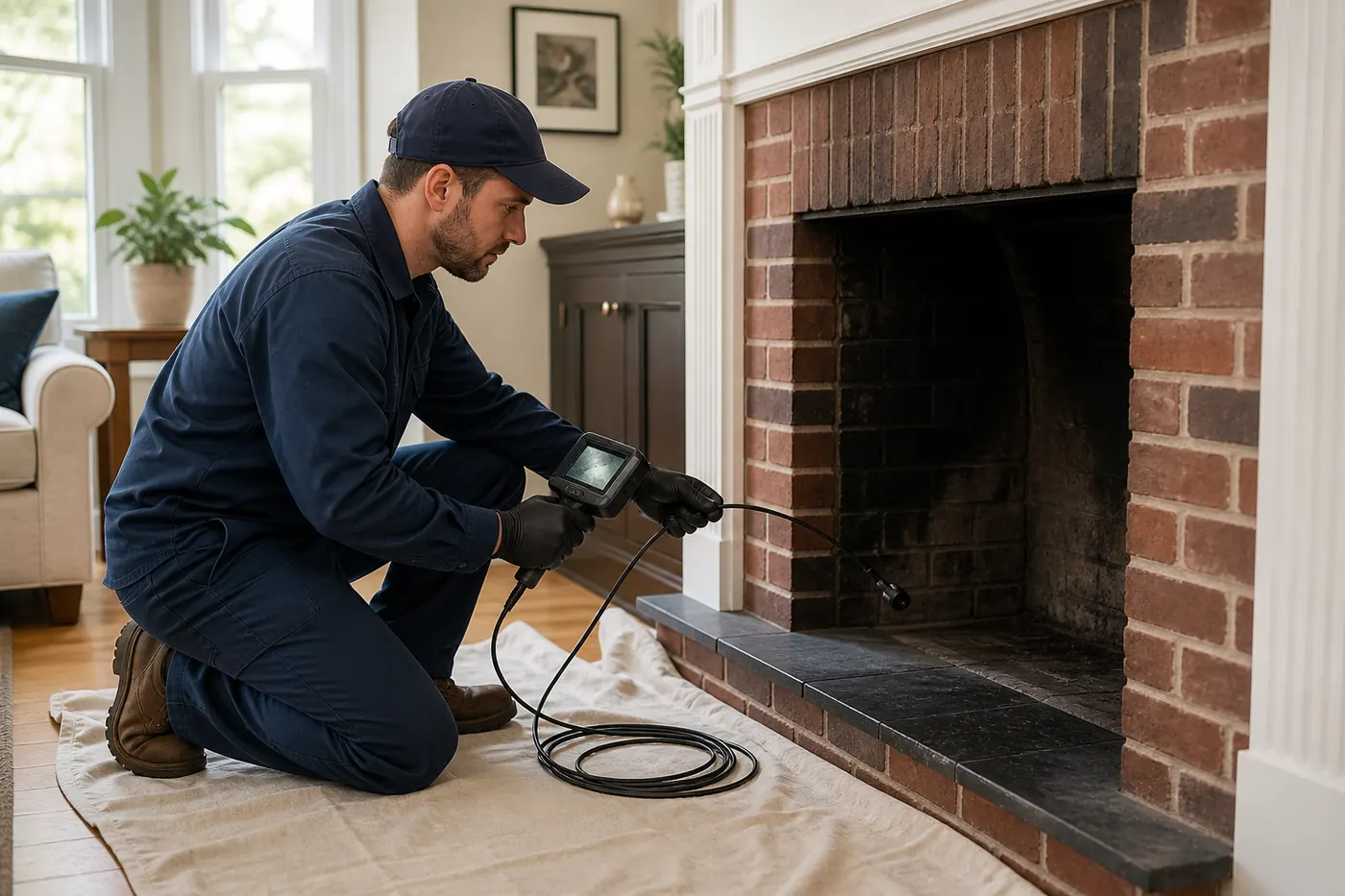
Look for a missing or rusted cap, crumbling mortar, white or dark staining, a leaning stack, and any smoke or smell inside the house. None of these proves a specific repair is needed, but each one is a reason to have the chimney looked at before you commit. A chimney inspection costs $49 in Greater Boston and is credited toward approved repair work.
Red flags you can spot from the street
Start outside, before the agent opens the front door. Stand back far enough to see the whole stack, from the roofline up to the top. Binoculars or the zoom on your phone help. You are not climbing anything. You are just reading what the masonry is telling you.
- No cap, or a cap that is rusted through. A cap keeps rain and animals out of the flue. Without one, water runs straight down the inside of the chimney.
- Chimney leaning or stepped away from the house. Even a small gap between the stack and the siding or roof can mean movement.
- Crumbling or missing mortar joints. Sandy gray dust at the base of the chimney or on the roof is a clue.
- Bricks with flaking faces. That peeling is called spalling, and in Greater Boston it usually follows years of freeze-thaw cycles.
- A cracked, chipped, or patched crown. The crown is the concrete or mortar slab across the top.
- Tar or caulk smeared along the roof joint. Fresh blobs of sealant often hide a leak that has been going on for a while.
Older brick houses, triple-deckers, brownstones, and rowhouses all have chimneys that have taken decades of weather. Wear is normal. What you want to know is whether the wear is cosmetic or whether water is getting inside the wall.
Clues inside the house
Once you are indoors, check the fireplace and the walls around it. Water stains and smells tell you things the roofline cannot.
Stains and moisture
Brown rings on the ceiling near the chimney, bubbling paint on the chimney breast, and damp wallpaper all point to water coming down or through the stack. Look in closets and attic corners the chimney passes through too. If the seller has freshly painted only that one wall, ask why.
Smoke and smell
Sniff the firebox. A sharp, tar-like odor means old creosote buildup, and it gets stronger in humid weather. Black staining above the fireplace opening means smoke has been spilling into the room instead of going up. Smoke that spills into a room is never something to shrug off.
The firebox itself
Cracked firebrick, gaps in the floor of the firebox, and a damper that sticks or will not close are all worth noting. A damper that will not shut is also an energy leak you will pay for every winter, so test it while you are there.
Take photos of everything you see. They will help the inspector, and they give you something concrete to bring to a price conversation.
Count every fireplace and fuel-burning appliance
Many older Boston homes have more than one flue. A house may have a living room fireplace, a basement boiler or furnace vented into the same stack, and a sealed-off opening in an upstairs bedroom. Listings often mention only one fireplace.
Walk the house and write down each place where something burns or used to burn:
- Living room and dining room fireplaces.
- Basement boiler, water heater, or furnace flue.
- Wood stoves or inserts, including ones that a previous owner added.
- Gas logs or gas fireplaces, which have their own venting needs.
- Capped, bricked, or plastered-over openings.
Each one needs to be accounted for. A flue that serves a heating appliance matters even if you never plan to light a fire. A sealed-off flue can still hold moisture or hide cracks. When you book the inspection, tell the company how many flues you counted so the visit covers all of them.
Records worth asking the seller for
A seller who has cared for a chimney usually has paperwork. A seller who has not will tell you that too, by having none. Ask for these through your agent:
- Invoices from past cleanings, inspections, or repairs, with dates.
- Any written estimates the seller was given and did not act on.
- Permit records for an insert, a liner, a gas conversion, or a chimney rebuild.
- Warranty paperwork for new caps, liners, or gas appliances.
- Any report from an earlier home inspection that mentioned the chimney.
A recent estimate the seller never acted on is especially useful. It tells you what another company already found, and it gives you something to compare against your own inspection. If the seller says the chimney was never serviced, that is not a deal breaker. It just means you should assume nothing about what is inside the flue.
Why the chimney inspection belongs inside your contingency window
A general home inspector looks at the chimney from a distance, and reports often say little more than that the chimney was not inspected inside. That is not a criticism. Seeing inside a flue takes a camera and a chimney technician.
The right moment for that closer look is before your inspection or financing contingency runs out, while you can still negotiate. After closing, every repair is yours. Before closing, a documented problem can become a price adjustment, a seller repair, or a reason to walk.
If your timeline is tight, call early. Our guide for sellers explains the same visit from the other side, and a $99 buyer or seller inspection is available when you need a report written for a real estate transaction. Ask for photos of what the technician finds so your agent and attorney can see the same things you do.
You can also get a second opinion for free if the seller already has a written report from a reputable local chimney company. Bring that report along.
How to read a repair quote when the house is not yet yours
If the inspection finds problems, resist a single lump-sum number like "chimney work, one total." A useful quote lists each component, where it is, and what is being done to it. Compare what you are shown against the typical Boston ranges:
| Item | Typical range |
|---|---|
| Crown repair | $300 to $900 |
| Standard chimney cap | $300 to $700 |
| Partial repointing | $300 to $700 |
| Flashing repair | $200 to $400 |
| Liner replacement | $1,500 to $4,500 |
Anything that is not on that list, such as a partial rebuild of a leaning stack, should be quoted in writing after the $49 inspection. Our inspection cost page shows how the credit toward approved work is applied. For a deeper look at what the work involves, see chimney repair.
A buyer's walk-through checklist
Print this and bring it to your second showing.
- Photograph the chimney top from the ground, front and back.
- Check for a cap and look for rust or gaps at the roof joint.
- Note any ceiling stain, damp wall, or peeling paint near the chimney.
- Sniff the firebox for a tar or smoke odor.
- Open and close each damper. Does it move freely?
- Count flues and appliances. Ask which ones work.
- Request cleaning, repair, and permit records.
- Ask whether the seller has ever had smoke or water trouble.
If any carbon monoxide alarm sounds during a visit, leave the house and call 911. Do not use the fireplace as a test.
When you have an offer accepted, book the $49 inspection at our contact page or call (617) 404-9587 so the findings arrive before your deadlines do.
Questions homeowners ask
Can a home inspector clear the chimney for me?
A general inspector usually checks what is visible from the firebox and roofline. A flue interior needs a camera and a chimney technician. If the report says the chimney was not evaluated inside, that part is still open.
Is a cracked crown a reason to walk away from a house?
Usually not. Crown repair is $300 to $900, and a rebuild is $900 to $2,500. It does matter as a bargaining point, because a bad crown lets water into the masonry below it.
What if the seller says the fireplace has not been used in years?
An unused chimney can still have a collapsed liner, nests, or water damage. Disuse also hides problems, since nobody noticed smoke or leaks. Ask for the inspection anyway.
Should I ask the seller to fix the chimney or give me a credit?
Either can work, and your agent or attorney should guide that choice. A written quote with photos makes a credit easier to negotiate than a general complaint.
Do I need to inspect a chimney if I plan to use only gas heat?
Yes. A gas boiler or furnace may vent through the same masonry chimney, and a damaged flue can let exhaust gases into the home. The flue still needs to be checked.