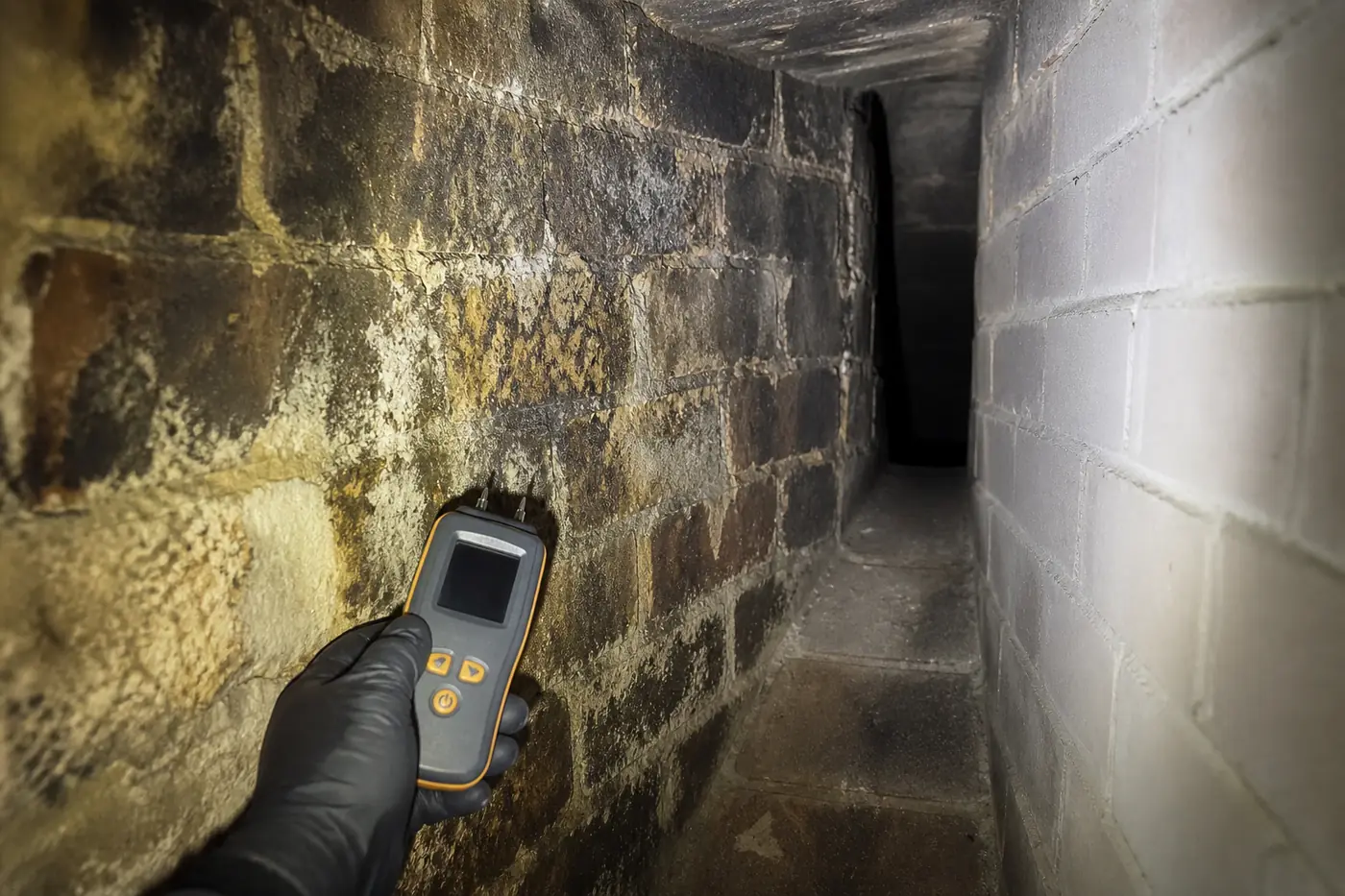
Start by finding and stopping the water, because mold near a chimney is a symptom of moisture that keeps coming back. A chimney company fixes the entry point, such as the cap, crown, flashing or masonry. In Boston, leak repair runs $400 to $3,000 depending on the source, and the $49 inspection is how that source gets identified.
Why the water matters more than the mold
Mold grows where materials stay damp. If you clean a stained wall near the chimney and the water keeps arriving, the stain comes back. So the first job is always to trace the moisture to its entry point and close it.
A chimney company works on the chimney side of that problem:
- Locating the opening, whether at the cap, crown, masonry, flashing, chase cover or flue.
- Repairing or sealing that opening.
- Telling you what damp materials remain so another trade can deal with them.
What a chimney company does not do is treat mold in drywall, insulation, framing or other parts of the house. That belongs to a licensed remediation professional. And if anyone in your home has health concerns about damp air or mold, a doctor is the right person to ask, not a chimney technician.
Keeping those roles separate saves money. Paying to clean a wall while the crown is still cracked means paying twice. Fix the entry point first, then decide what else in the house needs attention.
Where chimney moisture comes from
Water enters a chimney from the top, from the sides, from the roof junction and sometimes from the inside. Greater Boston's nor'easters and wet springs test every one of these. The table shows the usual suspects and where to read about each fix.
| Entry point | What goes wrong | Typical Boston price |
|---|---|---|
| Chimney cap | Missing or rusted, so rain drops straight down the flue | Standard $300 to $700 |
| Crown | Cracks in the slab let rain into the stack | Repair $300 to $900 |
| Flashing | Lifted or dried sealant at the roof joint | Repair $200 to $400 |
| Masonry joints | Open mortar lets water into the wall | Partial $300 to $700 |
| Chase cover | Rusted or sagging metal top on a framed chimney | $800 to $1,500 for custom |
If a leak is more than one of these, the total sits inside the leak repair range of $400 to $3,000. Details are on our chimney leak repair page.
Is it the chimney or something else?
Not every damp spot near a fireplace comes from the chimney. Before you blame the stack, think about the other possible sources:
- A roof leak nearby that is running along framing toward the chimney wall.
- Plumbing or a vent pipe passing through the same wall.
- High indoor humidity in a closed-up room, especially in basements.
- Condensation inside a flue that is too large or unlined for a modern appliance.
Dense older construction can let water travel along beams and boards, so a ceiling stain may be several feet from the real opening. A clue that points to the chimney is timing. If the damp spot gets worse after rain or snowmelt, and it sits close to the stack, the chimney deserves a look. If it shows up in dry weather, the cause may be humidity or plumbing, and a chimney visit may rule the stack out, which is useful too. Our post on chimney leaks when it rains covers the rain pattern in more detail.
Signs inside the house
Moisture from a chimney tends to leave a trail. Walk through the rooms that share a wall with the chimney, top floor to basement, and watch for:
- Brown or yellow stains on ceilings or walls near the stack.
- Peeling paint or bubbling wallpaper beside the chimney breast.
- A damp, earthy odor that is stronger on humid or rainy days.
- Water on the firebox floor or rust on the damper and firebox parts.
- Stains inside the attic on the wood around the chimney.
- White powder or flaking on the brick inside the house.
A fireplace that smells worse in summer is often moisture mixing with old soot. That is a different cause and is covered in why a chimney smells in summer. Take dated photos so you can show a technician how the marks change after storms.
What a chimney technician will do on the visit
The $49 general inspection is credited toward approved repair work. It includes findings and recommendations, and you receive photos of whatever the technician finds. For a moisture complaint, that means checking:
- The cap and crown for cracks, gaps and rust.
- The flashing and the roof edges beside the stack.
- Masonry joints, brick condition and any white staining.
- The firebox, damper and smoke chamber for signs of water.
- Where the stain pattern inside lines up with the exterior.
You get the findings in writing, with the price for the fix, before work starts. If the technician sees evidence of mold on materials beyond the chimney, such as wall or attic material, the report should say that and point you to a licensed remediation professional rather than guessing at its extent. If you already have a quote, a second opinion is free with a written report from a reputable local chimney company.
What changes the price
Because the work depends on the source, it is quoted after the inspection. These factors move the number within the leak repair range of $400 to $3,000:
- How many entry points there are. One cracked crown costs less than a crown, flashing and joints all failing together.
- Height and roof pitch. A steep roof or a tall stack takes more safety setup and time.
- Hidden damage. Rotted wood or wet materials discovered during repair can add scope.
- Protection of the home. Tarping, drop cloths and clean-up add labor.
- Add-ons. A water-repellent treatment is a separate line.
Waterproofing starts at $300 to $500 for a standard treatment, $500 to $800 with a crown seal, and from $800 for a full system. It protects sound masonry but does not close an open crack, so it follows the repair, never replaces it. See the chimney waterproofing cost guide for the details.
After the repair: drying out and watching it
Once the entry point is closed, damp materials need time and airflow to dry. Run a dehumidifier in damp basements and keep air moving in the room. Do not paint over a stain until it is dry and the source is confirmed to be fixed.
Seasonal habits help too. Check the ceilings near the stack after the first big storm of fall and again after the spring thaw. A stain that is new, or one that has grown since last time, is a reason to call. A stain that has not changed and stays dry is usually an old mark that needs no action beyond a repaint.
Watch the area through the next two or three heavy rains. If the stain returns, tell the company right away with photos of when it appeared. Mold or material damage that remains beyond the chimney is a separate job for a remediation professional, and your homeowner's insurance agent can tell you whether any of the damage is covered.
If you ever smell gas, leave the house and call the gas utility or 911. To find where your chimney is letting water in, book the $49 inspection at /contact/ or call (617) 404-9587.
Questions homeowners ask
Can a chimney company remove the mold in my walls?
No. We repair the chimney so water stops entering. Mold in drywall, insulation or framing is handled by a licensed remediation professional, and health questions go to your doctor.
Will a waterproofing spray stop the leak?
Only if the masonry is sound. A repellent treatment does not close cracks in a crown or lifted flashing. The opening is fixed first, then waterproofing may be added on top.
Why does my fireplace smell damp only on humid days?
Moisture reactivates old soot and creosote odor, and damp masonry holds it. A cap, a sealed damper and a clean flue reduce it. A cleaning with inspection is $299.
The stain on my ceiling is far from the chimney. Is it still the chimney?
It can be. Water can run along beams and boards before it shows. The inspection traces the stain pattern back to the exterior, which is how we confirm or rule out the chimney.
Is moisture damage covered by insurance?
That depends on your policy and the cause of the damage. Ask your insurance agent before work starts, and keep dated photos and the written inspection report.