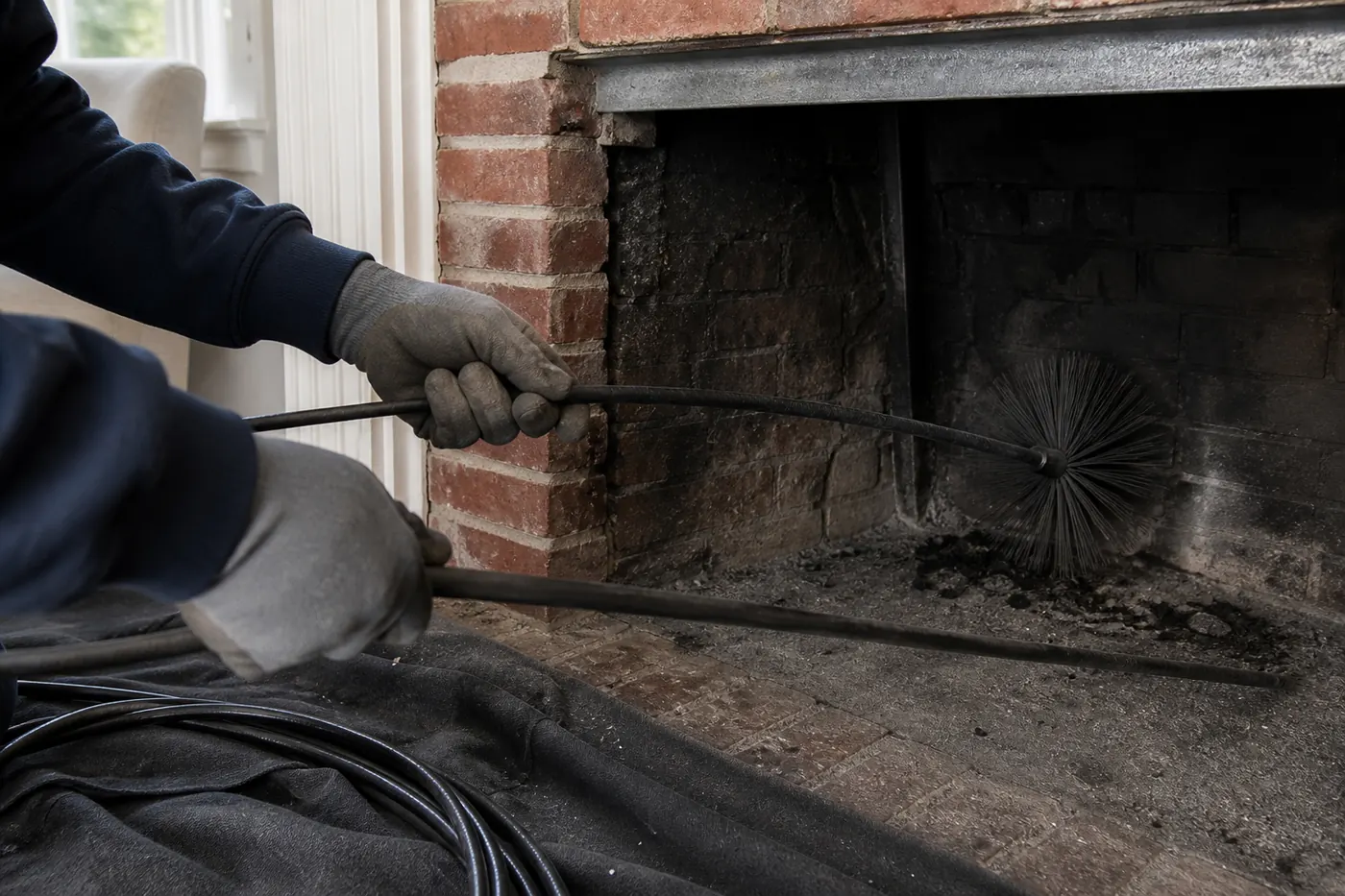
Check four things: that the chimney has been swept and inspected, that the damper opens fully, that your alarms work and that your wood is dry. Then light a small, smoke-free test fire. A sweep with inspection is $299 fixed in Boston, and it is easiest to book before the first cold night, not on it.
Two weeks out: look at the calendar
The first cold snap in Greater Boston can arrive with little warning. A damp, chilly week in October or November sends everyone to their fireplaces at once, and the schedule tightens. A little planning avoids a cold house and a rushed repair.
- Find the date of your last sweep or inspection. If it was more than a year ago, or you do not remember, book one now.
- Think about the last time you used the fireplace. Did it smoke, smell or act strangely?
- Check whether any repair was done over the summer. New masonry and sealant need time to cure, and the technician can tell you when it is ready to use.
- Decide whether you also need dry wood, new alarm batteries or a new cap.
If you are comparing options, our chimney sweep cost page lists what is included.
A flashlight check from the living room
You can do a careful visual check without tools. Turn on a flashlight and look at what is visible from the room.
- Firebox walls. Look for cracked or missing firebrick, loose mortar and heavy black buildup.
- The floor of the firebox. Clear old ash. Leave a thin layer if it helps hold heat, but never let it reach the grate.
- The damper. Open and close it a few times. It should move freely and stay open.
- The area above the damper. Look for debris, nest material, feathers or water marks.
- The hearth and mantel. Check for clearance from anything flammable.
Take photos. If the damper sticks or the brick looks damaged, chimney repair is quoted in writing after the $49 inspection, and the damper itself ranges from $199 to $1,200 depending on the fix.
Fuel, tools and alarms
The best chimney still smokes if the fuel is wrong.
Fuel
Use seasoned hardwood that has dried for many months. It should feel light, show cracks at the ends and make a sharp sound when two pieces are knocked together. Wet wood hisses, smokes and builds creosote. Our guide to the best firewood in New England explains how to pick it.
Tools and safety gear
Make sure the screen or glass doors fit, the poker and tongs are within reach and a metal ash bucket with a lid is ready. Keep a fire extinguisher near an exit.
Alarms
Test every smoke and carbon monoxide alarm, and replace batteries or units as the manufacturer directs. Do this first, before any fire is lit.
Storage
Bring in only a few days of wood at a time and keep the main stack covered on top and open on the sides. Wood stacked against the house invites insects, and a pile left uncovered soaks up the rain and snow that Boston weather brings.
Lighting the first fire step by step
Treat the first fire as a test, not a party.
- Open the damper all the way. Confirm it is fully open by looking up, using a flashlight.
- Warm the flue. A cold flue can hold a plug of heavy air that pushes smoke down. Hold a rolled newspaper, lit, near the damper for a minute until you feel the draft pull upward.
- Build small. Use dry kindling and two or three small splits, not a big stack.
- Watch the smoke. It should rise steadily up the chimney with no wisps drifting into the room.
- Add wood slowly. Keep the damper open until the fire is completely out and the embers are cold.
- Never leave it. Keep the fire attended and do not sleep with it burning.
If a draft is hard to establish, open a window slightly in the same room. Tightly sealed modern homes can starve a fireplace of air.
Stop signs: when to put the fire out and call
Some signs mean the chimney is not ready. Stop using the fireplace and book an inspection if you see any of these.
- Smoke rolls into the room and does not clear after the first few minutes.
- The damper will not open fully or will not stay open.
- A strong smell of smoke when the fireplace is cold.
- Pieces of brick, tile or black flakes falling into the firebox.
- Birds, scratching or a nest in the flue.
- Water dripping or a damp smell.
If a carbon monoxide alarm sounds, leave the house and call 911. If you see flames in the chimney or hear a roar, get everyone out and call 911 from outside. If you smell gas, leave and call your gas utility or 911.
Our article on a chimney fire emergency shows what to do in order.
Cleaning or inspection: which one do you need?
The answer depends on how much you burned last winter and what the chimney looks like now.
| Situation | Best choice | Boston price |
|---|---|---|
| Burned often last season, or never swept | Sweep with inspection | $299 fixed |
| Light use, recently swept, no symptoms | General inspection | $49 (credited toward approved repair work) |
| Heavy black deposits found | Creosote removal | $299 to $450, $450 to $700 or from $700 |
| Gas fireplace | Gas fireplace cleaning | $299 |
When in doubt, a chimney sweep includes the inspection, so you get both a clean flue and a report.
Think about what you will do with the answer, too. If the report says the chimney is clean and sound, you can light your first fire with confidence. If it lists repairs, you can plan them, and you know not to burn until the technician says it is safe. Either way you are not guessing about what is happening above the damper.
Homes with an older, unlined flue deserve extra attention. If you are not sure what is inside the chimney, say so when you book.
Gas fireplaces need preparation too
A gas fireplace does not make wood smoke, but it still needs care before winter.
- Look at the glass, logs and burner area for dust, cobwebs or shifted pieces.
- Check that the pilot light and controls respond as they should.
- Listen for odd sounds or a delay when the unit starts.
- Look for soot on the glass or logs, which can signal poor combustion.
If you smell gas at any point, do not operate the unit. Leave the house and call your gas utility or 911. A gas fireplace cleaning is $299, and repair runs $299 to $900. Do not try to repair gas parts yourself.
Book before the rush
The simplest way to stay ahead of the cold is to book your visit early, when the schedule has room. You choose a preferred day, you get a 3-hour arrival window with a call ahead, and the technician takes photos of what they find. Any repair comes with a written price before work starts.
Book the $299 sweep with inspection at /contact/ or call (617) 404-9587.
Questions homeowners ask
How long should I wait after a summer repair before burning a fire?
Follow the technician's guidance for that specific repair. Masonry products and sealants need cure time, and the right wait depends on the material and the weather.
Why does my fireplace smoke only on the first fire of the year?
A cold flue holds dense air that resists the draft, and a closed house can lack replacement air. Warming the flue and opening a window slightly usually helps. If the smoke continues, have the chimney inspected.
Can I just burn a few fires and have the chimney cleaned later in the winter?
It is safer to have it checked first. A blockage or buildup is not visible from the room, and the first fires are when problems show up.
Is it normal to smell smoke when the fireplace is not in use?
It is common in damp weather, but it means deposits are in the flue. A sweep removes the source.
Do I need to do anything if I only use a gas fireplace?
Yes. Check the glass and logs, test the controls and consider a $299 cleaning. Make sure carbon monoxide alarms are working as well.